Editorial: Medicare -- Essential in wartime, too
Published in Op Eds
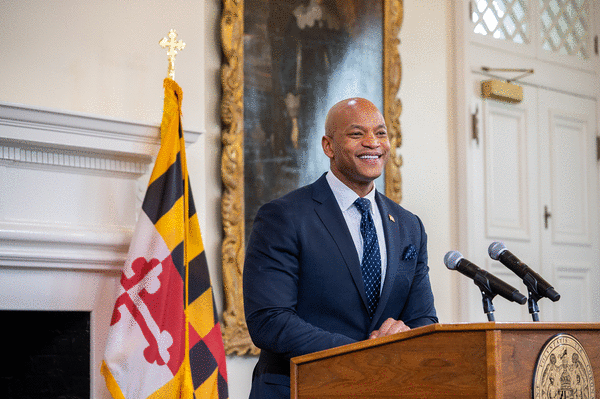
When Maryland Gov. Wes Moore appeared on CBS’ “Face the Nation” on Sunday, he dismissed as “nonsense” the president’s suggestion that the federal government should reconsider funding programs such as Medicare or child care during wartime. His broader point deserves serious consideration: National security and domestic stability are not competing priorities; they are intertwined.
Medicare and Medicaid are not optional line items or discretionary add-ons. They are foundational commitments. Funded through dedicated payroll taxes, these programs function as earned benefits, much like Social Security. Americans contribute over a lifetime with the expectation that coverage will be there when needed. Treating them as expendable during periods of military spending risks mischaracterizing both their purpose and their structure.
Wars are undeniably expensive. History shows that when the United States has entered major conflicts from the Civil War to World War II and Vietnam, leaders have often paired military action with explicit strategies to finance it, including targeted taxes. That precedent reflects a basic principle: The cost of war should be acknowledged transparently, not absorbed indirectly through reductions in unrelated domestic commitments.
Proposals or rhetoric that suggest scaling back health care or early childhood programs such as Head Start to offset defense spending raise legitimate concerns. These programs are not merely expenditures; they are long-term investments. Research has consistently shown that early childhood support can reduce future public costs while strengthening workforce participation and social outcomes.
At the same time, concerns about fiscal sustainability are real. Medicare’s Hospital Insurance Trust Fund is projected to face insolvency in the next decade, with Social Security not far behind. These challenges require thoughtful, bipartisan solutions. Addressing them responsibly will demand honesty about both revenues and obligations, not short-term tradeoffs that weaken core programs.
Shifting federally funded responsibilities to the states, particularly for programs financed through national payroll systems, would add complexity without resolving underlying fiscal pressures. It may also create disparities in access and coverage that undermine the programs’ original intent.
Moore’s remarks also point to a broader issue: the need for clarity about U.S. objectives abroad and the full cost of military engagement. That includes not only defense spending, but its ripple effects from deficits to energy prices. Americans can weigh tradeoffs, but they should be given a clear accounting.
A strong nation is measured not only by its military capability, but by the stability and security it provides its people at home. Sustaining both requires discipline, transparency and a commitment to honoring obligations already made.
____
©2026 The Baltimore Sun. Visit at baltimoresun.com. Distributed by Tribune Content Agency, LLC.





















































Comments