Clive Crook: Why the great unraveling will be so hard to stop
Published in Op Eds
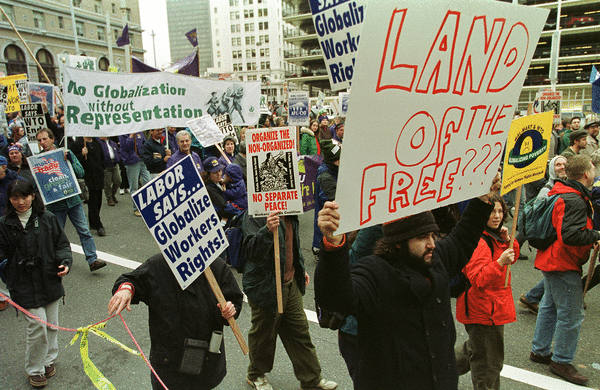
Global fragmentation appears to be well underway. The astonishing shift in U.S. foreign and economic policy is a primary cause, but the picture is far from simple and implicates many other factors. How to make sense of this teeming disorder? Where will these shifting forces lead the world?
For a persuasively bleak assessment, read "The Doom Loop" by Eswar Prasad. The author, a professor at Cornell University and leading international economist, draws on years of scholarship and experience, including as a senior official at the International Monetary Fund. This background makes his carefully grounded pessimism all too authoritative. Prasad doesn’t say that the case is hopeless; he offers some prescriptions, which we’ll come to shortly. But it’s impossible to read his book and not be alarmed.
Prasad examines the recent setbacks to globalization thoroughly and lucidly. But what’s most novel and disturbing is his analysis of global economic disorder as self-sustaining: The forces one might have expected to restore stability aren’t working. In economic models, disturbances are often self-correcting (supply falls, prices rise); economists are conditioned to expect a mechanism of this kind. According to Prasad, recent disturbances have inverted these hitherto equilibrating forces, creating pressures that make the disorder worse.
If so, the great unraveling is just getting started.
Classical liberals expect economic integration, domestic political stability and cordial international relations to form a virtuous circle. Trade raises living standards; rising prosperity softens political rivalries and stifles partisan resentments; cross-border commerce creates shared interests and eases geopolitical tensions; trade and economic integration take another step forward.
But an equal and opposite vicious circle — a doom loop — is also possible. Trade benefits most people but hurts some, which widens domestic inequality; rising inequality inflames rivalries and resentments; governments raise barriers to trade, which increases geopolitical tensions; trade retreats, growth falters and inequality worsens.
Though sympathetic to the classical-liberal worldview, Prasad explains how this feedback sequence turned toxic. Globalization had a good run for decades up until the turn of the century. But then the “China Shock” of cheap manufactured imports disrupted the lives of many workers in the U.S. and elsewhere. The global financial crisis of 2007-2009 shattered confidence in market-friendly policies. The COVID pandemic left many distrustful of governments and their expert advisers. Russia’s invasion of Ukraine highlighted the vulnerability of economies to geopolitical risk. All these events underlined the dangers of too much cross-border integration — and shifted the attention of governments and companies to “resilience.”
Despite this series of disasters, you might still have expected governments to limit the hazards through greater cooperation, not fragmentation. Why didn’t they? A decisive factor, Prasad argues, has been the deteriorating relationship between the U.S. and China.
The two are all but condemned to be great-power rivals — yet this rivalry can take different forms. Competition in trade, for instance, is a positive-sum interaction, and hence a species of cooperation.
Geopolitical rivalry, in contrast, is zero-sum: If one side gains power, the other loses it. What’s new is that the U.S. and China have come to regard their trading relationship as wholly wrapped up in the competition for geopolitical power. They no longer believe that trade delivers mutual advantage.
“Consequently,” says Prasad, “economic forces no longer serve as a counterweight to the intrinsically competitive geopolitical rivalry between the two.” And this merging of economics and geopolitics has led other countries, in turn, to weigh the greater risks of dislocation and rethink the costs and benefits of economic integration.
So far as diagnosis is concerned, I have only one real point of disagreement with The Doom Loop. The dislocation caused by trade, and especially by China’s emergence as an export powerhouse, plainly contributed to the new disorder; it’s also true that governments in the U.S. and other rich countries did too little to cushion the workers who lost out. Even so, I’d give less weight than Prasad does to the stresses due to trade.
He says trade shocks undermined support for economic integration and rewarded “political appeals to resentment.” To some extent, no doubt. But it would be more accurate to say that politicians have used trade-induced dislocation to advance their own priorities, rather than to meet voters’ demands, and that a spontaneous populist turn against trade hasn’t been a dominant driving force. Support for free trade in the U.S. is still strong. According to one recent poll, eight out of 10 Americans still think trade benefits the U.S.; fewer than 20% think it mostly benefits other countries; roughly half say there should be no restrictions on trade at all. Most voters understand that tariffs lower their standard of living.
The politics of resentment, on the other hand, is indeed crucial, but in my view this agent of disorder is energized less by trade or alarm over economic inequality than by divisions over culture and status, factors that Prasad leaves aside. The rise of the populist right in the U.S. and Europe filled the space created by centrists and progressives who prioritized multiculturalism and identity over national solidarity, sovereignty and citizenship. Healthy liberal democracies need to keep all these elements in balance — or risk becoming, as they are now, socially divided and politically dysfunctional. (Francis Fukuyama’s Identity examines these issues at length.)
Prasad’s prescriptions are certainly correct. He urges governments to rebuild broken national and international institutions to promote accountability and rule-based, positive-sum competition, as opposed to zero-sum rivalry. Returning from disorder to stability is possible, given “bold, principled leaders and engaged citizens.” Absolutely. But right now this prospectus seems so unlikely as to be almost a counsel of despair. As Prasad says in conclusion, “The solution is clear, but the path to attaining it is not.”
____
This column reflects the personal views of the author and does not necessarily reflect the opinion of the editorial board or Bloomberg LP and its owners.
Clive Crook is a Bloomberg Opinion columnist and member of the editorial board covering economics. Previously, he was deputy editor of the Economist and chief Washington commentator for the Financial Times.
_____
©2026 Bloomberg L.P. Visit bloomberg.com/opinion. Distributed by Tribune Content Agency, LLC.
















































Comments