Mark Gongloff: The home insurance crisis could use a public assist
Published in Op Eds
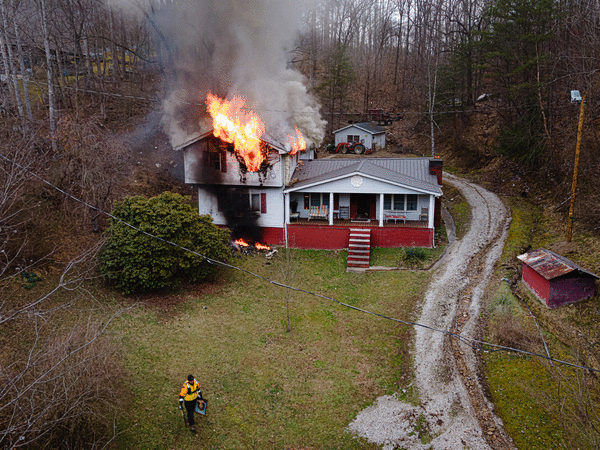
At a moment when America’s home insurance crisis has become bad enough to turn conservatives into socialists, a possible solution may just involve — you guessed it — big government. And contra Ronald Reagan, in this case there’s reason to think the government truly can help.
To address soaring insurance premiums and coverage gaps in an age of worsening climate-fueled disasters, the Brookings Institution has proposed creating a federal reinsurance company to cover U.S. home insurers. It would be, as proposal co-author Benjamin Keys of the Wharton School put it in a rollout event last week, a sort of “public option” for home insurance.
Ideally, “US Re” would lower costs, make it easier for homeowners to protect themselves against catastrophe and absorb insurance-market shocks, all without encouraging people to keep rebuilding in risky areas. That’s a thin tightrope to walk, and the proposal’s political odds seem even thinner — for now. The longer we have to wait for better ideas, the more the idea of federal reinsurance will get attention. As well it should.
Reinsurance is basically insurance for insurance companies that helps them cover disaster losses. One reason home insurance costs have far outpaced consumer price inflation in recent years, as the price-comparison site Insurify reported last week, is that private reinsurers have jacked up their own rates to deal with ever-bigger damages. Insurance companies have hot-potatoed those costs down to the rest of us. In the most extreme cases, they’ve abandoned markets altogether, pushing homeowners into state-backed plans like the California FAIR Plan, which offer less coverage at high rates.
Rising disaster damage only partially explains the jump in reinsurance premiums. The rest of it, as the Brookings proposal explains, is down to capital costs and uncertainty. Reinsurers’ costs of raising the capital they need to do business have been rising, with spikes after particularly bad disaster seasons. Reinsurers also want thicker financial padding in their premiums to account for the uncertainty of a world where the atmosphere is growing more chaotic because of global heating.
A U.S. government-run reinsurer, in contrast, would have the cheapest capital costs of any player on the planet, Brookings points out. It would also be the only reinsurer with a big enough fiscal stomach to digest the damage from multiple mega-disasters. It needn’t fear uncertainty. Cutting those two costs — capital and uncertainty — from the premium bill would make reinsurance much cheaper.
Lower reinsurance premiums might lure insurers back to California hillsides, Florida beaches and other climate-change battle zones. A market with more insurers would mean competition, which would mean lower premiums, bringing homeowners back to the fold and encouraging them to buy better coverage.
The gap between home values and actual insurance coverage, which could amount to $2.7 trillion, by one estimate, would close. More and better home insurance would also relieve some of the financial burden on the Federal Emergency Management Agency and other taxpayer-funded disaster-relief agencies.
That’s the perfect world. In reality, a lot can go wrong with this kind of plan if it’s not executed well.
A relevant cautionary tale is the National Flood Insurance Program, which was created in 1968 after devastating floods chased private insurers from the market. The idea was for the government to provide flood coverage while also discouraging people from building and rebuilding in flood-prone areas.
Everything that could go wrong with the NFIP has gone wrong. Political pressures have kept premiums artificially low. Outdated floodplain maps have left everybody in the dark about true flood risks. While mortgage lenders typically make sure homeowners keep house insurance, they don’t often bother for flood policies, Harvard University economics professor Rebecca Diamond said at the Brookings event. Only 4% of Americans have flood insurance, though many thousands more need it.
The proposal’s authors acknowledge these pitfalls and have tried to design US Re to avoid them. Because it would be a reinsurer and not a direct provider like the NFIP, private companies would still write actual home policies. Those insurers would still have incentives and the risk data they need to set realistic premiums and send constructive signals to homeowners and politicians about risky behavior. There would be less threat of homeowners in relatively disaster-free locales subsidizing those who take bigger risks.
“We’re not thinking of this as a government backstop of the market,” Keys said. “It’s an option. It would be a countercyclical shock absorber rather than taking over the market.”
A slightly better, though still flawed, model can be found in that socialist haven of, uh, Florida. The Florida Hurricane Catastrophe Fund is a state-backed reinsurer set up in 1993 after Hurricane Andrew caused huge insurer losses. Every private carrier in the state must participate in it for a fee, but they don’t seem to mind; most take the priciest plans available. The FHCF has arguably helped keep Florida premiums from being more expensive. But it hasn’t been nearly enough to keep them from leading the nation at $8,292 a year, according to Insurify, nearly triple the national average.
The problem with FHCF, as Brookings sees it, is Florida’s limited access to capital. That means it can cover only middling disasters, leaving private insurers to cope with the biggest ones, your Andrews and your Ians. That helps explain why Florida’s insurance market has been in and out of crisis since Andrew. By focusing on the worst end of the risk scale, a national reinsurer would ideally avoid this pitfall.
Even with a clever design, there are still many ways US Re could go astray. Most critically, insurers will have to pass the savings it provides on to consumers, which is certainly no sure thing. Thirty-six states don’t regulate insurance rates, former California Insurance Commissioner Dave Jones pointed out in an interview. Unless rate cuts are mandated by the federal government, a steep political ask, insurers will be free in those states to pocket the benefits of lower reinsurance premiums.
A government-run reinsurer will also have to stay politically independent. It will have to base its premiums solely on risk. That means it may need credible, property-level modeling — a whole other can of worms, given the uncertainties around the reliability of such models. Jones has suggested a national reinsurance program should cover only state-backed insurers of last resort like California FAIR, arguing this would be cheaper and less encouraging of risky behavior.
Anyway, the idea’s political moment may not be here yet. People have been kicking around plans for federal home insurance for decades and gotten nowhere. But soaring premiums have already caught Congress’ attention, and they’re pushing popular opinion in surprising directions. A recent Insurify poll found 32% of Americans, including 32% of “conservative” homeowners, would like to see a government-run home insurer “to compete with private companies.”
As catastrophes mount and premiums rise, such sentiment will probably grow. Thinking about previously unthinkable solutions like these today will help us avoid ill-advised, hasty decisions in a hotter, more chaotic future.
____
This column reflects the personal views of the author and does not necessarily reflect the opinion of the editorial board or Bloomberg LP and its owners.
Mark Gongloff is a Bloomberg Opinion editor and columnist covering climate change. He previously worked for Fortune.com, the Huffington Post and the Wall Street Journal.
©2026 Bloomberg L.P. Visit bloomberg.com/opinion. Distributed by Tribune Content Agency, LLC.




















































Comments