Commentary: American Muslims' unique role against anti-US sentiment and Islamophobia
Published in Op Eds
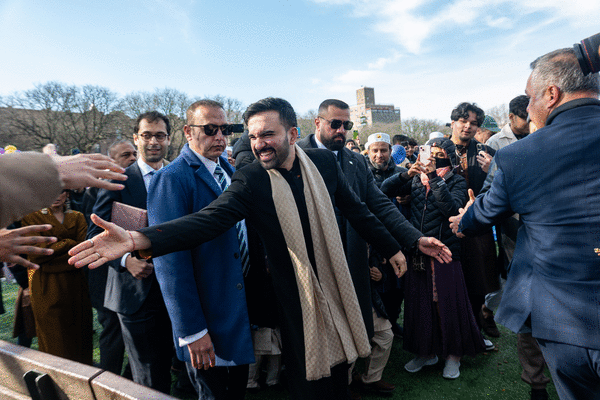
It is not easy to be an American Muslim today. At a time when the United States is engaged in yet another conflict involving a Muslim-majority country, rhetoric from a growing number of public figures, including some of our highest officials, continues to vilify Islam and cast suspicion on Muslims as disloyal or dangerous. Too often, national conversations about Islam proceed without Muslims at the table. Yet despite this, American Muslims remain committed to a few simple but powerful beliefs: that our faith makes us better citizens and that this country affords us the opportunity to practice our faith freely.
The problem is not Islam, nor is it America, both of which are based on the foundational principles to uphold justice, dignity and the equality of all people. The problem lies in the political, ideological and economic forces that benefit from division. War, in particular, amplifies these distortions. It thrives on falsehoods: that Islam and the West are destined to clash, that Muslims are inherently disloyal and that domination and surveillance are necessary for security. These narratives marginalize the overwhelming majority of Muslims who seek peace while empowering the extremists on all sides.
The reality tells a different story. The United States maintains deep strategic and economic ties with Muslim-majority countries, including longstanding alliances and extensive trade relationships that underpin the global economy.
And yet even while the United States depends on partnerships with Muslim societies, it frequently portrays those same regions as primary sources of global threats. The result is a reliance on authoritarian regimes to suppress popular movements — an approach that breeds anti-American sentiment abroad while fueling anti-Muslim prejudice at home.
In this environment, American Muslims occupy a unique and indispensable space. We are firmly rooted in American civic life while connected to a global community that spans continents. We understand both the promise of American pluralism and the aspirations of people in Muslim-majority societies. This dual identity is not uncommon; it’s akin to Irish Americans, Greek Americans and Jewish Americans. Nor is it a liability; it is a strategic asset. It positions us to contribute meaningfully to the nation’s most pressing challenges, including foreign policy and national security.
American Muslims have long contributed across every sector in the U.S. — medicine, law, education, business and public service. A 2017 Institute for Social Policy and Understanding study found that American Muslims are among the most civically engaged religious communities in the country, participating actively in charitable giving and community service.
We envision an era in which American Muslims help inform the work of the president, the secretary of State and Congress — offering insight on how to advance U.S. national interests while preventing military confrontations. We also see ourselves at the table with leaders from Muslim-majority countries, helping to advance diplomacy on issues such as nuclear nonproliferation, religious freedom and democratic governance.
History reminds us that transformative movements rarely begin with the majority. They begin with a principled minority committed to truth. From the civil rights movement to the struggle against apartheid, progress has always depended on those willing to challenge prevailing narratives. Today, American Muslims are called upon to play that role — standing against war, rejecting falsehoods and striving for equality at all levels of society.
This is not a moment to retreat. It is a moment to lead.
After 9/11, American Muslims helped build partnerships with local communities and government to protect our country. During the wars in Iraq and Afghanistan, Muslim voices called for accountability and justice. In the face of extremism from groups like al-Qaida and Islamic State, Muslim scholars and communities were among the strongest voices rejecting violence and defending the true teachings of Islam. If you visit the shrines of Iraq, you will see thousands of photos honoring Iraqis who gave their lives in the fight against the Islamic State group. This reality remains largely unknown to most Americans.
Today, as new conflicts emerge and old narratives resurface, American Muslims must once again be part of the solution. Our commitment to faith calls us to justice; our patriotism calls us to service. Together, these commitments position us to advance both peace abroad and pluralism at home.
This is our moment — not only to defend ourselves against mischaracterization but also to help shape a better future, a future in which America lives up to its ideals, a future in which Islam is understood not as a threat but as a source of moral clarity and social good.
For the sake of ending wars, strengthening our democracy and upholding human dignity everywhere, American Muslims are not on the margins of this conversation: We are at its center. Other Americans should not only acknowledge our presence but also ensure that Muslims have their rightful and respected seat at the table shaping America’s future. The nation’s leaders need to reject the language of division and vilification.
___
Salam Al-Marayati is the president of the Muslim Public Affairs Council.
©2026 Los Angeles Times. Visit at latimes.com. Distributed by Tribune Content Agency, LLC.



















































Comments