Abby McCloskey: Universal child care isn't always good for kids
Published in Op Eds
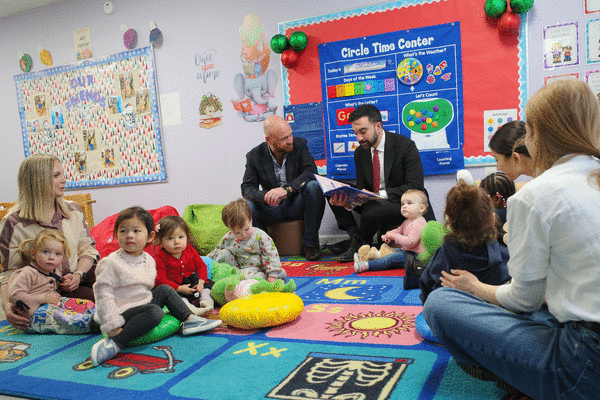
Free child care is starting to take root in the U.S. But is it good for kids?
Last year, New Mexico became the first state to offer free universal child care. This year, New York began offering free child care for children ages 0-3 in certain cities, with a goal of reaching all children under 5 by 2028. Massachusetts has set its sights on universal, high-quality preschool access for every 4-year-old in the state’s major cities by the end of 2026.
Even politicians in conservative states like Texas are jumping in. Senate candidate James Talarico, a Democrat, has called for establishing universal pre-K for every 3- and 4-year-old nationwide.
To the working mom writing this column, the need for better care options is clear. Most parents of young children work. Roughly a quarter of families with young kids are single-parent households. Half of American parents don’t live near grandparents, who are the most likely to provide backup care.
But according to a recent report from the Bipartisan Policy Center (BPC), where I am a fellow, “It would take 10% of a married couple with children’s median income (and 35% of a single parent’s median income) to afford the average annual cost of child care — outpacing in-state university tuition and mortgage payments in nearly every state.” Atop the cost problem is a capacity problem. Nearly 4.2 million children do not have access to a formal child-care slot, according to BPC data.
Better child care policy feels like a no-brainer. Child-care subsidies boost gross domestic product — and tax revenue — by making it easier for parents to work. What politician worth their salt doesn’t want a growing economy and higher tax revenue?
There’s just one big question. That’s whether universal programs are good for kids. And in true economist form, the answer is: It depends. It depends on the quality of the program — are caregivers attentive and affectionate, and are there enough of them? It also depends on what the kids would be doing if they weren’t in care. If the answer is “playing on an iPad,” well, even a lower-quality program might start to look pretty good. Both political parties have failed to capture these nuances.
Conservatives skeptical of universal child care tend to highlight the experience of Quebec in the latter part of the 20th century. The province offered universal low-cost child care and parents understandably took them up on it, resulting in a remarkable 14.5% increase in married mothers’ employment. Unfortunately, the quality of the program was low and resulted in rising aggression and behavior issues among children, especially boys, and hurt parental relationships. Similar, disappointing results were found more recently in a 2022 Vanderbilt study of Tennessee’s voluntary pre-K program.
Liberals tend to point to a couple of small programs that worked well: the Perry Preschool Project and the Carolina Abecedarian Project. In the 1960s and 1970s, these programs delivered incredible, intergenerational benefits, including improved work, education and health outcomes for the participating children (and even their grandchildren)! But these now-ancient programs only served roughly 100 children from significantly impoverished backgrounds, began in infancy and included other services for parents. The results are not comparable to the universal preschool programs being implemented today.
Large-scale studies also offer a more mixed picture. Universal preschool programs (in Georgia and Oklahoma) tend to improve outcomes for at-risk children but not higher-income ones. And even that’s not guaranteed. Some universal programs serving the lowest-income kids (in New York City) have actually widened achievement gaps because they tend to be of poorer quality, not unlike what we sometimes see in public K–12.
Herein lies the tension that we don’t love to say out loud in 2026. What benefits parents and what benefits children might not always be one and the same. Universal preschool and child care supports parents’ ability to work, especially women. For parents who want or need to work, that is a good thing. (Although when polled, parents tend to prefer more flexible work, rather than additional child care.) It also frees up a significant share of the family budget.
But only a particular kind of child-care program (high-quality) and a particular cohort of children (primarily low-income) seem to reap long-term benefits.
This raises the question of why lawmakers are pursuing one-size-fits-all universal care solutions instead of more targeted programs. There’s a strong case to be made that all children are best off with their parents in the early weeks of life, which paid parental leave would help deliver.
Beyond that, generous child-care support should be provided to low-income families to pay providers of their choice. (Right now, the block grant for low-income families is woefully underfunded.) This investment would be best paired with incentives to companies to offer greater part-time and flexible work options.
But requiring all 3- or 4-year-olds to participate in a public preschool program or pretending that child care will produce better outcomes for all children doesn’t hold up to the data. Politicians planting universal child care programs in rocky soil shouldn’t expect a garden.
____
This column reflects the personal views of the author and does not necessarily reflect the opinion of the editorial board or Bloomberg LP and its owners.
Abby McCloskey is a columnist, podcast host, and consultant. She directed domestic policy on two presidential campaigns and was director of economic policy at the American Enterprise Institute.
_____
©2026 Bloomberg L.P. Visit bloomberg.com/opinion. Distributed by Tribune Content Agency, LLC.





















































Comments