Commentary: NYU's decision to air prerecorded graduation speeches is cowardly
Published in Op Eds
On May 31, 1969, the first student speaker to address a Wellesley College graduation took the stage. You already know her name: Hillary Rodham.
The future first lady and secretary of state — who later took the last name of her husband, Bill Clinton — was preceded at the podium by Massachusetts Sen. Edward Brooke, a moderate Republican and the first popularly elected African American in the Senate. Citing a decline in the poverty rate, Brooke insisted that America was moving in the right direction. And he added a jab at student protesters who seemed to think otherwise.
“When all is said and done,” Brooke said, “I believe the overwhelming majority of Americans will stand firm on one principle: Coercive protest is wrong, and one reason it is wrong is that it is unnecessary.”
Rodham wasn’t having it. Departing from her prepared remarks, she shot back at Brooke.
“What does it mean to hear that 13.3% of the people in this country are below the poverty line?” Rodham asked. “That’s a percentage. We’re not interested in social reconstruction; it’s human reconstruction. How can we talk about percentages and trends?”
In her four years at Wellesley, Rodham had witnessed urban riots, the escalation of the war in Vietnam and the murders of the Rev. Martin Luther King Jr. and Robert F. Kennedy. She was in no mood to hear a lecture from an establishment figure about needless student protest.
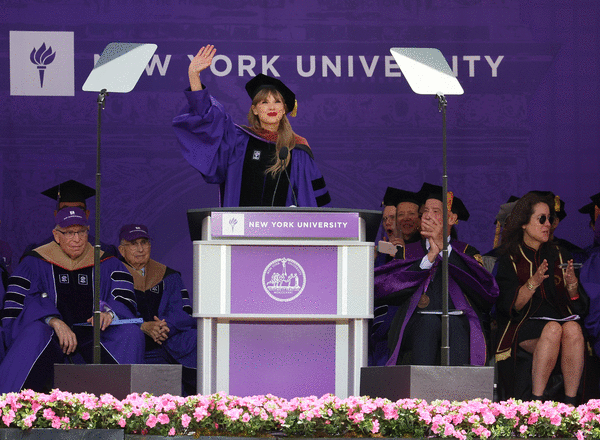
I thought about Rodham as I read the sad news from New York University, which recently announced that student speakers at the graduation ceremonies of its different schools will deliver their remarks via prerecorded video, not live. The reason was that the university wanted to ensure a “respectful experience,” a dean told one of the speakers, In the past, the dean added, some people had left the ceremonies “feeling disappointed or disrespected.”
That was a nod to last year’s speech by Logan Rozos at the graduation ceremony of the Gallatin School of Individualized Study, NYU’s small liberal arts school. Rozos — like Rodham — departed from his prepared remarks, condemning Israeli “genocide” in Gaza.
But there were two big differences. Unlike Rodham, Rozos had to clear the original text of his speech — which made no mention of Israel or Gaza — with NYU administrators beforehand. And after some listeners condemned Rozos’ comments, the university withheld his diploma.
This heavy-handed approach wasn’t unique to NYU. At the Massachusetts Institute of Technology, the senior class president was barred from a 2025 graduation ceremony after delivering a pro-Palestinian speech at a commencement the previous day. And George Washington University banned a graduation speaker from campus — yes, you read that right — for criticizing its connections to Israel and for calling on graduates to withhold donations from her school.
Never mind that the speaker, Ceclia Culver, earned a 4.0 GPA and her college’s Distinguished Scholar Award for academic excellence. She is persona non grata there now, because she made “very different remarks” than the ones she had submitted and recited at a rehearsal, the university said in a statement. As a result, the university added, a “moment of special celebration was violated.”
That’s also why NYU has moved to a video-only format for its school graduations this spring: to create “ceremonies and experiences that feel engaging, modern, celebratory and inclusive,” a spokesman said.
Really? Since when are universities supposed to make everyone feel good?
That’s not our job. We’re not companies trying to improve our market share. And we’re not — or shouldn’t be — branding agencies, devoted to polishing our images.
We’re in the idea business. We generate knowledge and learning via debate and discussion. That means our graduation ceremonies — like everything else we do — can become heated and contentious.
And if you don’t like that, you’re in the wrong place. Sometimes your feelings might get hurt. But that’s the price of an open society and of a democratic university.
It appalls me that student graduation speakers now have to submit their remarks for approval from their universities. Back in 1969, Wellesley President Ruth Adams asked Rodham to share her speech before delivering it. Rodham did the only thing a self-respecting student would do: She said no.
If I were chosen to address a graduation today, I’d do exactly what the NYU and George Washington University speakers did: Submit one speech, and give another. And I would take it for granted that some listeners — including university administrators — might not like what I had to say.
Indeed, Adams was none too pleased by Rodham’s sharp rejoinder to Brooke. After the Wellesley graduation, Adams fired off a note of apology to him. “Courtesy is not one of the stronger virtues of the young,” she wrote.
That’s true. But cowardice isn’t the mark of a virtuous university, either. If you’re afraid to let students speak in person at your graduations, such as New York University is, you have lost your moral and intellectual spine. Period.
I taught for 20 years at NYU, and I loved every minute of it. I still miss the university’s crazy quilt of schools and its rowdy spirit, as loud and boisterous as the city that surrounds it. But I am ashamed of it now.
“To be educated, the goal of it must be human liberation,” Rodham told her graduation in 1969. “Fear is always with us, but we just don’t have time for it.”
I don’t have time for it, either. Do you?
____
Jonathan Zimmerman teaches education and history at the University of Pennsylvania and is an emeritus professor at New York University. He serves on the advisory board of the Albert Lepage Center for History in the Public Interest.
___
©2026 Chicago Tribune. Visit at chicagotribune.com. Distributed by Tribune Content Agency, LLC.



















































Comments