Noah Feldman: The Virginia ruling bolstered democracy, if not Democrats
Published in Op Eds
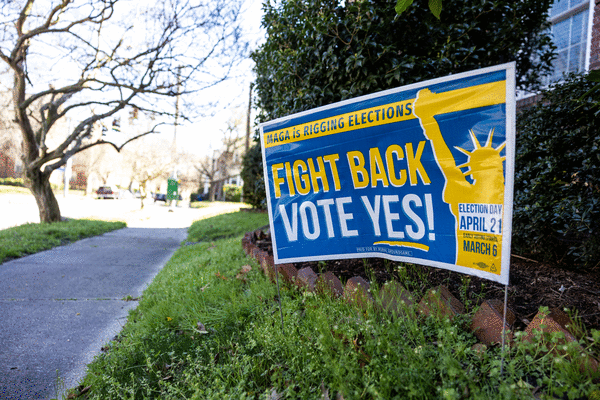
Distraught that the Virginia Supreme Court invalidated a statewide referendum that would have enabled them to gerrymander their way to a 10-to-1 advantage in the state’s congressional delegation in November, up from the current 6-to-5 split, some Democrats are reportedly considering a novel response: firing the whole court.
They shouldn’t. The Virginia court’s 4-3 decision last week is undeniably a blow to the Democrats in the distasteful and bizarre partisan gerrymandering race to the bottom, now including Alabama, that has been unleashed by the U.S. Supreme Court. And the justices in Washington aren’t going to overturn the decision of the justices in Richmond, despite the state’s appeal of the ruling.
Still, the state supreme court opinion is not an affront to constitutional or democratic logic. In fact, it could be argued that the majority opinion reinforces democratic ideals more than the dissent does.
The issue before the state court was an extremely challenging one. On the one hand, the court was being asked to overturn the results of a state constitutional referendum in which the citizens of Virginia voted to allow partisan gerrymandering. On the other hand, the state legislature was not meticulous about complying with the procedure that the state constitution lays out for proposing amendments. And the legislature’s shortcut implicated the very reasons that the procedure exists.
The court therefore had to weigh a constitutional amendment approved by the people of Virginia against the rules that the very same people of Virginia set out in their constitution for how to amend it. The case forced the court to confront the underlying meaning of democracy.
Some context: The rules for proposing a constitutional amendment require the Virginia legislature to approve any proposed amendment two separate times before it goes to the public for a referendum: before a statewide general election for legislative representatives, and again after the new state legislature has taken office.
The reason for that design is to give the voters the opportunity to communicate their disapproval of the legislature’s act in proposing the constitutional amendment in the first place. It’s not unique to Virginia. Nine states have “two-session” requirements before a constitutional amendment can be put to the public for a vote.
In Virginia, the state legislature introduced the proposed constitutional amendment for the first time on Oct. 31, 2025. That was several days before the Nov. 5 legislative elections. But it was within the extended voting period for early voting that had begun more than a month earlier. Some 1.3 million Virginians had already voted when the proposal was introduced — about 40% of the total number of votes cast in that election.
So those early voters didn’t have an opportunity to register their approval or disapproval of the proposed amendment. On that basis, the Virginia Supreme Court majority held that the amendment was invalid, even though a majority of Virginians subsequently approved it.
The dissent’s argument focused on the language of the state constitutional provision, which says that the proposed amendment must be introduced before the “general election.” If the phrase “general election” refers to Election Day, then the proposed amendment satisfied the procedure because it was introduced before Nov. 5. In support of this view, the dissent rightly pointed out that other provisions of Virginia law use the word “election” to refer to Election Day.
The trouble with this interpretation is that Virginia’s constitutional amendment procedure should be interpreted in light of its true democratic purpose: for all voters to have a chance to weigh in on the proposal, not just those voters who voted on Election Day. You might think that’s unnecessary, but it is the only logical reason to require an intervening election between the first and second introductions of the proposed constitutional amendment.
The dissent’s methodology seems like an instance of textualism, the preferred statutory interpretation theory of most conservatives, which purports to ignore legislative purpose. Liberals shouldn’t like a decision that relies on textualism. In any case, even textualists admit that context matters. In the context of the state’s constitutional procedures for amendment, it makes more sense to treat the words “general election” as referring to the whole election process by which the legislature is subject to re-election.
The larger point is that, for democracy to function, it needs rules. If the state of Virginia is going to change its constitution, it needs to follow those rules — because they are intended to empower the people as a whole. Demanding that a rule be followed gives effect to the larger democratic purpose.
The U.S. Supreme Court is very unlikely to overturn the Virginia decision because it is an interpretation of the Virginia state constitution, not the federal constitution. Under the federal constitution, states and their supreme courts are the ultimate judges of state law.
Democrats shouldn’t focus their ire on the Virginia Supreme Court but rather on the U.S. Supreme Court, which has signally failed to protect voting rights through its unwillingness to find that partisan gerrymandering violates the equal protection of the laws. The Virginia court was trying to do the difficult job of protecting voters’ voices in the democratic process. If only the U.S. Supreme Court had done as much.
____
This column reflects the personal views of the author and does not necessarily reflect the opinion of the editorial board or Bloomberg LP and its owners.
Noah Feldman is a Bloomberg Opinion columnist. A professor of law at Harvard University, he is author, most recently, of “To Be a Jew Today: A New Guide to God, Israel, and the Jewish People."
©2026 Bloomberg L.P. Visit bloomberg.com/opinion. Distributed by Tribune Content Agency, LLC.





















































Comments