Commentary: Vladimir Putin's costly warmongering is stirring up resentment at home
Published in Op Eds
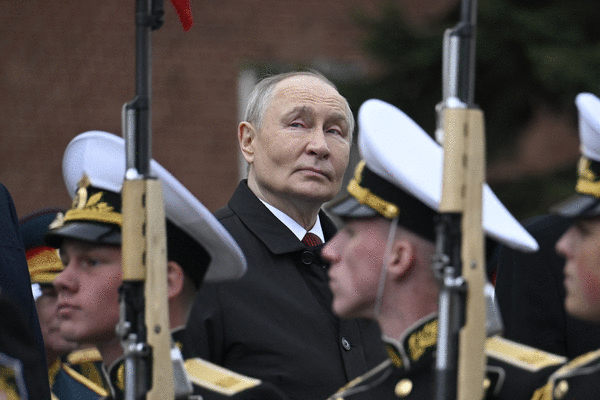
If you ask the average person to name one of today’s dictators, Russia’s Vladimir Putin would likely be the first to come to mind. The former career intelligence operative and mayor of St. Petersburg has ruled Russia’s political system since 1999, when a pickled President Boris Yeltsin called it quits and handed power over to Putin on an interim basis. More than 27 years later, Putin remains on top, having established a system in which he’s not only the chief enforcer but also someone who keeps the Kremlin’s various factions in line. Those who deviate are eliminated, leaving a trail of blood that deters other would-be challengers.
Yet this year so far has been a dicey one for the Russian authoritarian. A man who likes to project strength, unity and decisiveness increasingly finds himself on shaky footing. While challenges to Putin’s rule are still few and far between, the discontent in Russian society — from online personalities with large social media followings to normally robotic-like supporters in the Russian political system — is beginning to bubble up. As The New Yorker’s Joshua Yaffa wrote last week, “the normally placid waters of Russian politics have been marked by the appearance of small but noticeable ripples.”
Ironically, the war in Ukraine, Putin’s pet project, is the genesis for most of the trouble. A conflict Putin and the Russian security services thought would be over in days has instead dragged on for more than four years, with the Ukrainians holding off the much larger Russian army in the east of the country. The territorial gains the Russians have captured since early 2024 have been relatively minor and typically consist of small villages and midsize cities that have already been destroyed by Russian glide bombs and artillery. A newly released study conducted by Russian media outlets Meduza and Mediazona estimates that more than 350,000 Russian troops have died as of the end of last year.
For those who have followed the war since its inception, none of this comes as a surprise. The situation, in fact, has worsened considerably for the Russians over the last few months due in part to Ukraine’s tactical ingenuity and Kyiv’s growing ability to do to Russia what Russia has long done to Ukraine — strike deep into its territory. Ukrainian long-range drone strikes against Russian energy infrastructure, from oil processing stations to gas turbines, are now par for the course.
Ukrainian drone strikes hit Russian energy facilities 21 times in April, bringing Russia’s average crude processing rates to their lowest level since December 2009. For a country that relies on crude oil and natural gas exports for a significant chunk of its budget revenue, these attacks are not only producing financial strain for the Kremlin but darkening the Russian people’s psychology as well.
This is a big problem for Putin. No, there won’t be a palace coup in the Kremlin anytime soon, and there’s unlikely to be a grassroots revolution either. Still, the normally apathetic members of the Russian public, at least a number of them, are no longer willing to gobble up whatever Russian state television spoon-feeds them.
Ordinary Russians are feeling the impacts of a war that Putin has tried to keep hundreds of miles away. With the war’s turbulence on the economy more prevalent and the internet now throttled, Russians no longer have the luxury of pretending the war in Ukraine isn’t happening.
Based on public reporting, a sense of dread is taking hold. Russia is nowhere near a breakthrough in the war — even if Putin continues to pretend otherwise. The lengthier the war, the worse the economy will be. And the worse the economy is, the choppier the political waters become. The impressive 4% growth the Russian economy experienced in 2023 and 2024 did not materialize again in 2025. The first quarter of 2026 was even slower, falling by 0.5% and making the possibility of a recession more likely.
Unemployment in Russia is at 2.1%, which is low by Western standards. Yet labor shortages are intense as more young Russian men are sent to Ukraine. Those shortages will compound over time because the war’s high casualties are affecting Russia’s broader demographic outlook. Entire sectors that don’t have access to massive government contracts such as the corporations churning out tanks and missiles are struggling to sustain their operations and finding it hard to access credit. This, in turn, will affect the ability of these companies to maintain growth, forcing them lay off workers in order to cut costs.
Putin has another problem on his hands: maintaining recruitment numbers for the Russian army. Russia’s regional governors are under severe pressure by Moscow to ensure the army’s ranks are padded to continue the war in the midst of high casualties. Russian authorities continue to pay obscene sums for those willing to sign up. Russian universities, previously thought of as off-limits, are now seeing more military recruiters roaming the halls. Over the last two years, 30,000 to 40,000 Russian men have been inducted into the rolls every month, enough to replace the 30,000 or so casualties the Russian army sustains on the battlefield on a monthly basis.
But there may come a time when those figures begin to dwindle. At that point, Putin will have to make a decision: Authorize another full-scale mobilization or begin reassessing his negotiating position. The former is liable to instigate a huge amount of distress in the major Russian cities such as Moscow and St. Petersburg that Putin has tried to insulate from the war’s costs. The latter, however, would upset the uber-nationalists and war hawks who believe that nothing short of Ukraine’s full capitulation is acceptable for the mighty Russian state.
Heavy is the head that wears the crown.
____
Daniel DePetris is a fellow at Defense Priorities and a foreign affairs columnist for the Chicago Tribune.
___
©2026 Chicago Tribune. Visit at chicagotribune.com. Distributed by Tribune Content Agency, LLC.















































Comments