Commentary: When immigration rules keep changing, the system stops working
Published in Op Eds
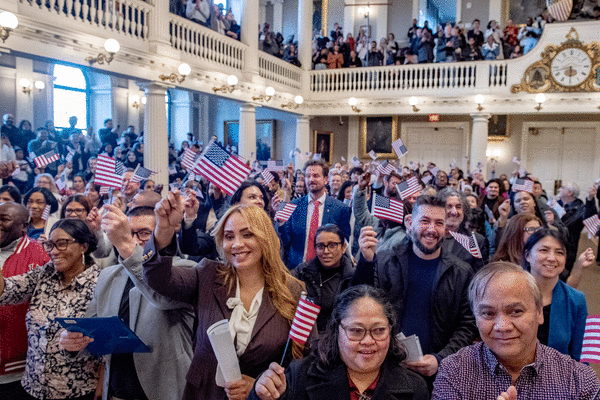
For generations, the United States has framed legal immigration as a kind of social contract. Since 1965, when the Immigration and Nationality Act ended the national-origin quota system, the U.S. has formally opened legal immigration to people from around the world without racial or national-origin preferences.
If people from across the globe sought to reunite with family or bring needed skills to the American economy, they were told they would be welcomed. If they sought U.S. citizenship, the country would provide a clear route to reach it.
Follow the procedures, submit the forms, pay the fees, pass the background checks, and your time will come. Legal immigration has never been easy or quick. But the promise has always been that the path exists.
For decades, that process has been central to the country’s immigration narrative. The paperwork is complex, the wait is long, and the costs can be substantial, but the underlying premise has been simple. Follow the rules and the system will eventually produce an answer.
Increasingly, that premise is breaking down.
Across multiple visa categories and legal statuses, immigrants who have spent years navigating the formal process are finding themselves caught in an environment of shifting policies, administrative pauses, reversals, and uncertainty. The problem is no longer just that the process is slow. Instead, the process itself is becoming opaque.
For many applicants, the financial commitment alone is substantial. Filing fees, required medical exams, document translations, and legal assistance can easily exceed $5,000 over the course of an application. Families often structure their lives around these timelines. Job offers, housing decisions, schooling for children, and long-term financial planning are frequently tied to expected milestones in the immigration process.
When those milestones suddenly move or disappear, the consequences ripple outward.
Part of the challenge is sheer scale. U.S. Citizenship and Immigration Services currently carries a backlog of more than 8 million pending cases across the immigration system. Even when policies are stable, that backlog means applicants often wait years for decisions on visas, work authorization, and green card petitions.
But the backlog alone does not explain the growing uncertainty. In recent months, policy shifts and administrative pauses have created additional instability for people already navigating the legal process.
One example came in December when the State Department paused visa processing for applicants from dozens of countries. The pause was presented as a security review, but for families and employers already waiting in line, it created immediate uncertainty. Applicants who had already submitted paperwork, paid fees, and waited months for interviews suddenly found themselves stuck without any clear timeline for when the process would resume.
For many applicants already inside the system, the most immediate impact is the loss of the ability to work legally. When immigration processing pauses or policies change midstream, employment authorization tied to those applications often lapses while cases remain unresolved. People who followed the rules, paid the required fees, and maintained a valid status can suddenly find themselves unable to continue working in jobs they already hold, whether running a small business, repairing cars, or writing software, simply because the process they relied on has stalled.
The consequences are not abstract. Families who have structured their lives around the expectation of lawful employment can lose their primary source of income overnight. Rent, mortgages, and school tuition do not pause simply because an immigration application does. Employers face sudden disruptions as well, losing workers they have already hired and trained, even though the underlying immigration case is still pending.
For the people involved, it surely feels like the rules changed halfway through the process, because they did. They entered the system under one set of expectations, complied with every requirement, and waited in line as instructed. Then the process stopped moving.
In this environment, even basic questions become difficult to answer. Can someone continue working while waiting for a decision? Should a family keep paying legal fees to pursue an application if the policy framework may shift again? Is a delay temporary, or does it signal a deeper structural change in the program itself? And these days, if someone seeking permanent resident status makes the wrong decision on any of these - whether due to acts of omission or commission - it can result in the family members being placed on an ICE list of people targeted for deportation.
But the broader issue is institutional credibility.
A functioning system requires more than rules written on paper. It requires confidence that those rules will remain stable long enough for participants to act on them. When the framework shifts repeatedly, sometimes affecting people who have already invested years and resources in the process, it creates the perception that compliance offers no clear advantage. If individuals follow established procedures, the institutions administering those procedures will behave in a consistent and predictable way. When that expectation erodes, participation itself becomes riskier. Applicants begin to wonder whether the rules they follow today will still apply tomorrow.
None of this means immigration policy cannot change. Democracies revise laws and regulations in response to elections, court decisions, and evolving public priorities. Immigration policy in particular has always reflected political debate about how many newcomers the country should admit and under what conditions.
But there is an important difference between policy change and procedural instability.
Policy change establishes new rules going forward. Procedural instability alters the environment for people who are already in the system, often after they have invested significant time, money, and personal planning in reliance on the existing framework.
The result is a system that begins to resemble a moving target rather than a structured queue.
At a moment when immigration remains deeply contentious in American politics, restoring clarity to legal pathways would serve multiple purposes. Supporters of immigration reform often argue that expanding lawful avenues reduces pressure on unauthorized migration. Critics frequently emphasize the importance of enforcing existing rules.
Both arguments depend on the same foundation. A legal process must function consistently enough for people to trust it.
Without that consistency, the debate risks losing a critical distinction between lawful participation and rule breaking. When the system itself becomes unpredictable, the promise that following the rules will lead where you want them to begins to lose meaning.
Once that promise weakens, rebuilding confidence in the system becomes far more difficult than maintaining it in the first place. Or perhaps an uneven system with stops and starts that frustrates the people in it so much that they no longer want to be here is an intentional message being sent by those in charge.
_____
Brent McKenzie is a writer and educator based in the United States. He is the creator of Idiots & Charlatans, a watchdog-style website focused on democratic values and climate change. He previously taught in Brussels and has spent the majority of his professional career in educational publishing.
_____
©2026 The Fulcrum. Visit at thefulcrum.us. Distributed by Tribune Content Agency, LLC.




















































Comments