Justice Jackson’s birthright citizenship opinion includes Black Americans in the story of the nation’s search for equality
Published in Political News
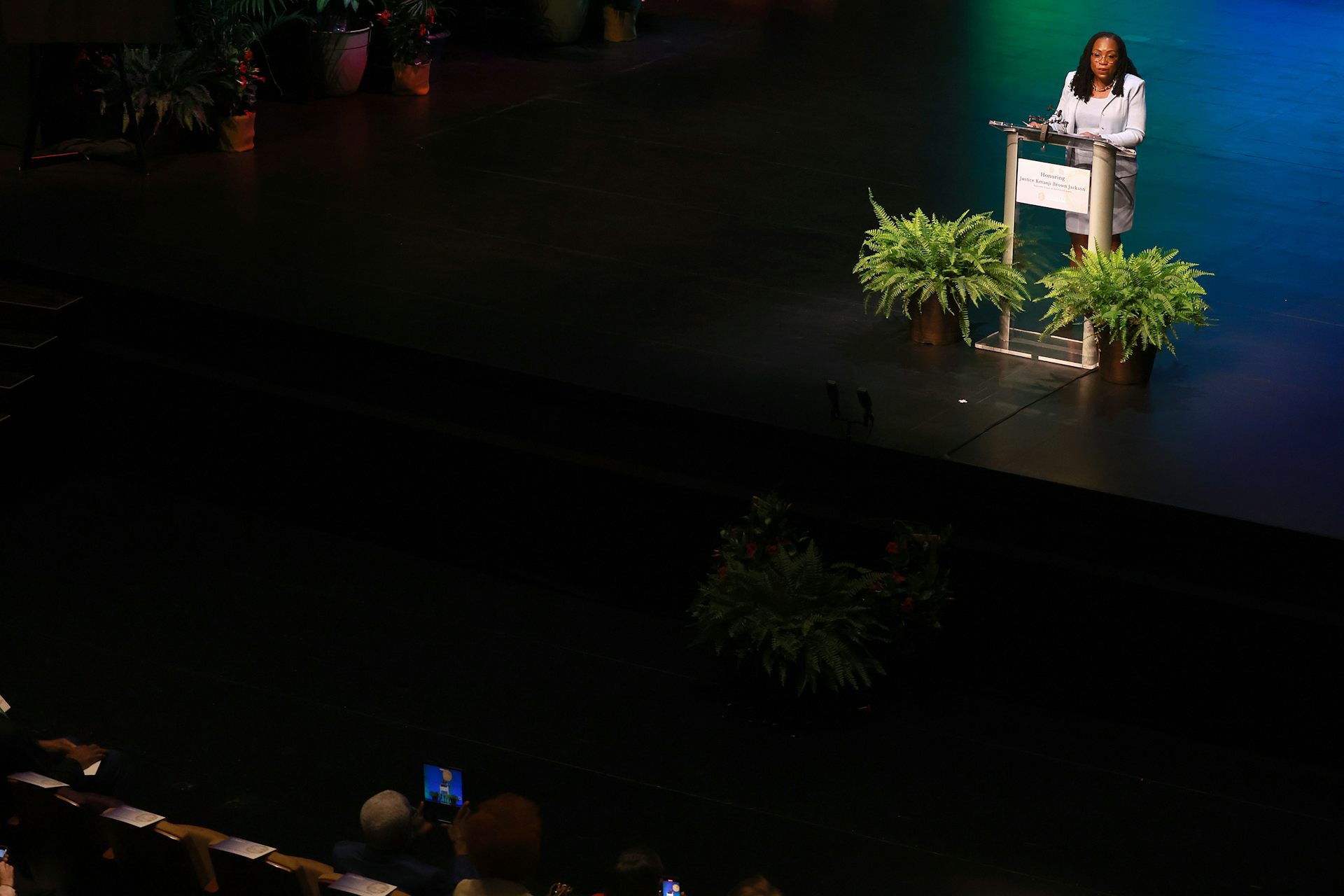
In the annals of Supreme Court decisions, the public likely remembers what justices wrote for the court in famous cases, such as the Brown v. Board of Education ruling that outlawed racial segregation in public schools.
Or perhaps the public remembers great dissenting opinions that display foresight and speak across the ages. Justice John Marshall Harlan’s dissent in the 1896 Plessy v. Ferguson case, which legalized racial segregation, is a shining example.
But Supreme Court scholars and the public alike seldom pay much attention to concurring opinions, in which a justice expounds on the views of their colleagues in the majority. Some legal experts have denigrated concurring opinions as “the worst form of legal clutter… that are, usually, better left unwritten.”
On June 30, 2026, in the Trump v. Barbara ruling, Justice Ketanji Brown Jackson showed how wrong that view can be when she delivered a monumental concurring opinion in the birthright citizenship case.
Chief Justice John Roberts wrote the majority opinion, ruling that the 14th Amendment guarantees automatic citizenship to virtually everyone born on U.S. soil. The decision invalidated President Donald Trump’s executive order that sought to deny citizenship to children born to foreign parents who are unlawfully in the United States.
Jackson, however, used her concurrence to go far beyond that and offer a new understanding of the origins of the 14th Amendment’s guarantee of birthright citizenship and its promise of equal treatment. She did so while emphasizing the singular contributions of Black Americans to that endeavor.
Along the way, Jackson criticized Justice Clarence Thomas and the court’s dominant originalist jurisprudence – centered on interpreting the Constitution based on how it was understood when it was adopted – for distorting the historical record. Jackson has previously signaled that a responsible use of history requires examining all relevant sources instead of cherry-picking among them to make a particular point.
As a politics scholar who has written about history and law, I believe that years from now, when Americans look back on Trump v. Barbara, it will be Jackson, not Roberts, whom they remember.
During her brief tenure on the court, Jackson has shown herself to be no shrinking violet. From the start, she has made her voice heard during oral arguments and in her written opinions.
As political scientists Jake Truscott and Adam Feldman wrote in December 2022, after her first three months as a justice, Jackson “was by far the most active participant in oral arguments.”
Since then, nothing has changed about Jackson’s style on the bench. The Washington Examiner reports that she “took up more than 20% of the Supreme Court’s questioning last term.”
Jackson also is not shy about writing dissenting opinions, and the occasional concurrence, whether in combination with others or alone. In both her dissents and concurrences, Thomas, the court’s only other Black member and its leading proponent of originalism, has been one of her main targets.
For example, in her 2023 dissent from the court’s decision to end affirmative action in higher education, Jackson directly criticized Thomas when she wrote that “those who demand that no one think about race … refuse to see, much less solve for, the elephant in the room – the race-linked disparities that continue to impede achievement of our great Nation’s full potential.”
Jackson has also called herself an originalist. However, she departs from Thomas’ brand of originalism.
For Jackson, to understand how any provision of the Constitution was understood requires unearthing sources of constitutional meaning that have been largely ignored by others on the court.
That vision was on display in her concurring opinion in the birthright citizenship case. There, Jackson paid particular attention to what Black Americans did in inspiring and crafting the 14th Amendment.
This contrasts with the traditional originalist story that highlights white protagonists such as Pennsylvania Rep. Thaddeus Stevens, who introduced the proposal to add the 14th Amendment to the Constitution, or President Andrew Johnson, who resisted the 14h Amendment on the grounds that it infringed on states’ rights.
Justice Thomas embraced this sort of vision in Trump v. Barbara. As he tells it, the birth of the 14th Amendment can be traced to the concerns of members of the Reconstruction Congress that the 1866 Civil Rights Act, which extended certain fundamental rights to “all persons born in the United States,” would be repealed or overturned in the courts.
Black people have little or no role in Thomas’ account.
Jackson’s opinion registers her impatience with such an exclusion. She faults Thomas for his “narrow vision of the Fourteenth Amendment (that) bears little relationship to the history of its ratification.”
Instead, Jackson traces the 14th Amendment to work done by people “within and beyond Congress.”
Jackson follows Harvard historian Jill Lepore’s suggestion that originalist judges should always attend to “all the people who are basically knocking on the windows and banging on the doors with their ideas about what should be in the Constitution.”
As Jackson recounts, “In the decades leading up to the ratification of the 14th amendment, black Americans organized and gathered at more than 600 local and national conventions across the country. There, delegates erected the political and intellectual scaffolding of the 14th amendment and, later, for the black civil rights movement more generally.”
Contrary to Thomas, who argues that birthright citizenship applies only to former slaves and their offspring, Jackson notes that Blacks “helped galvanize the push for full equality.” When ratified, Jackson explains, “the citizenship clause thus vindicated the universalist vision of the delegates at the colored conventions and their allies in Congress.”
And in a pointed dig at her colleague, Jackson writes that the “distortion of historical facts – retellings that reimagine and repurpose past events to lend credence to misbegotten aims” – poses a grave threat to the constitutional project and America’s well-being.
Jackson’s concurrence in the birthright case builds on the approach to history taken by the so-called 1619 Project. That project, unveiled by The New York Times in 2019, “aimed to reframe the country’s history by placing the consequences of slavery and the contributions of black Americans at the very center of our national narrative.”
Nikole Hannah-Jones, creator of the 1619 Project, insists “the United States simply would not exist without us. The idealistic, strenuous, and patriotic efforts of black Americans have helped the country live up to its founding ideals.”
Jackson fully embraces that story and, in her concurring opinion in Trump v. Barbara, extends it to include what happened in 1866 when the U.S. restated and renewed its founding commitment to equality. She suggests that the 14th Amendment would not have come into being without similar “patriotic efforts” by Black Americans.
What makes Jackson’s concurrence extraordinary, Slate’s Robyn Nicole Sanders writes, “is that it insists on telling the 14th amendment story honestly … (and) it is at moments elegiac in its remembrance of the people whose suffering and resistance gave birth to the citizenship clause.”
That is why I believe Jackson’s concurrence will be remembered as one of the great opinions produced by a Supreme Court justice.
This article is republished from The Conversation, a nonprofit, independent news organization bringing you facts and trustworthy analysis to help you make sense of our complex world. It was written by: Austin Sarat, Amherst College
Read more:
In rebuke to Trump, Supreme Court upholds birthright citizenship, emphasizing the promise of equality in the Declaration of Independence
‘In the end the court did its job’ – a former federal judge reviews a Supreme Court term full of momentous decisions
Why the DOJ is investigating Philadelphia after police stripped gun permits from Black Panthers‑inspired group
Austin Sarat does not work for, consult, own shares in or receive funding from any company or organization that would benefit from this article, and has disclosed no relevant affiliations beyond their academic appointment.






















































Comments