Little clarity on Iran from Trump, but new help ahead for Ukraine
Published in Political News
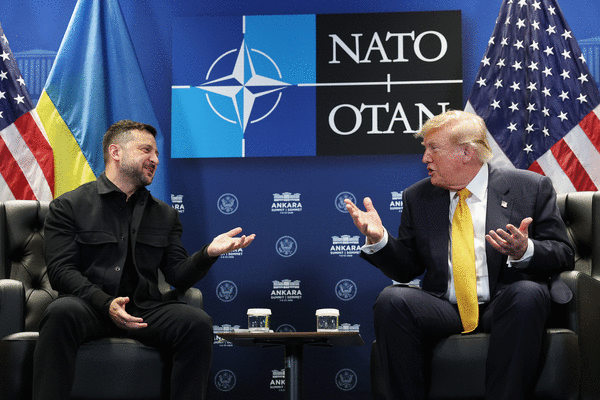
WASHINGTON — Lawmakers and European officials hoping to get clarity on the U.S.-Iran conflict from President Donald Trump at a NATO summit likely left disappointed.
During a Wednesday evening news conference in Ankara, Turkey, the first reporter to question him characterized the Iran standoff as a “strategic dead end for you” and asked why Trump has been unable to fully end it.
“I think we’re doing just the opposite. The Iran war has been a tremendous military success,” Trump replied, before adding without mentioning still-high gas prices that rose after the war started on Feb. 28: “I can only answer the question by saying they’re not going to have a nuclear weapon.”
By the end of that answer, Trump, somehow, managed to bring up the 2024 U.S. presidential race, noting that his anti-immigration policies were a big reason “we won this election.”
Asked earlier Wednesday during a meeting with NATO Secretary-General Mark Rutte if a ceasefire with Iran was still in place after the countries traded strikes this week, Trump declared: “To me, I think it’s over.”
But he sent mixed signals about the state of the conflict and negotiations toward a hard-to-reach peace pact.
“I don’t want to deal with them anymore. They’re scum. You know what scum is? They’re scum. They’re sick people. They’re led by sick people, and they’re vicious, violent people.
“As far as I’m concerned, it’s just a waste of time dealing with them. They’re liars,” Trump said. “My whole life, that’s all I do is deals ... Frankly, I don’t want to waste my time with them. Now, I’ll let our wonderful negotiators keep talking if they want, but I don’t see it. I don’t like these people.”
Less than one month ago, on June 16, a more optimistic Trump called Iran’s new leadership “very rational people” who were “nice to deal with.” Asked about that during the press conference, Trump explained his change of mind with a hawkish line: “I got to know them. ... I’m not sure I want to make a deal. Let’s just finish the job.”
Kansas GOP Sen. Roger Marshall told Kansas City’s KCMO radio on Wednesday that what he hears in the president’s rhetoric is “that’s Trump negotiating.”
“I had a saying that started nine years ago: ‘Take everything he says seriously, but not literally.’ I’m still locked in on a couple goals as I look forward to the future years: No. 1, no nukes for Iran; No. 2, no boots on the ground; No. 3, keep the Strait (of Hormuz) open, pay attention to the price of gas and groceries,” Marshall said, adding: “We may have to bomb the heck out of them some more.”
Meantime, Trump seemed to grow irritated in Turkey at times Tuesday and Wednesday when journalists pressed him on his relations with European leaders. “Europe’s a very different place than it was 20 years ago,” Trump said on the summit’s first day, his tone growing more serious. “They better be careful with immigration and energy. If they’re not careful with those two things you’re not going to have a Europe anymore.”
Trump’s comments on Iran were among a handful of notable reveals he made during the annual NATO summit.
Patriots for Ukraine
Trump in recent weeks has clashed with Senate Republicans and mostly watched from the sidelines as House Republicans have feuded with each other. He set up another possible friction point with both on Wednesday when he announced he planned to clear the way for Ukraine to begin producing its own Patriot missiles.
“But one of the things I think we’re going to be talking about today, just a little birdie told me this about the fact that we’ll give them the right to make Patriots, we’ll show them how to do it,” the U.S. commander in chief said during a meeting with Ukranian President Volodymyr Zelenskyy. “We haven’t informed the company of that, but that’ll work out.”
Made in the United States by defense giants Lockheed Martin and Raytheon, the surface-to-air missile system is considered perhaps the world’s best at taking down aircraft, cruise missiles and tactical ballistic missiles.
Secretary of State Marco Rubio, also in the Zelenskyy session, told reporters that “one of the dynamics that’s changed in this ... war over the last few months ... is that the Russians are finding it more difficult to defend their own airspace.”
Congressional Republicans for years have opposed any additional support for Kyiv in its 4-year-old conflict with Moscow.
Kyiv coalition
Should the White House ask Congress to approve any new funding for Ukraine’s war effort, Trump could find a rare bipartisan coalition to provide the necessary votes.
A group of Republican and Democratic members — GOP Sens. Mike Rounds of South Dakota and Lindsey Graham of South Carolina, Democratic Sens. Richard J. Durbin of Illinois and Chris Coons of Delaware and Ohio Republican Rep. Michael R. Turner — also met with the Ukrainian leader at the summit.
“It is abundantly clear that Russia is not winning this war. ... Putin is at his weakest position in years and real sustained pressure can finally bring this war to a close,” the group said in a joint statement, referring to Russian President Vladimir Putin.
The group called on the administration to provide “additional security assistance” to Ukraine, including the kind of air defense help Trump announced moments earlier, and to begin “tightening sanctions on Russia’s war machine.”
“On a bipartisan and bicameral basis, Congress is prepared to help President Trump apply the necessary pressure on Putin to get him to the negotiating table and end the killing once and for all,” the lawmakers added.
Strained relations
Trump on Wednesday wrapped the summit amid renewed tensions with the alliance’s European leaders over the joint conflict with Iran, the Russia-Ukraine conflict and how much their countries spend on defense. Notably, Trump did not hold any public one-on-one meetings with European leaders, known as “bilaterals,” during the summit, despite announcing several pending deals between American arms manufacturers and NATO members and describing alliance leaders’ closed-door sessions as warm and professional.
“They didn’t respect us two years ago. They laughed at us,” Trump said at the news conference. “NATO laughed at us. Everybody laughed at us. They don’t laugh anymore. There’s no more laughing this year.”
In what appeared a signal to European leaders, he showed notable deference to the meeting’s host, Turkish President Recep Tayyip Erdogan.
He also panned European leaders both days for opting to mostly stay out of the joint U.S.-Israeli war with Iran.
“I said, ‘Would you like to help?’ They said, ‘We do, but we want to wait till the war is over.’ This was not in the spirit of Winston Churchill,” Trump quipped during Wednesday’s press conference.
Earlier in the day, Rutte tried a little flattery to ease the trans-Atlantic tensions, telling Trump he was solely responsible for a recent uptick in European countries’ defense budgets.
“I would argue without you in this chair, this would not have happened. It is, of course, because of Russia, but also because of you,” he told Trump in front of reporters. “You did this. ... You made this happen.”
During an event last week sponsored by the Center for European Policy Analysis, Jan Lipavský, a former Czech Republic foreign affairs minister, said that “now (more) than ever it’s more about practical commitments rather than big geopolitical discussions."
“I think everyone understands, or at least the major players understands, that real things have to happen now,” he said. “We may use the names like ‘NATO 3.0,’ or whatever. But at the end of the day, it will be about ... European countries putting money into defense.”
_____
©2026 CQ-Roll Call, Inc. Visit at rollcall.com. Distributed by Tribune Content Agency, LLC.

















































Comments