Supreme Court backs state transgender athlete bans
Published in Political News
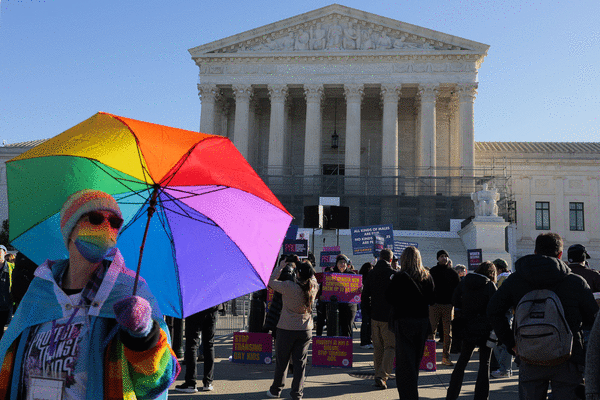
WASHINGTON — The Supreme Court backed state laws banning transgender girls from participating in scholastic girls’ sports in a decision issued Tuesday, upholding a legal argument used by the Trump administration in seeking to ban transgender athletes nationwide.
Justice Brett M. Kavanaugh, in a majority opinion that turned aside challenges to West Virginia and Idaho laws, wrote that states could bar transgender girls from participating in women’s and girls’ sports under the Constitution and Title IX, which governs civil rights in schools.
“The question is whether Title IX permits schools to maintain women’s and girls’ sports for biological females. The answer is yes,” Kavanaugh wrote.
Kavanaugh’s decision pointed to “inherent physical differences” between girls and boys and pointed to potential safety and competitiveness concerns that justified the separation. Kavanaugh wrote those concerns were justified even when a potential athlete had taken puberty blockers or hormones to transition.
Kavanaugh used similar reasons to reject claims that such bans violated the Equal Protection Clause of the 14th Amendment to the Constitution. Delving into assessments of whether individuals had the athletic ability to compete on boys and girls teams would involve endless, frustrating litigation, Kavanaugh wrote.
“The questions would be endless (and bitter) and yield few, if any, principled answers. The Equal Protection Clause and this Court’s precedents do not require such a quagmire,” Kavanaugh wrote.
Justice Clarence Thomas filed a concurring opinion that emphasized that transgender status should not receive the same heightened judicial scrutiny of immutable characteristics such as race, sex or national origin, because “‘gender dysphoria’ is a mutable mental state that is the object of psychiatric treatment.”
“A man does not have a legal right to compete against women just because he believes that he is a woman,” Thomas wrote.
Justice Neil M. Gorsuch also wrote a separate opinion that distinguished the cases decided Tuesday from a prior case he wrote, known as Bostock v. Clay County, which held that federal employment law under Title VII prohibits discrimination based on transgender status and gender identity.
“Put simply, it is a mistake to assume that, just because firing someone in part because of his biological sex amounts to unlawful discrimination in violation of Title VII, sponsoring a single-sex sports team limited to biological women or girls must also amount to unlawful discrimination in violation of Title IX,” Gorsuch wrote.
In the last several years, about half of the states across the country have passed laws similar to West Virginia and Idaho banning the participation of transgender girls in scholastic girls’ sports.
Lower courts had ruled against the state bans, finding in various cases that they violated Title IX of the Civil Rights Act, which states no one should be discriminated against in education programs “on the basis of sex,” and the Equal Protection Clause of the 14th Amendment to the Constitution.
The states and the Trump administration asked the justices to uphold the state laws, arguing that they only defined participation in sports on the basis of biological sex and did not discriminate on transgender status.
Justice Sonia Sotomayor, joined by Justice Elena Kagan and Ketanji Brown Jackson, concurred in the portion of the decision that relied on Title IX. However, Sotomayor wrote that the justices should not have decided the constitutionality of the state laws without further litigation.
Sotomayor said the justices should have sent the case back to lower courts to fully explore whether transgender athletes should be considered different once they have undergone gender-affirming treatment.
“These circumstances demand exercising judicial restraint, not rushing to answer conclusively difficult questions without sufficient evidentiary development,” Sotomayor wrote.
“Sports, of course, are often zero sum, but the law need not and should not be,” Sotomayor wrote.
The decision comes as the Trump administration has sought to ban transgender girls from scholastic girls’ sports nationwide through executive order, and the president has pushed members of his party to enact a similar ban through legislation.
Earlier this term, the justices ruled against a state law ban on conversion therapy, finding that Colorado could not ban therapists from counseling their patients to “convert” from their LGBTQ identity.
Last term, the court’s conservative majority upheld state laws banning minors from receiving gender-affirming care in U.S. v. Skrmetti, stating that such laws were within states’ rights to regulate medical care. In that case, several justices wrote separately expressing doubts that transgender Americans could receive protection from discrimination under the Constitution based on their transgender identity.
The cases are Bradley Little, in his official capacity as Governor of the State of Idaho, et al. v. Lindsay Hecox, et al. and West Virginia, et al. v. B.P.J.
©2026 CQ-Roll Call, Inc., All Rights Reserved. Visit cqrollcall.com. Distributed by Tribune Content Agency, LLC.



















































Comments