Supreme Court rejects Trump's plan to limit birthright citizenship
Published in Political News
WASHINGTON — The Supreme Court on Tuesday upheld the Constitution’s promise that all those born here are citizens of the United States, regardless of the status of their parents.
In a 6-3 decision, the justices rejected President Donald Trump’s plan to revise the Constitution by executive order and to end citizenship at birth for newborns whose parents were here illegally or temporarily.
Chief Justice John G. Roberts spoke for the court to reject Trump’s proposed limits on birthright citizenship.
“Citizenship, then and now, was the right to have rights — to freely participate in our political community,” he said. “The Framers of the 14th Amendment extended that promise to ‘every free-born person in this land.’ We keep that promise today.”
Justices Sonia Sotomayor, Elena Kagan, Amy Coney Barrett and Ketanji Brown Jackson joined in full. Justice Brett M. Kavanaugh concurred in the outcome based on the federal law that incorporates birthright citizenship.
But the outcome was closer than most had predicted.
Justices Clarence Thomas, Samuel A. Alito and Neil M. Gorsuch dissented in agreement with Trump.
The decision is the second major defeat for Trump from a conservative court that usually supports broad presidential power.
In February, the court struck down Trump’s sweeping worldwide tariffs, his signature economic policy. Roberts said Congress, not the president, has the power to raise revenue and impose taxes, including duties on imports.
In April, Trump came to the court to hear the arguments over birthright citizenship. He sat in the gallery while the justices posed steadily skeptical questions to his solicitor general.
He left after an hour having heard enough to know he was likely to lose.
It was the rare Supreme Court case which was decided based simply on the words of the Constitution.
The justices, both conservative and liberal, say they look to what the Constitution says and how its words were originally understood.
The 14th Amendment adopted in 1868 says: “All persons born or naturalized in the United States and subject to the jurisdiction thereof are citizens of the United States and of the State where they reside.”
The amendment overturned the infamous Dred Scott decision of 1857, which declared that Black persons could not become U.S. citizens.
In its place, the Reconstruction Congress adopted the broad view of citizenship based on the place of birth, not parentage, that had been part of English law for centuries.
In the 19th Century, it was understood that the only exceptions to this rule of birthright citizenship were for the children of foreign diplomats, foreign troops on American soil or, for a time, Native Americans who lived on tribal reservations.
In 1924, Congress extended full citizenship to all Native Americans who were born in this country.
The Supreme Court had also confirmed the broad understanding of birthright citizenship in 1898. The justices upheld the U.S. citizenship of Wong Kim Ark who born in San Francisco to Chinese parents who later returned to China.
“The 14th Amendment affirms the ancient and fundamental rule of citizenship by birth within the territory,” the court said then. “In clear words and in manifest intent, [it] includes the children born, within the territory of the United States, of all other persons, of whatever race or color.”
Congress added birthright citizenship to the immigration laws in 1952.
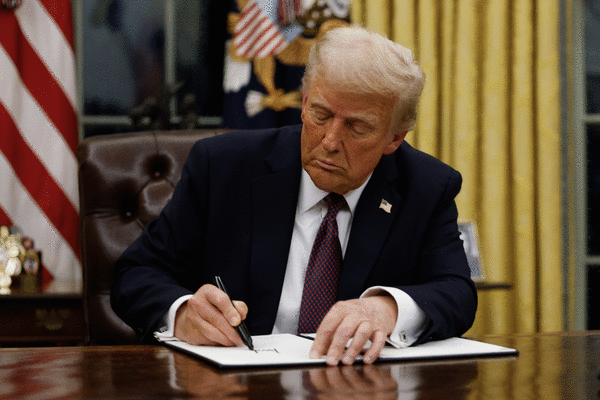
But in his first day back in the White House, Trump signed an executive order to revise the citizenship laws.
“The privilege of United States citizenship is a priceless and profound gift,” he wrote, and in the future, it will not extend to newborns whose parents are in this country unlawfully or temporarily, such as on tourist, student or work visa, he said.
His proposal was quickly blocked by judges as unconstitutional, and it never went into effect.
In his appeal, Trump’s attorney argued that judges have been “misreading” the phrase “subject to the jurisdiction.”
He said this refers to “political allegiance.”
By that standard, the children of temporary visitors and unlawful immigrants are not citizens because they and their parents “not completely subject to the United States’ political jurisdiction,” according to the administration.
Trump could have proposed legislation on tariffs and birthright citizenship and urged the Republican-led Congress to adopt new laws. Instead, he chose to try to change the law and revise the Constitution by executive order.
Before the Supreme Court, Trump’s attorney pointed to the surge of illegal immigration in recent decades.
“We’re in a new world now,” he said, one that calls for new restrictions on citizenship.
“It’s a new world. It’s the same Constitution,” responded Roberts.
©2026 Los Angeles Times. Visit at latimes.com. Distributed by Tribune Content Agency, LLC.

















































Comments