Supreme Court ends Trump's birthright citizenship change
Published in Political News
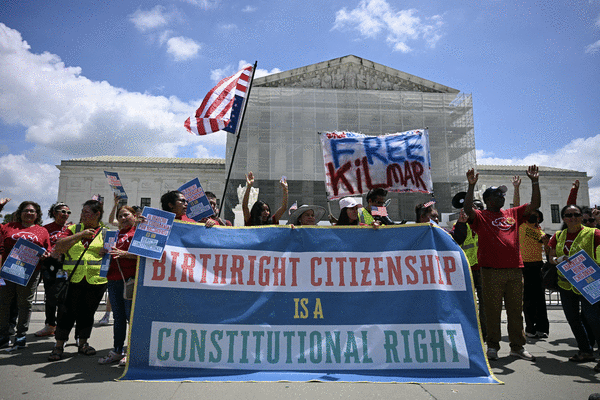
WASHINGTON — The Supreme Court on Tuesday wiped out President Donald Trump’s executive order seeking to redefine birthright citizenship, an effort to restrict American citizenship without Congress that cut against more than a century of legal precedent.
The 6-3 decision, with Chief Justice John G. Roberts Jr. writing a five-justice majority opinion, backed a challenge to the order, which would disallow citizenship for children born in the United States to undocumented immigrant parents or those with temporary legal status.
Roberts wrote that the 14th Amendment to the Constitution granted birthright citizenship to anyone born in the United States.
“Citizenship, then and now, was the right to have rights — to freely participate in our political community. The Framers of the Fourteenth Amendment extended that promise to ‘every free-born person in this land,’” Roberts wrote. “We keep that promise today.”
States and others challenging the executive order have said in court filings that it could strip citizenship from hundreds of thousands of children each year. Experts said the ruling could confine Congress’ power to define who is considered part of the nation.
A portion of the 14th Amendment provides that all people born in the U.S. and “subject to the jurisdiction thereof” are eligible to be citizens. The decision Tuesday said that clause meant citizenship applied to everyone born in the country outside certain specific exceptions.
The decision cited a more than 100-year-old Supreme Court decision where the majority found that an American-born man, Wong Kim Ark, was a citizen even though his parents were born in China.
Justice Brett M. Kavanaugh joined the overall judgment in the case but dissented on Roberts’ view of the constitutionality of birthright citizenship. Trump’s executive order violated federal immigration law, which has a definition of birthright citizenship, Kavanaugh said.
However, Kavanaugh argued that Congress still has the power to change the citizenship rules.
“Consistent with the Fourteenth Amendment, Congress could amend §1401(a) or otherwise enact new legislation establishing exceptions to birthright citizenship for children born to foreign citizens unlawfully or temporarily in the country. But Congress has not yet done so,” Kavanaugh wrote.
Republicans in Congress have for years sought to end birthright citizenship through legislation. Sens. Lindsey Graham, R-S.C., and Katie Britt, R-Ala., have sponsored a bill in the current Congress to do so. That bill has not advanced.
Rep. Chip Roy, R-Texas, said in a news release Tuesday that Congress “must act immediately” to counter the decision, defining citizenship as tied to the parent and not the soil and using appropriations to enforce it.
“The 14th Amendment to the U.S. Constitution in no way stands for the proposition of creating a dangerous cottage industry of traveling to our soil to manufacture United States citizenship. That’s insane,” Roy said.
The decision in the birthright citizenship case Tuesday will almost certainly increase the tension between the Supreme Court and the Trump administration. Trump himself has spent months fuming about an earlier decision by the justices that tossed his global tariff regime on the grounds that Congress did not give him the power to do so.
In April, Trump posted that Republican appointees to the court “don’t stick together” and blamed them for siding with Democratic appointees and killing his tariff regime. He also complained about “nasty, one sided questions on the country destroying subject of Birthright Citizenship, something which virtually NO OTHER COUNTRY IN THE WORLD IS STUPID ENOUGH TO ALLOW.”
Trump took the unprecedented step of attending the April oral arguments in person.
Throughout the court cases the Trump administration has maintained that the amendment was meant to provide the children of slaves with citizenship and should not apply to the children of people in the country temporarily or illegally.
Justice Clarence Thomas, in a dissent joined by Justice Neil M. Gorsuch, argued that the 14th Amendment was meant to provide birthright citizenship to the children of former slaves. That clause of the Constitution and the initial Civil Rights Act of 1866 did not mean to cover immigrants without a permanent home in the country.
“Neither guaranteed citizenship to persons who were not domiciled in the United States,” Thomas wrote.
Thomas pointed to decades of practice by presidential administrations to deny citizenship to the children of immigrants until the 1890s. Thomas argued that Trump’s executive order was consistent with those practices and the Constitution.
Justice Samuel A. Alito Jr. also filed a dissenting opinion, criticizing the majority for extending citizenship to “birth tourists” who travel to the U.S. solely to give birth. Alito argued that the millions of people who may be deprived of citizenship due to a change should instead look to Congress for relief.
“Congress can and should address the situation. The Fourteenth Amendment dictates who must be a citizen, but it does not address who may be a citizen by an Act of Congress,” Alito wrote.
Justice Ketanji Brown Jackson, joined by Justice Sonia Sotomayor in parts, filed a concurring opinion which argued that the dissenters had a myopic view of the 14th Amendment that was limited to the freedom of children of former slaves.
Tuesday’s decision was the second time the justices have faced the birthright citizenship order. Last term when faced with an appeal from the Trump administration, the justices curtailed the ability for lower courts to issue nationwide injunctions.
Shortly after that decision several lower courts re-blocked the executive order on different grounds.
The case is Barbara v. Trump.
©2026 CQ-Roll Call, Inc. Visit at rollcall.com. Distributed by Tribune Content Agency, LLC.


















































Comments