Supreme Court strikes down campaign coordination limits
Published in Political News
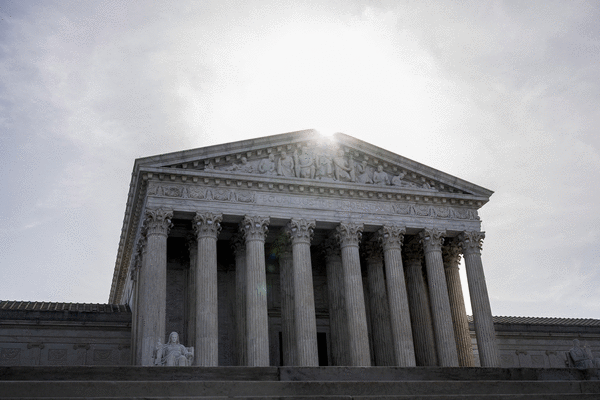
WASHINGTON — The Supreme Court overturned a key campaign finance restriction in a decision issued Tuesday, clearing the way for political parties nationwide to spend unlimited amounts on behalf of candidates in federal elections.
The 6-3 decision came in a challenge from the National Republican Senatorial Committee, as well as Vice President JD Vance from when he was a senator, and former Rep. Steve Chabot, R-Ohio. They argued the limits violated the free speech rights of political parties.
Justice Brett M. Kavanaugh, writing for the court’s conservative majority, said that concerns about the circumvention of individual contribution limits and an appearance of undue influence by big donors was not enough to justify the coordinated spending bar.
“In short, under the Court’s more recent First Amendment precedents, the Government’s desire to prevent or reduce influence, ingratiation, gratitude, access, or the like for those who spend in support of, or contribute to, political parties or candidates is not a constitutionally permissible objective for campaign finance restrictions,” Kavanaugh wrote. “Therefore, the political-party coordinated-expenditure limits can no longer be justified on that basis.”
The decision overturned an opinion from the U.S. Court of Appeals for the 6th Circuit that upheld the limits.
The coordinated party expenditure limits challenged in the case started when Congress passed the Federal Election Campaign Act and amended it in 1974. Congress changed the law in 2014, increasing the amounts that could be spent, and allowing new expenditures such as for nominating conventions, party headquarters and election court challenges.
The Federal Election Commission sets those limits each year depending on the state and the office of the candidate. The FEC caps the limit for most House races at $63,600, but in states with only one representative, committees can spend up to $127,200, according to the FEC. Senate race caps vary by state, from as low as $127,000 in Alaska up to $3.9 million in California.
Defenders of the law said that it was meant to prevent large donors from being able to contribute a large amount of funds to an individual candidate, circumventing the normal campaign finance limits by using a political party as a conduit.
Kavanaugh wrote that several other limits still exist, including individual donation limits, disclosure rules and limits on “earmarking” political contributions to parties that would prevent such problems.
“So prophylaxis upon prophylaxis upon prophylaxis already serve to prevent quid pro quo corruption or its appearance,” Kavanaugh wrote.
Justice Elena Kagan, in a dissent joined by Justices Sonia Sotomayor and Ketanji Brown Jackson, argued that removing the limits effectively allowed national parties to operate as alternative checkbooks for political campaigns. Kagan said that donors can give up to $500,000 to political campaigns, far more than the $7,000 limit to individual candidates.
“So the Court ushers back in the same opportunities for quid pro quo corruption that the contribution limits were meant to check,” Kagan wrote.
Kagan also said that the First Amendment did not mandate the outcome and the majority decision would create “untold harm” to the political system. Rules like disclosure regimes would not be enough to uncover the backdoor dealings that the limits themselves were intended to prevent, she wrote.
The case is the National Republican Senatorial Committee, et al. v. Federal Election Commission, et al.
©2026 CQ-Roll Call, Inc., All Rights Reserved. Visit cqrollcall.com. Distributed by Tribune Content Agency, LLC.

















































Comments