Pro-Trump outsider wins Colombia vote, sets up heated runoff
Published in Political News
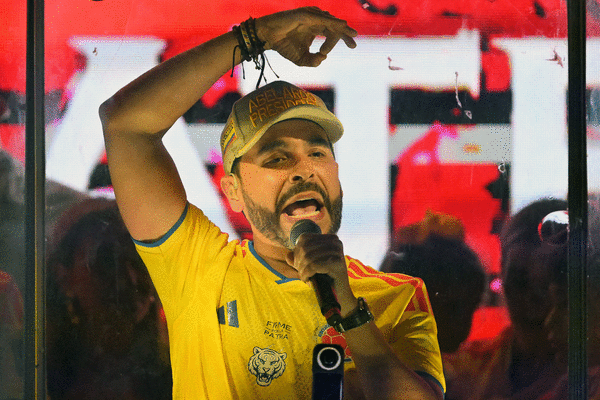
Celebrity lawyer Abelardo de la Espriella unexpectedly topped the first round of Colombia’s presidential vote, as Latin America heads into another highly polarized election.
The conservative outsider is in a strong position to become the nation’s next president when he faces leftist Senator Iván Cepeda, an ally of current President Gustavo Petro, in a June 21 runoff.
The country’s dollar notes gained across the curve in early trading Monday with bonds due in 2036 jumping 2.9 cents to 107.5, according to indicative pricing data collected by Bloomberg.
De la Espriella had 43.7% of the vote with nearly all ballots counted, according to official results. Cepeda sat in second place with 40.9%. Another conservative hopeful, Senator Paloma Valencia, was in distant third with 6.9%. She pledged her support to De la Espriella in a speech after the vote.
“The fact that De la Espriella came first in the first round, on a high turn-out, with the third-placed candidate’s supporters more likely to break for him in the run-off than for Cepeda, suggests he is the favorite for the second round,” said Graham Stock, a senior EM sovereign strategist at RBC Bluebay in London.
Emphasizing the heated nature of the runoff, De la Espriella called on the military and the world to defend the results of Sunday’s vote from “miserable delinquents” after Petro and Cepeda questioned the results. He also asked the U.S. to oversee the second round of the vote.
“Turn your attention to Colombia,” De la Espriella said from a bulletproof glass-enclosed stage on Barranquilla’s riverfront promenade. “Petro, the coup plotter, as he has warned, intends to cling to power by disregarding the will of the people.”
Petro had said in an earlier post on X that he would not recognize the unofficial results until the formal scrutiny process is completed. Cepeda, too, said he’ll accept the results after a review of what he called irregularities. He also accused Ecuador leader Daniel Noboa of interfering in the election by lifting tariffs on Colombian goods after he spoke with De la Espriella two days before the vote.
“With effort and imagination, we have achieved a vote as significant as the one we have today, albeit poorly counted,” Cepeda said in a speech from a hotel in Bogota.
Voter turnout was roughly 58% on Sunday, the highest ever for a first-round presidential election.
Before the vote, most polls had shown De la Espriella coming second behind Cepeda. Prediction markets suggest the runoff may only be a formality. De la Espriella now has an 81% chance of becoming Colombia’s next president compared to 18% for Cepeda, according to Polymarket.
The country’s debt had seen a modest jump in the week ahead of the election, as investors were encouraged by signs of De la Espriella’s increasing popularity. Markets eventually came to see De la Espriella as an alternative to Valencia and they consider him the best hope for ousting Petro’s movement. Dollar bonds handed investors gains of almost 2% this past week, while yields on peso-denominated notes fell.
De la Espriella has pledged to strengthen ties with U.S. President Donald Trump, curb spending, cut taxes and order a military crackdown on the cocaine-trafficking militias that have overrun swathes of the nation.
Cepeda, in contrast, is skeptical of U.S. intervention in Latin America and wants to boost social spending and extend negotiations with illegal armed groups.
At polling stations across Bogota, many voters, along with their children and even their pets, wore Colombia’s yellow national soccer team jersey, which became one of the most recognizable symbols of De la Espriella’s campaign. Cepeda, however, prevailed in the capital, securing nearly 42% of the vote versus 38% for De la Espriella.
The runoff will likely hinge on whether De la Espriella can consolidate support from voters who backed Valencia, and which of the pair can reach out to centrist voters.
“The momentum is with De la Espriella, who pulled off a major upset by defeating Cepeda, despite never having run in a popular vote election before and lacking the backing of political parties and traditional political machines,” said Sergio Guzmán, director of Colombia Risk Analysis. “De la Espriella has an advantage, but he needs to manage it carefully. The runoff is going to be extremely close.”
The results delivered a blow to the mainstream Colombian conservatives, who had sought to propel Valencia to the presidency. Her failure to reach even 10% of the vote marked a sharp decline for Uribismo, the political force led by former President Álvaro Uribe that dominated the country’s politics for two decades before Petro became its first leftist president in 2022.
De la Espriella initially described Valencia as an ally, but tensions between them increased in the lead-up to the vote. But her endorsement — along with Uribe’s — should quell any concerns about whether right-wing forces can unite in a potential runoff against Cepeda.
De la Espriella goes into the second round as the clear favorite, according to Sandra Borda, a political scientist at Bogota’s Universidad de los Andes.
“The great majority of the votes for Paloma Valencia will go to him,” she said. “Some people in the center are frightened by the idea of someone like De la Espriella, and will vote a bit more for Cepeda. But even with those votes, it doesn’t look as though Cepeda is going to make it.”
Elsewhere in the region, presidential races are also deeply polarized between candidates with radically different ideologies.
Peru’s June 7 runoff vote is between Keiko Fujimori, the daughter of conservative former President Alberto Fujimori, and Roberto Sánchez, an anti-establishment leftist. In Brazil, President Luiz Inácio Lula da Silva is facing a conservative movement led by right-wing Senator Flávio Bolsonaro, the eldest son of former President Jair Bolsonaro.
Argentine President Javier Milei congratulated De la Espriella in a post on X, praising Colombian voters for their determination “to put an end to the failed socialist model that has done so much to damage our region — and to Colombia in particular — over the past four years.”
--------
—With assistance from Nicolle Yapur and Carolina Wilson.
©2026 Bloomberg L.P. Visit bloomberg.com. Distributed by Tribune Content Agency, LLC.


















































Comments