Trump DOJ creates $1.7 billion fund for victims of legal 'weaponization,' prompting outrage
Published in Political News
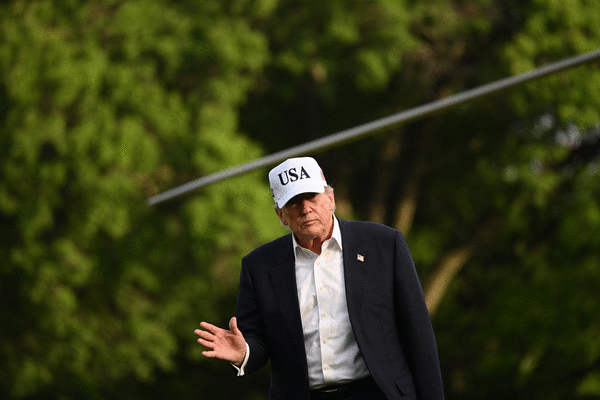
WASHINGTON — Shortly after attorneys for President Trump moved Monday to dismiss his $10 billion lawsuit against the Internal Revenue Service over claims it had leaked his personal tax returns, the Justice Department announced that a settlement in the case would be used to create a $1.776-billion fund for other victims of “weaponization and lawfare.”
“The machinery of government should never be weaponized against any American, and it is this Department’s intention to make right the wrongs that were previously done while ensuring this never happens again,” Acting Attorney General Todd Blanche said in a statement.
Trump has long claimed that the federal government under President Biden went after him and his political allies without justification and in violation of the law.
He has pardoned all of his supporters charged in connection with the Jan. 6, 2021, attack on the U.S. Capitol, along with other political allies, while pressuring the Justice Department to bring cases against his political opponents.
His lawsuit against the IRS had been challenged by Democratic lawmakers, former IRS and Justice Department officials and outside progressive organizations as a blatantly unlawful move by a deeply conflicted president.
It raised questions from the federal judge overseeing it — who had demanded answers this week on whether Trump and his own government were essentially colluding to reach a mutually beneficial agreement in a case in which Trump stood on both sides.
Sen. Ron Wyden of Oregon, the top-ranking Democrat on the Senate Finance Committee, called the potential deal “a stunning act of corruption. ... If he follows through, it will be the most brazen theft and abuse of taxpayer dollars by any president in American history.”
Blanche defended the settlement Monday as similar to one reached during the Obama administration to address claims that the U.S. Department of Agriculture had systematically discriminated against Native American ranchers and farmers for decades.
However, experts said the creation of a fund for Trump’s political allies, as part of a deal to settle a lawsuit he had personally brought against his own government, was completely unprecedented — and concerning.
“Essentially the president is on both sides of the ‘vs.’ [in the lawsuit], and has control over the very agency that is responsible for offering the funds, in settlement of a lawsuit that he has brought in his own personal capacity, along with members of his family,” said Rupa Bhattacharyya, legal director at the Institute for Constitutional Advocacy and Protection at Georgetown Law. “That has never, ever, ever happened before. No former president of the United States would have been so brazen.”
The lead attorney in the case cited by Blanche said that the settlement he negotiated on behalf of Native American ranchers and farmers had required sign-off from the courts at every step and was not a comparable situation to the fund announced Monday.
“It doesn’t remotely provide precedent for it,” said Joseph Sellers, the lead attorney in the Keepseagle case. “I’m already hearing from people in the Native American community who are outraged about this.”
The lawsuit is one of numerous legal attacks by Trump and his administration against a wide range of the president’s perceived enemies, including universities, media outlets and law firms. A number of those cases were settled with promised payments to a future Trump presidential library, funds sent to the federal government, cash for workforce development programs and free legal work.
The Justice Department said the new “weaponization” fund will be paid out of the federal Judgment Fund, which is a permanent appropriation by Congress and administered by the U.S. Treasury. It was created to ensure that settlements by and judgments against the government could be paid out without individual appropriations being made each time.
The Justice Department said the fund will cease processing claims no later than Dec. 1, 2028 — shortly before Trump is set to leave office — and that the fund will consist of five members appointed by the attorney general, with the president having removal power.
In a separate court filing Monday in the case, 93 Democrat House members blasted the potential IRS deal.
“Should this lawsuit achieve Plaintiffs’ desired ends, it would result in the improper and unconstitutional transfer of taxpayer dollars into the pockets of the President, his family, and his allies,” the filing reads.
The initial complaint, brought by Trump, his sons Donald Trump Jr. and Eric Trump, and the Trump Organization, focused on leaks by a former IRS contractor, Charles Littlejohn, to the New York Times and ProPublica of tax information for Trump and other wealthy individuals.
Littlejohn pleaded guilty to the unauthorized disclosure of tax information and was sentenced to five years in prison in 2024.
The progressive legal organization Democracy Forward had previously filed a brief in court challenging Trump’s lawsuit as raising serious legal concerns. The February brief was filed on behalf of two other groups — Common Cause and the Project on Government Oversight — as well as four former federal officials, including former IRS Commissioner John Koskinen.
The brief argued that the lawsuit was significantly flawed and barred by a statute of limitation, but also raised “serious concerns about collusive litigation tactics,” and that the court “should exercise its inherent authority to proactively manage” it.
“This case is extraordinary because the President controls both sides of the litigation, which raises the prospect of collusive litigation tactics. Collusive litigation threatens the integrity of the judicial process by risking the Court’s entanglement in an illegitimate proceeding,” the filing said.
The complaint “was filed too late, against the wrong party, and for an unsupported and excessive sum of damages,” the filing said.
Last week, Brandon DeBot, a senior attorney advisor and policy director at the Tax Law Center at New York University Law, and Dave Hubbert, a senior fellow at the center, wrote that the lawsuit was “absurd,” and that a settlement — particularly one in which the IRS would agree to drop any audits of Trump, his family and their businesses — would be “deeply concerning.”
They wrote that the Justice Department has no authority to negotiate any such terms, and that “negotiations involving the President and White House officials to end audits of the President, his family, and his businesses risk violating laws protecting against political interference in tax administration.”
They noted that Congress had “strengthened the tax code’s protections against political interference on an overwhelmingly bipartisan basis following public revelation of President Nixon’s failed attempts to use the IRS to target political enemies,” and that any moves by anyone in the White House to “directly or indirectly” request an audit of the president be suspended would violate the law.
Bhattacharyya, who previously oversaw complex settlement cases at the Justice Department, said the “mechanism” by which any such settlement could be used to facilitate payments directly to Trump’s allies would seem to “deviate” from guidelines for the disbursement of settlements to third parties not part of the initial litigation.
Bhattacharyya said such third-party disbursements were banned under Attorney General Jeff Sessions during Trump’s first term, allowed under very narrow circumstances in environmental and pollution cases under Attorney General Merrick Garland during the Biden administration, and then barred again by Attorney General Pam Bondi in Trump’s second term, before her recent ouster.
A settlement in Trump’s IRS case being distributed to his supporters “would seem to deviate from all of those guidelines,” she said. “It would violate all of them.”
The Justice Department said there will be “no partisan requirements” on filing a claim against the new fund. However, the move was clearly a continuation of the Trump administration’s efforts to undercut a wave of prosecutions against Trump and his allies, including Jan. 6 insurrectionists, during the previous Biden administration.
Trump has called those prosecutions illegitimate and politically motivated, while his critics have noted that they were brought after long investigations by career prosecutors and independent counsel. By contrast, Trump has expressly directed the prosecution of many of his political enemies, with several cases being brought against the advice of career prosecutors.
Sen. Adam Schiff, D-Calif., who helped lead multiple investigations into Trump during his first term and has been targeted for prosecution during Trump’s second term — for thin allegations of mortgage fraud he denies — denounced Trump’s efforts in the IRS case last week.
“First, Donald Trump sues his own IRS to enrich himself. Now he wants to use billions in taxpayer funds to compensate his allies, including thousands charged for the January 6 insurrection,” Schiff wrote. “This is easily the most corrupt regime in U.S. history.”
Trump’s legal maneuverings against the IRS come amid wider concerns about mismanagement at the agency and a wider battle over its providing the sensitive data of other taxpayers to Immigration and Customs Enforcement, at the Trump administration’s direction.
Trump removed IRS Commissioner Billy Long in August 2025, allowed Treasury Secretary Scott Bessent to serve as acting commissioner for a time and then created the new position of IRS “CEO,” which congressional Democrats have railed against as a “fake” position designed to avoid congressional oversight while the agency falls into “chaos.”
Congressional Democrats have also demanded answers about the release of taxpayer data to U.S. Immigration and Customs Enforcement, ostensibly for the purposes of deporting taxpayers who lack proper documentation to be in the country as part of Trump’s massive deportation campaign.
“The IRS now admits that this system led to exactly the kinds of grave mistakes our taxpayer privacy laws were designed to prevent,” Sen. Alex Padilla, D-Calif., and several other senators wrote in February.
_____
©2026 Los Angeles Times. Visit at latimes.com. Distributed by Tribune Content Agency, LLC.



















































Comments