Democrats clash over where Wasserman Schultz should run for reelection, jeopardizing alliances
Published in Political News
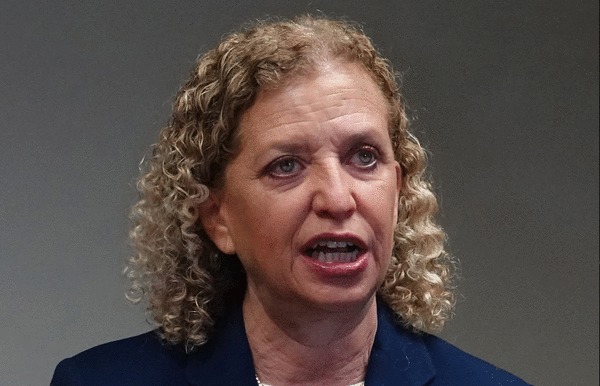
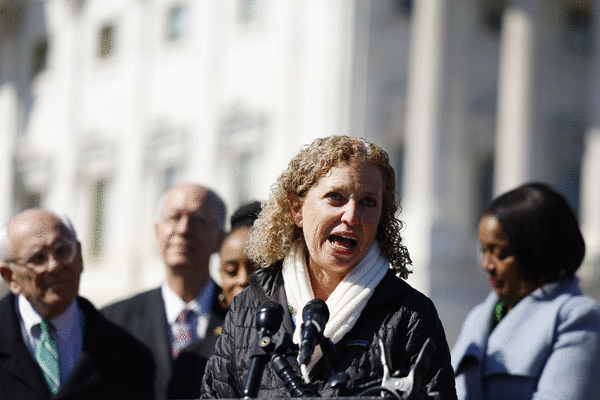


SUNRISE, Fla. — Most of the 200-plus political activists, elected officials and candidates stood, applauding and cheering, when U.S. Rep. Debbie Wasserman Schultz was introduced before speaking to a coalition of Broward Democratic clubs.
People at a few of the 25 tables, most of whom were Black, stayed in their seats.
The divided reaction is a stark illustration of a seismic political battle in Broward County and beyond over where Wasserman Schultz should run for reelection. It could devolve into a rupture between two of the Democratic Party’s most important, enduring and loyal constituencies, Black voters and Jewish voters.
What’s going on is a byproduct of Florida’s new congressional districts, pushed through the Florida Legislature by Gov. Ron DeSantis after President Donald Trump told Republican-controlled states to reconfigure their congressional maps. Trump’s goal: elect more Republicans and fewer Democrats in November.
Wasserman Schultz, the longest-serving Democrat in the Florida congressional delegation and for years a prominent critic of both Trump and DeSantis, was a prime target. Drawn by a DeSantis aide, the new map chopped up her all-Broward congressional district and placed pieces in five different districts, four of which have significant territory in other counties.
The result leaves her with politically treacherous options. One is to run in a newly configured Broward congressional district, where DeSantis’ mapmaker crammed as many Democrats as possible, making the neighboring districts lean more Republican.
The new 20th Congressional district is so Democratic that the primary winner is all-but-certain to win the general election. And there’s no incumbent representing that district. But even though it’s the only safe seat for a Democrat in Broward County, a Wasserman Schultz candidacy there is fraught.
The issue: The district includes a large number of Black voters and much of the territory represented since 1993 by Black members of Congress, Alcee Hastings, who died in 2021, and Sheila Cherfilus-McCormick, who resigned from Congress in April.
State Sen. Shevrin Jones of Miami Gardens, who has been elected by his colleagues to become Senate Democratic leader after the 2028 elections, said a Wasserman Schultz candidacy in the 20th District “would absolutely create a rift.”
“The Republicans got us exactly where they wanted us. They have us fighting over a solid (Democratic) blue seat,” said Jones, who is Black and used to represent part of South Broward.
Burnadette Norris-Weeks, a prominent Black lawyer who has worked for governments and around politics, said she, too, believes “part of the intent was to create confusion and chaos within the Democratic Party for sure, to pit groups against each other.”
Wasserman Schultz was the first Jewish woman from Florida elected to Congress.
Mitch Ceasar, former longtime Broward Democratic Party chair, who is white and Jewish, offered a similar assessment. “I’m very concerned about serious divisions within the Democratic Party,” he said. “I believe the Republicans’ game plan included creating this type of friction.”
Ceasar, like more than a dozen Black and white Democrats interviewed in recent days, declined to offer an opinion about what Wasserman Schultz should do, or predict what she would do. Ceasar had a one word, Yiddish response: “Oy.”
Objections
As Wasserman Schultz talks privately with elected officials and political activists, some in the Black community have been outspoken in their opposition to her running in District 20.
“She should not run in District 20,” Marsha Ellison, president of the Fort Lauderdale/Broward Branch of the NAACP, said in an interview. “I have no issue with the congresswoman at all — except when it comes to running in District 20.”
The next member of Congress in that district should be “someone who looks like me, who has my life experiences,” Ellison said. “You can relate to the issues of our community if you’ve lived what we’ve lived. We need someone who knows where I’ve been and where our people have been.”
State Sen. Rosalind Osgood, D-Fort Lauderdale, offered a similar assessment. “Just like I want white people in Congress, I want Jews, Hispanics, Muslims. I want the same for my people.”
“She doesn’t have a Black lived experience,” Osgood said. “I love Debbie, but if she’s in a committee meeting, and they’re talking about racial profiling, she doesn’t have my experience of being stopped by the police or a Black man’s experience being stopped by the police.
“For us as Black people, this is about Black representation in Congress,” Osgood said. “We’re fighting for respect. We’re fighting for a seat at the table, which we shouldn’t have to.”
Their view isn’t universal.
Former U.S. Rep. Al Lawson, a Black Democrat from Tallahassee, worked with Wasserman Schultz in Congress and in the state Legislature. He said Wasserman Schultz should run in the newly configured 20th District.
“She wouldn’t have a problem at all representing minorities,” Lawson said. “I don’t know anyone else that could do a better job in representing that area and those communities than Debbie.”
Lawson rejected the notion that Wasserman Schultz couldn’t effectively represent Black constituents because she doesn’t have their lived experience. “That’s not true,” he said. “Someone can say that. But not with Debbie. Debbie’s been there. She understands their concerns. … I can tell you right now if she’s elected they will be very happy with her.”
During his career, Lawson said, he was elected at times in state legislative districts — and his first congressional race — where a majority of the population was white.
Wasserman Schultz is a senior member of the Appropriations Committee and part of the House leadership team, which Lawson said makes her more effective than many members.
“Because of her seniority, she has a lot of clout in Congress, which is good for her constituents to keep,” he said. “If you’ve been in Congress and you understand Congress and the way things work, a new person coming in really can’t do much.”
The district
The reconfigured 20th District is basically a square in the central part of Broward, all north of Interstate 595. Most of its eastern boundary is Federal Highway or the FEC railroad tracks. Most of the northern boundary is Sample Road and much of the western boundary is the Sawgrass Expressway.
It has a protrusion that reaches north to the Palm Beach County line to pick up a swath of Democratic voters straddling Interstate 95.
The district includes all or parts of Coconut Creek, Deerfield Beach, Fort Lauderdale, Lauderdale Lakes, Lauderhill, Margate, North Lauderdale, Oakland Park, Plantation, Pompano Beach, Sunrise, Tamarac and Wilton Manors.
The latest update to the independent Cook Political Report ratings of House districts, released Wednesday, shows the newly crafted 20th District as “solid” Democratic. Inside Elections, also independent, rates it “solid” Democratic.
In the 2024 presidential election, Trump finished 39 points behind Democrat Kamala Harris in the district’s precincts, data analysts have reported. In such a heavily Democratic district, winning the congressional primary is tantamount to winning the general election.
Democratic data analyst Matthew Isbell estimated Democratic primary voters as 51% Black, 35% white and 7% Hispanic.
Multiple candidates
Voters often, though not always, make choices based on racial, gender or religious lines, a phenomenon that features prominently in many discussions of the 20th District.
Black Democratic leaders who don’t want Wasserman Schultz to run there believe that a field of multiple Black Democrats would split support among Black voters in the primary, leading to her victory.
Linda Hugley, of Lauderdale Lakes, believes that’s exactly what would happen. She was part of a group of Black voters at the Democratic clubs’ gathering at the Flamingo Park Meeting Hall in Sunrise T-shirts that said “District 20 Protect Black Representation.”
“It’s not about (Wasserman Schultz) personally,” Hugley said. “We feel that we’re being wiped off the map.”
Four Black men announced congressional candidacies before the new maps, and have switched their efforts to the reconfigured 20th District.
— Luther Campbell, famous from his time as the leader of the rap group 2 Live Crew and a free-speech advocate, and more recently an activist, podcaster and youth football coach. Announced in February.
— Dale Holness, a former Broward County commissioner who lost 2021 and 2022 congressional primaries to Cherfilus-McCormick. Announced in August.
— Elijah Manley, an activist who has run unsuccessfully for office several times before. Announced in February 2025.
— Rudolph Moise, a physician and unsuccessful congressional candidate in 2010 and 2012. Announced in April.
On Monday, Cherfilus-McCormick, who was the first Haitian American Democrat elected to Congress, said she was running to return.
She resigned in April minutes before the House Ethics Committee was scheduled to discuss what sanction to recommend to the full House. Cherfilus-McCormick faced possible expulsion over 25 ethics violations and faces a criminal trial for some of the same allegations next year. She has denied wrongdoing.
Manley and Osgood said they didn’t think all of the candidates would actually qualify to get on the Aug. 18 primary ballot and the field wouldn’t be as split.
Jones said the candidates should make a collective decision. “The Black candidates in a perfect world, they would get into a room with each other and they would talk it out and they would pick the best person,” Jones said. “They would lower their egos and raise their strategic approach.”
Campbell offered a different view in a social media video. “All of you Black folks, all of you Black men and women: Stay in the race. Stay in the race. Don’t let all of these people talk you out of the race.”
Osgood said Black community leaders need to coalesce around a candidate, and said she would consider running for the congressional seat herself.
“People have been asking me, ‘Are you running?’” Osgood said. “I have to consider it, I have to consider everything. I go with my community. I have to consider everything.” (She’s also been mentioned as a potential 2028 candidate for mayor of Fort Lauderdale. She demurred when asked about that possibility, saying she hasn’t thought that far ahead.)
At the Democratic clubs’ meeting on Monday, Osgood and Cherfilus-McCormick hugged when they saw each other. Osgood, who is an ordained Baptist minister, said that shouldn’t be seen as politically significant.
“You’ll see me do that with anybody that’s going through the fire and the storm. As a Christian, I have to,” Osgood said. “I’m not going to turn my back to her. I hugged her and I said, ‘I’m praying for you.’”
Run over there
Democrats who don’t want Wasserman Schultz running in District 20 have urged her to run in the new District 22, which includes part of western Broward and Palm Beach counties — and runs west to Marco Island and the Gulf of Mexico.
Manley asserted that it would be easy for Wasserman Schultz to win there this year.
He and Holness pointed to the $2 million Wasserman Schultz had in her campaign account on March 31, according to her April filing with the Federal Election Commission. They said that money, which is more than all the candidates in District 20 combined, would make her competitive in the 22nd District.
Democrat Joe Biden won the territory by 3 percentage points over Trump in 2020 but Trump ran 10 points ahead of Harris in 2024. The Cook Political Report rates it as “lean” and Inside Elections rates it “tilt” Republican.
Sean Foreman, a political scientist at Barry University, said the suggestion that Wasserman Schultz run in the 22nd District “sounds reasonable.” Still, he said, it would be difficult for her to win, though not impossible.
“Debbie Wasserman Schultz isn’t as popular as she was 10 years ago. She has a lot of (political) negatives that her (Republican) opponent can capitalize on in a general election,” Foreman said. “The national mood might show that Democrats are favored to make gains in Congress, but the environment in Florida is more favorable for Republicans to hold on.”
Not saying
DeSantis’ office unveiled the map on April 27, it was ratified by the Republican-controlled Legislature on April 29, and signed into law by the governor on May 4.
Wasserman Schultz, like the other three Florida Democrats who now face difficult paths to reelection because of the new districts, quickly said she’d seek reelection. But she has repeatedly declined to say where she’ll be running.
“I’m going through … a very deliberative process where I’m talking and reaching out to leaders across the community and really getting their insight and feedback,” she said, promising to “reach a decision in short order.”
Wasserman Schultz, 59, was first elected to Congress in 2004 after serving in the Florida Senate and the state House of Representatives.
Wasserman Schultz was President Barack Obama’s handpicked chair of the Democratic National Committee from May 2011 until July 2016. In Congress, she was one of the founders and is a current co-chair of the Congressional Caucus on Black-Jewish Relations.
In South Florida, Norris-Weeks said Wasserman Schultz “has shown herself to be someone who has built relationships” including in the African American and Caribbean American communities. “She worked closely with Alcee Hastings when he was living. And I saw a lot of that play out. You certainly have to build coalitions to get anything done and she was there. I don’t think that’s something that can be ignored or denied,” Norris-Weeks said.
In 2016, when Wasserman Schultz faced the most formidable primary challenge of her career, U.S. Rep. John Lewis, D-Ga., an icon of the civil rights movement, campaigned in South Florida on her behalf. Lewis, who died in 2020, was nearly beaten to death at the Edmund Pettus Bridge during the 1965 Bloody Sunday march for voting rights from Selma to Montgomery, Alabama.
Wearing an “I heart Debbie” sticker, Lewis described her as brilliant, a leader, a friend, a sister and a fighter. “If I could vote here, I would cast my vote for Debbie,” he said.
That was a decade ago.
In 2026, Osgood said, Wasserman Schultz might throw that away by running in the 20th District.
“She may win, she may not win,” Osgood said. “But let’s say she does win, and then it’s going be her legacy that she, who has been a friend to the Black community all these years, took away black representation in Congress.”
©2026 South Florida Sun Sentinel. Visit sun-sentinel.com. Distributed by Tribune Content Agency, LLC.





















































Comments