How the Middle East and the word 'genocide' became the defining issue of the Philly congressional race
Published in Political News
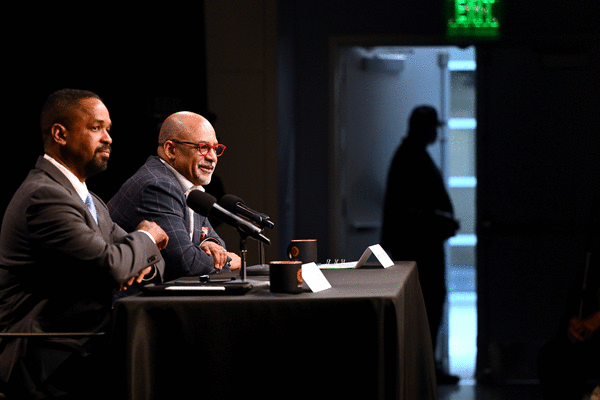
PHILADELPHIA — A bitterly contested race for an open seat in Congress representing a deep-blue Philadelphia district has become something of a symbol of a broader national debate among Democrats about how far the party should go in criticizing Israel.
While voters in the city have long said that economic concerns, public safety, and healthcare are the top issues affecting their lives, it is the wars in the Middle East that have thus far defined the race to replace outgoing U.S. Rep. Dwight Evans in Pennsylvania’s 3rd Congressional District.
And the key dispute among the three leading candidates is largely not about policy. Rather, it is about whether they are willing to call Israel’s actions in Gaza a “genocide” and the role the pro-Israel lobby plays in Democratic politics.
Ahead of the May 19 primary election in Philadelphia, the battle lines are clear.
State Rep. Chris Rabb, a progressive and a staunch opponent of the Israeli government, has kept the issue front and center for months.
He has excoriated his opponents for refusing to use the word genocide, saying Wednesday during a debate: “If you can’t name the beast, you can’t kill it, and that’s injustice.” On Thursday, Rabb is scheduled to campaign with Hasan Piker, a controversial leftist streamer who has said the Palestinian insurgent group Hamas, which perpetrated the Oct. 7, 2023, attack on Israel, is “one thousand times better” than the Israeli government.
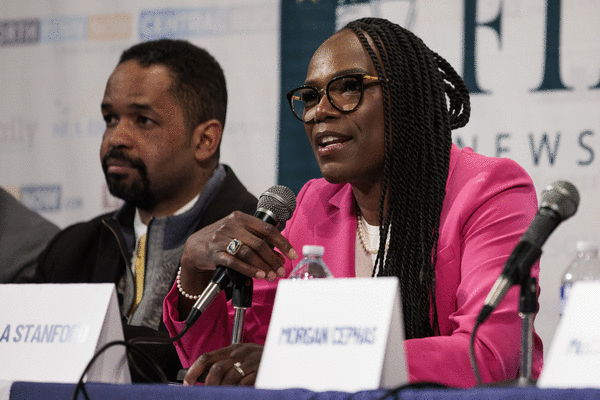
Rabb and his supporters have at times attacked his opponent Ala Stanford, a physician and a first-time political candidate, who they have said is being supported by the American Israel Public Affairs Committee.
However, AIPAC, the pro-Israel organization, has not directly donated to Stanford, and a Washington-based group called 314 Action Fund that has poured money into supporting her bid says it has not taken “a dime” from AIPAC or its affiliates this election cycle.
Two years ago, 314 received money from an AIPAC-aligned political group. And on Wednesday, Stanford touted an endorsement from a group called Elect Democratic Women, which similarly accepted a $100,000 donation from an AIPAC-funded super PAC in 2024, according to federal campaign finance records.
Stanford has refused to call Israel’s military operation and bombing campaign in Gaza a “genocide.” A video that recently went viral on social media showed Stanford speaking during a candidates forum and being drowned out by hecklers calling on her to use the word.
The third front-runner is State Sen. Sharif Street, who would be Pennsylvania’s first Muslim member of Congress. He has been critical of Israeli Prime Minister Benjamin Netanyahu, but has relatively moderate views on the nation and defends its right to exist as a Jewish state.
He, too, does not refer to Israel’s actions in Gaza as a “genocide.”
The debate is illustrative of a broader rift within the Democratic Party: Centrists say Israel remains a critical ally in the Middle East, while progressives say their voters want candidates who will challenge the United States’ relationship with Israel.
And it comes amid the unpopular U.S.-Israel joint war against Iran, which was spurred by Trump and Netanyahu and, the longer it stretches on, could drive inflation ahead of the midterm elections.
While much of their disagreement has been rhetorical, the candidates’ positions can be a way for voters to differentiate them in a race where they otherwise largely agree on issues, said Chris Borick, a pollster and director of the Muhlenberg College Institute of Public Opinion.
For example, all three candidates running for the Philadelphia congressional seat say they favor a Medicare for All-style healthcare program, and they each believe that U.S. Immigration and Customs Enforcement should be abolished.
“In a primary election where you have incredible alignment on many of the other topics,” Borick said, “it opens the door for even moderate differences on an issue to catapult that issue forward in terms of the campaign.”
An anti-Zionist streamer comes to town
As the race enters its final weeks, Rabb has doubled down on his strident views on Israel.
“We have to acknowledge our complicity in an ongoing genocide in Gaza,” Rabb said during the debate Wednesday. “It’s our taxpayer dollars that are sending bombs.”
He will hold multiple campaign events Thursday with Piker, a commentator who reaches millions of viewers worldwide every day on the live streaming service Twitch.
Piker has recently been at the center of a broader debate among Democrats about whether they should embrace leftist influencers as they try to regain power. He has made a series of inflammatory statements critical of Israel and of U.S. foreign policy, including saying in 2019 that America “deserved” the Sept. 11 attacks, a comment he later said was poorly worded.
In 2024, Piker said that it “doesn’t matter” if victims were raped on Oct. 7, 2023, saying “that doesn’t change the dynamic for me.”
That comment and others are not sitting well with some constituents in the district — which spans about half of Philadelphia — who say Rabb’s appearance with Piker is disqualifying.
“I don’t know a woman in Philadelphia who would speak so callously about rape or align with someone who speaks this way,” said Eryn Santamoor, a Democratic committee member who lives in the district and is supporting Stanford.
And Mark Segal, a prominent LGBTQ+ activist who is Jewish, said Piker’s sympathy for Hamas is akin to homophobia — LGBTQ+ people in the Palestinian territories can face persecution at the hands of the insurgent organization.
“I personally believe in a Palestinian state,” said Segal, who is supporting Street. “People have to realize there’s a difference between a Palestinian state and Hamas.”
Rabb said Wednesday that there’s “a double standard for Black folk with my politics.”
He noted that white Democrats who are considered more mainstream have appeared on programs with hosts who have said things he finds offensive, such as on Fox News. Other liberals, he said, have gone on the HBO political talk show hosted by comedian Bill Maher, who has made a series of controversial remarks.
“What is the purity test, and who sets it?” Rabb asked. “Where do we draw the line? And if we’re going to have a line, it should be level.”
While Rabb may draw condemnation from some, his appearances with Piker could further endear him to the left. Some of the nation’s most prominent progressives have appeared on the stream, including Democratic U.S. Rep. Alexandria Ocasio-Cortez of New York, who has endorsed Rabb.
Piker also recently campaigned in Michigan with Abdul El-Sayed, a progressive Democratic U.S. Senate candidate.
Borick said Rabb’s strategy to lead with the Israel issue may be aimed at motivating younger voters to turn out for him. Within the Democratic electorate, Borick said, young voters are far more likely than their older counterparts to express support for Palestinians.
However, Borick said, younger voters are less likely to turn out to the polls when there is no presidential contest on the ballot.
“If you’re banking on that constituency showing up and you think the Palestinian-Israeli conflict is the one to do that, you are clearly rolling the dice,” Borick said. “But I also think that if there’s been any cycle where that might actually end up being fairly productive, it’s probably now because of the expressed preferences that younger voters have on this topic.”
AIPAC looms over the race
For months, AIPAC and its rumored involvement has loomed over the race, though the group has not endorsed a candidate.
Stanford has steadfastly denied taking money from the organization as she runs for Congress. So has 314 Action Fund, the super PAC that has poured more than $2 million into an advertising campaign supporting her bid.
The group is dedicated to electing pro-science candidates, and it has worked to recruit doctors and scientists to run for public office.
Joshua Morrow, the executive director of 314 Action Fund, said it has “not taken a dime from AIPAC or its affiliated entities this cycle.”
“This is another lie in a long list of lies that Chris Rabb has told on the campaign trail,” Morrow said.
Still, Stanford’s opponents have branded her the AIPAC-supported candidate. In 2024, during a different election cycle, 314 Action Fund accepted a $1 million donation from United Democracy Project (UDP), an AIPAC-aligned super PAC, according to federal campaign finance records.
Rabb and his campaign also point to more recent donations 314 has received from nonprofits that are not required to disclose their donors under federal law.
Street, who earlier in the campaign defended Stanford against attacks linking her to AIPAC, said during Wednesday’s debate that he “was wrong” for having done so.
Meanwhile, Rabb has won support from groups that exist largely to be a counterweight to AIPAC. He was endorsed by the Peace, Accountability, and Leadership PAC — or PAL PAC — a new super PAC that backs pro-Palestinian political candidates.
“There’s been a real lack of leadership within the Democratic Party, and that is the most clear on Palestine,” said Amira Hassan, the group’s political director. “If you’re willing to say the truth about what is going on in Palestine, you are somebody who is going to stand up for community as well.”
_____
©2026 The Philadelphia Inquirer. Visit inquirer.com. Distributed by Tribune Content Agency, LLC.




















































Comments