Ban on kids' companion chatbots advanced by Senate committee
Published in Political News
WASHINGTON — Artificial intelligence chatbot providers would need to verify users’ ages and ban minors from using AI companion chatbots under a bill that advanced unanimously in a Senate committee Thursday.
The Judiciary Committee voted 22-0 to approve the bill, which would make it a crime to knowingly provide a chatbot that might encourage minors into sexually explicit behavior or suicide.
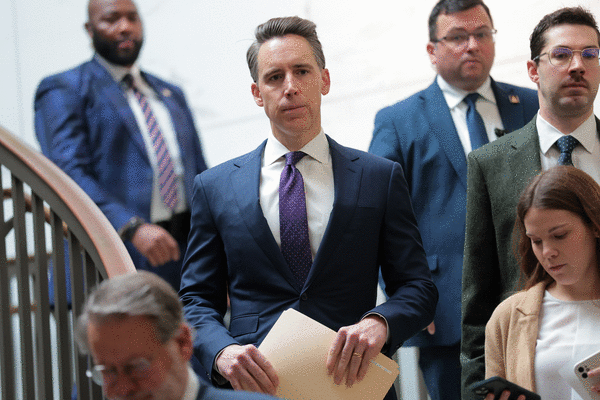
Sen. Josh Hawley, R-Mo., sponsored the bill, dubbed the “Guidelines for User Age-verification and Responsible Dialogue,” or GUARD Act. The legislation has 18 co-sponsors across both parties, including the committee’s ranking member, Sen. Richard J. Durbin, D-Ill.
Hawley called the bill a “targeted, tailored effort” to protect kids using chatbots and said senators could help choose what the future of AI use would look like.
“We’re often told that this new dawning age of artificial intelligence is going to be a great age that will strengthen families and workers. I would just say that’s a choice, not an inevitability,” Hawley said.
The bill is part of a larger push by members in both chambers to protect kids on the internet.
Earlier this week, Senate Commerce Chair Ted Cruz, R-Texas, introduced his own chatbot bill, which would require providers of AI chatbots to create family accounts for users under 13, which would be optional for teen users. Those accounts would allow parents to control a child’s privacy settings and time spent talking to the bot and to read a log of conversations.
Sen. Alex Padilla, D-Calif., voted to approve Hawley’s bill but said he still had “questions and concerns” about effects on data privacy and security.
“I ... welcome the opportunity to continue to fine-tune that section of this very, very important bill,” Padilla said.
The bill would require chatbot providers to verify ages using government-issued identification or “any other commercially reasonable method.”
The bill would also require that platforms limit their data collection to only what is minimally necessary and protect the data from unauthorized access, including by using industry-standard encryption protocols.
Cruz’s bill, by contrast, would not require age verification, but would instead require platforms to put family accounts in place for users they otherwise know are minors.
The Hawley bill would impose a penalty of $100,000 for offering a chatbot that encourages minors to engage in sexually explicit behavior or physical violence.
It would also require chatbots to disclose that they are nonhuman at the beginning of each conversation and every 30 minutes during the chat.
It would prohibit chatbots from claiming to be licensed professionals, including therapists, physicians, lawyers or financial advisers. At the beginning of each conversation and at regular intervals, chatbots would be required to state they don’t provide medical, legal, financial or psychological services and that users should consult a licensed professional.
The chatbot bill comes after the Judiciary Committee’s panel on crime and counterterrorism in September held a hearing on the “harm of AI chatbots.” At that hearing, members heard from parents who said chatbots drove their children to self-harm or suicide. Some of those parents attended the markup Thursday.
Both bills are opposed by the technology industry.
Ahead of Thursday’s markup, Amy Bos, vice president of government affairs for industry group NetChoice, in a statement called the bill an “overinclusive, blunt mechanism.”
“NetChoice implores the Senate Judiciary Committee to safeguard Americans’ most secure documents and reject the GUARD Act,” Bos said. “If implemented, such a broad and vague provision would force AI companies to collect and store highly sensitive personal data into honeypots ripe for cybercriminals to exploit through breaches, identity theft and fraud.”
Age-verification laws have also drawn objection on First Amendment grounds; critics say they limit all users’ access to speech.
NetChoice has sued to stop age-verification laws in states around the country based on limits to free speech and has been successful in some cases, at least temporarily.
Sen. Richard Blumenthal, D-Conn., a co-sponsor of the legislation, emphasized that the committee vote is not the end of the road for the legislation, which he anticipates will draw continued opposition.
“They will be relentless and tireless,” Blumenthal said. “Whatever they say publicly, they will be behind the scenes with armies of lawyers and lobbyists trying to fight us, back us down, convince colleagues, mislead and confuse.”
Sens. Amy Klobuchar, D-Minn., Cory Booker, D-N.J., and Sheldon Whitehouse, D-R.I., all mentioned during debate over the bill their support for repealing liability protections for third-party content online in the 1996 communications law.
They said that while the committee is acting to protect kids using AI, it should also protect kids using other online platforms, including by repealing the law’s Section 230 liability shield.
_____
©2026 CQ-Roll Call, Inc. Visit at rollcall.com. Distributed by Tribune Content Agency, LLC.





















































Comments