Family accounts would be mandated for kids in chatbots bill
Published in Political News
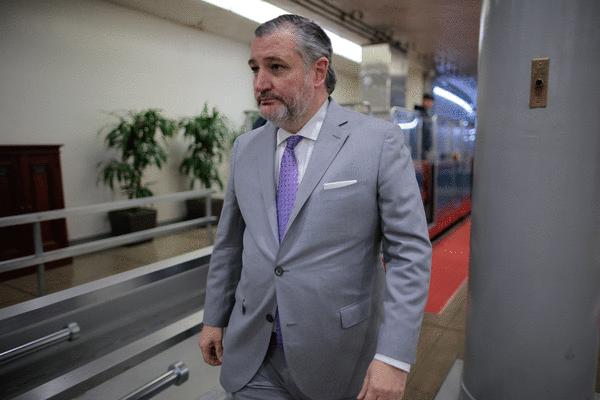
WASHINGTON — A bipartisan Senate bill unveiled Tuesday would govern kids and teens’ use of artificial intelligence chatbots by leaning on parental controls and would prohibit chatbots from using minors’ data for targeted advertising.
The bill comes ahead of a Senate Judiciary Committee markup this week of a separate bill meant to address chatbots’ harms to young users and as members on both sides of the aisle and the Capitol grapple with how to best protect kids online without infringing on freedom of speech.
The bill’s unveiling also comes amid rising concern about AI ahead of the midterm elections and after recent testimony on Capitol Hill from parents of children who died by suicide after online interactions, including with AI chatbots.
Senate Commerce Chair Ted Cruz, R-Texas, sponsored the new legislation with Sens. Brian Schatz, D-Hawaii, John Curtis, R-Utah, and Adam B. Schiff, D-Calif., joining as co-sponsors.
The as-yet unnumbered measure, dubbed the “Children’s Health, Advancement, Trust, Boundaries, and Oversight in Technology” or CHATBOT Act, would require providers of AI chatbots to allow parents to create “family accounts” for young users, according to a summary. The accounts would be required for children under 13 and optional for teens, though parents would still need to consent to teens’ creation of a chatbot account.
In a statement, Cruz said the bill “ensures America leads in deploying AI safely and responsibly.”
“The rapid development of sophisticated chatbots has left many parents in the dark as powerful AI systems enter children’s lives,” Cruz said. “Congress has an opportunity to put parents back in control. With the right safeguards, AI systems can benefit a child’s education without putting their well-being at risk.”
Family accounts would provide parents a range of controls, including:
•allow them to set their child’s privacy settings.
•limit the amount of time the child spends talking to the chatbot.
•disable features like push notifications or rewards that can increase time spent.
•make the chatbot display a label to say it is not human.
•Parents would also be able to read a full record of their kid’s conversations with the chatbot. If a teen user’s parent decided not to use a family account, the controls would be set to their most protective level.
The bill represents a different approach to regulating children’s use of chatbots than the measure up for consideration in the Senate Judiciary Committee on Thursday.
Sen. Josh Hawley, R-Mo., sponsored that bill with support from a bipartisan group of five other senators. The legislation would require chatbot providers to verify users’ ages and prohibit a chatbot from encouraging sexually explicit conduct or suicide. It would also ban AI companion chatbots for kids and require chatbots to regularly state they are not human.
Multiple proposals
Congress is considering other bills that would use variations on age verification or parental controls in an attempt to protect young people online.
In March, the House Energy and Commerce Committee combined several measures to create a bill that would set new requirements for parental controls on social media and require certain online platforms to put policies in place to address harms to kids online.
At the same markup, the committee also forwarded a bill to require app stores to verify users’ ages.
Critics say both strategies have faults, including on privacy and free speech grounds and on protecting children in abusive households.
Amy Bos, vice president of government affairs for technology industry group NetChoice, said in a statement that the Cruz chatbot bill “runs into protected rights” under the First Amendment.
“We appreciate the Committee’s goal, but the CHATBOT Act takes the same unlawful identity mandate framework NetChoice has successfully challenged in court across the country — including ID gates, requirements to hand over documentation proving parent-child relationships, and state-supervised access to lawful speech — and ports those onto AI tools,” Bos said.
NetChoice, whose members include OpenAI, Google and Meta, has brought lawsuits around the country to stop state age-verification laws. Many of the suits have been successful in pausing the laws, at least temporarily.
The American Civil Liberties Union has also opposed age-verification bills for what they say is requiring a decrease in speech access in return for safety.
Privacy advocates have also voiced concerns about age-verification measures and whether platforms attempting to verify users’ ages would store copies of driver’s licenses or of facial scans.
Age verification has been fully tested before the Supreme Court only as it applies to accessing sexual content online. The court last year upheld a Texas law that required age verification to visit pornography websites.
The Cruz bill specifies that it doesn’t require chatbot providers to verify users’ ages or collect personal data about a user’s age that wouldn’t already be collected. It instead would apply its rules to users that a chatbot provider knows are children or teens through actual knowledge or knowledge implied by circumstances.
Hawley’s bill would require chatbot providers to verify age using government-issued ID or “commercially reasonable” methods. It also contains requirements for data security.
Some have also raised concerns that requiring greater parental controls could cause harm to children or teens in abusive households.
During debate over the House kids’ safety package, Energy and Commerce ranking member Rep. Frank Pallone Jr., D-N.J., argued that giving parents control over a child’s messaging, as one section of that bill would do, goes too far.
“These bills also threaten kids in unsupportive or even abusive households, where there can be real world harms from allowing parents complete access and control over their teens’ online existence,” he said.
Cruz’s bill would prohibit chatbot providers from using minors’ personal data to provide targeted advertising. It would give enforcement powers to the Federal Trade Commission and state attorneys general, and does not include a private right of action for individual users or their families.
It would also require the National Science Foundation to study chatbots’ effects on human relationships and children and teens’ social needs.
In announcing the bill’s introduction, the senators said it has support from 18 groups, including the conservative America First Policy Institute and the AI safety and governance group Americans for Responsible Innovation.
The legislation comes as views on AI are at least cautious, if not negative.
A Quinnipiac University poll conducted last month found that 80% of respondents are either very concerned or somewhat concerned about AI.
©2026 CQ-Roll Call, Inc., All Rights Reserved. Visit cqrollcall.com. Distributed by Tribune Content Agency, LLC.





















































Comments