Supreme Court to hear oral arguments over deportation protections
Published in Political News
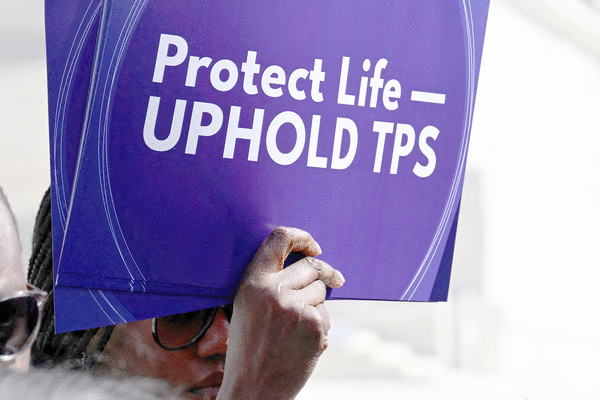
WASHINGTON — The future of the legal status for hundreds of thousands of immigrants in the U.S. will face a test at Supreme Court oral arguments Wednesday, as the Trump administration seeks to unilaterally strip deportation protections from migrants in the face of some congressional opposition.
The cases set for arguments Wednesday will determine the future of the legal status known as temporary protected status, or TPS, for more than 350,000 Haitians and 6,000 Syrians who sought refuge amid turmoil in their home countries.
Since starting his second term, Trump has sought to revoke TPS from immigrants from more than a dozen countries, which have been challenged in the courts. The Supreme Court, in emergency orders in two prior challenges, already has allowed the administration to strip the protections for Venezuelans.
In both cases set for arguments Wednesday, lower courts found the administration did not follow the process laid out by the law for Haiti and Syria, and, in the case of Haitians granted TPS, were driven by racial animus.
The administration has asked the Supreme Court to overturn those decisions, which postponed indefinitely then-Homeland Security Secretary Kristi Noem’s decision to revoke TPS for the two countries.
The administration has argued that it is in the “national interest” of the United States to cancel the legal status of immigrants, even at times while acknowledging the dangers that still exist in their home countries. The administration has argued in court that judges cannot second-guess those judgments.
The challengers in both cases argued the administration revoked their protections for pretextual opposition to immigration, not because it has gotten safer in their home countries.
“Rather than a good-faith result of the congressionally mandated review process, the termination of Haiti’s TPS designation was a preordained outcome driven by racially animated discriminatory intent,” the Haitian TPS holders’ brief said.
The justices are expected to issue a decision in the case before the close of the court’s term at the end of June, and experts said the decisions could impact the status of more than 1 million TPS recipients.
Thomas Berry, director of the Robert A. Levy Center for Constitutional Studies at the Cato Institute, said the cases will serve as a test for the justices. The law says the secretary is meant make TPS decisions based on the conditions in the immigrants’ home country, not domestic policy concerns, Berry said.
“They’re supposed to be about the facts on the ground in those countries from which the immigrants came, not policy choices about the correct number of immigrants in the United States,” Berry said.
The justices will have to see how willing they are to look behind the curtain at the administration’s motives, Berry said.
“Courts are hesitant, in my view often too hesitant, to recognize or call out when the executive branch is acting in bad faith,” Berry said.
Hiroshi Motomura, a law professor at UCLA and co-director of the Center for Immigration Law and Policy, said that although the law at issue does explicitly bar the courts from second-guessing the administration’s assessment of ongoing danger in a TPS recipient’s home country, it also laid out guardrails for when that can be revoked.
“I mean, there’s a process for getting a driver’s license. But once you get it, they can’t take it away without at least some kind of notice, and without some sense that they’re actually taking away something of value from you,” Motomura said.
Motomura said that even if the administration were to reissue the revocations after losing the Supreme Court case with new reasoning, the courts could still examine whether officials did enough to satisfy the law. The other co-director of the center, Ahilan T. Arulanantham, is set to argue for the TPS recipients from Syria.
Congress originally created the TPS program in 1990, and the law allows the secretary of the Department of Homeland Security to designate countries where it is too dangerous for immigrants to return home, according to court documents.
The Biden administration had provided protections for immigrants from more than a dozen countries. For every status that has come up for renewal so far, the Trump administration sought to end it.
In Supreme Court filings, the administration argued that Congress never meant for the courts to second guess the thoroughness of the administration’s review of the conditions in TPS recipients’ home countries.
“Any contrary approach would reduce Congress’s robust judicial-review bar to a minor speedbump while installing district courts as the ultimate foreign-policy superintendents of temporary status,” the brief said.
In addition, the administration said that any claims of racial animus should be disregarded because the justices decided in Trump’s first term to give broad latitude to a president on foreign policy issues.
The challengers, in their filings, cited numerous statements by Trump, including when he claimed that Haitian immigrants ate cats and dogs during his presidential campaign, to shore up their claims of discrimination.
The Haitian challengers’ filing noted that the State Department considers Haiti so dangerous it asks Americans who travel there to provide DNA samples to help identify their bodies but now considers it safe enough for TPS holders to return.
The TPS recipients also argued that the administration should have to do more than it did to justify taking away the legal status of TPS recipients in the country — consultation in the Haiti case involved just one three sentence email to a State Department staffer.
Congressional action
Congress earlier this month acted on the issue. A bipartisan House majority passed a bill that would automatically extend TPS for Haitians for 18 months dated back to last August.
Democrats led a discharge petition, a rare procedural move, to force the vote on the measure over the objections of House leadership and the bill ultimately passed on a bipartisan 224-204 vote. The measure has some GOP opposition in the Senate.
A group of 190 Democrats in Congress cited bipartisan support for TPS in their own brief at the court, arguing that Congress passed the law to keep the president from making ad hoc decisions about immigrants from unstable countries.
“Congress expressly enacted TPS to address prior concerns about the lack of criteria guiding the Executive Branch and the lack of transparency in the then-existing ad hoc process,” the brief said.
Republicans in Congress have backed the Trump administration, and Sen. Ted Cruz, R-Texas., said the courts should not second guess presidential decisions touching on foreign policy in his own brief to the court.
“The district court decisions below bypassed plain statutory limits on judicial review to second-guess decisions about foreign countries that the U.S. Constitution reserves to the political branches,” Cruz wrote in the brief.
The cases are Markwayne Mullin, Secretary of the Department of Homeland Security et al. v. Dahlia Doe et al., and Markwayne Mullin, Secretary of the Department of Homeland Security et al. v. Fritz Emannuel Lesley Miot et al.
©2026 CQ-Roll Call, Inc., All Rights Reserved. Visit cqrollcall.com. Distributed by Tribune Content Agency, LLC.


















































Comments