Commentary: Carlson's cautious apology does little to repair Trumpism's damage
Published in Political News
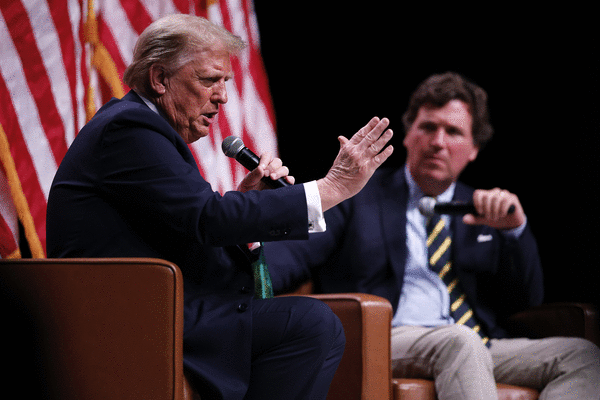
When you break a promise as clear as “No new wars,” you shouldn’t be surprised when even your most loyal supporters revolt. And that’s exactly what is happening to President Donald Trump.
One such disillusioned supporter is Tucker Carlson — who on a recent podcast with his brother Buckley admitted, in essence, “My bad.”
“You wrote speeches for him. I campaigned for him. I mean, we’re implicated in this, for sure,” Tucker Carlson said during the conversation.
“In real ways, you and me, and millions of people like us, are the reason this is happening right now,” Calson confessed, referring to the Iran war. “We’ll be tormented by it for a long time. I will be, and I want to say I’m sorry for misleading people, and it was not intentional.”
Having worked for Carlson for six years at the Daily Caller, I’ve always found him intelligent and funny and generous, even as I have profoundly differed with him on a variety of issues throughout the Trump era.
It did my heart good to hear him accept some responsibility for what Trump has wrought.
A lot of people were complicit in boosting Trump, and some of them have even subsequently criticized him for various sins (failing to release the Epstein files, going to war with Iran, etc.). But this is the first time I can recall anyone of this stature explicitly apologizing for helping elect Trump. And that warrants a certain amount of respect.
Still, let’s be clear-eyed about what Carlson is — and isn’t — saying here. Specifically, it’s worth noting that the apology doesn’t extend to validating those of us who opposed Trump from the beginning.
In fact, it almost can’t.
Doing that would require the confessor to reinterpret not just Trump’s presidency, but also the entire ecosystem that made supporting Trump a viable option in the first place.
It would mean admitting that the framework he used to evaluate Trump was flawed, not just the outcome.
That would end up being perceived as an indictment on the broader Republican electorate — and on Carlson’s worldview and judgment — not just on Trump’s recent performance or (even more conveniently) the notion that Trump has changed or was co-opted by Israel (or whomever) since 2024.
It’s a much bigger ask than saying, “I regret this specific result.”
Specifically, Carlson is not conceding that the “Never Trump” crowd got it right — which is what those of us who have spent a decade opposing Trump (with little fanfare) have been dying to hear for a decade (even more so than “I’m sorry.”)
This is an important distinction, partly because it means that, although Carlson is now a convenient ally in the “resistance,” he is not opposing Trump for the same reasons that most Democrats or Never Trump conservatives oppose Trump.
If you put aside Trump’s decision to go to war with Iran, the Carlsons’ second-biggest criticism of Trump (based on their two-hour-long podcast) is his failure to more vigorously defend the Jan. 6 Capitol rioters.
That’s right. It’s not that he sicced immigration enforcers on immigrants and that they subsequently killed two American citizens. It’s not that DOGE fired lots of good people. It’s not that this president tried to use the Department of Justice to seek vengeance on his political rivals. It’s that Trump — the person who pardoned these people — wasn’t aggressive enough in defending the criminals who stormed the U.S. Capitol while trying to overturn the 2020 election results.
And while there’s no reason to doubt Carlson’s remarks are sincere (he has been a vocal opponent of war with Iran) and meaningful (he’s an influential figure), his comments may also signal something else: a recognition that opportunity awaits.
Consider this: Trump’s political standing is in deep trouble (Trump’s approval rating is down to 33%, according to a new AP-NORC poll).
What is more, Trump’s fading fortunes aren’t just isolated to Trump. As always, there is collateral damage: JD Vance.
Once seen as Trump’s obvious heir, Vance now finds himself in a difficult position, defending the war in Iran and attacking the pope, while simultaneously releasing a book about his Catholic conversion.
In that sense, Carlson’s apology could be less a grudging epiphany than a strategic recalibration. It acknowledges that Trump has gone off the rails but stops short of examining why it was destined to go wrong in the first place.
Carlson gets close to the answer when he tells his brother, “there were signs of low character. We knew that,” but then dismisses it by saying “there are tons of people of low character who outperform their character.”
Without deeper reflection, this apology risks becoming just another pivot — one that has as much to do with positioning as it does with repentance.
And that would be a shame.
It’s easy to regret an outcome. It’s much harder to interrogate the instincts that led you (and tens of millions of Americans) to enable it.
Apologies like Carlson’s won’t close the chapter on this long national nightmare.
_____
Matt K. Lewis is the author of “Filthy Rich Politicians” and “Too Dumb to Fail.”
_____
©2026 Los Angeles Times. Visit at latimes.com. Distributed by Tribune Content Agency, LLC.
















































Comments