Commentary: America's wildlife refuges may no longer protect the animals
Published in Op Eds
The early 1900s were a very bad time to be a bird. On average, more than 5 million were killed every year — not for sustenance, but to feed perhaps the most frivolous of trades: plume-topped hats.
Ostentatious headwear made of egrets and other animals — some of which featured an entire taxidermied body— was so popular at the start of the 20th century that hunters swiftly wiped out 95% of Florida’s shore birds. As the feather supply dwindled, poachers started pillaging the rookeries of Pelican Island, north of the Everglades watershed, where one recalled seeing the heads and necks of young birds “hanging out of the nests by the hundreds.”
President Theodore Roosevelt was so alarmed by the wanton decimation of Florida’s wildlife that in 1903 he supposedly asked his staff,“Is there any law that will prevent me from declaring Pelican Island a federal bird reservation?” When Roosevelt was told there was not, since the island sat on federal property, he replied, “Very well, then I so declare it.” One executive order later, America’s first wildlife refuge was born.
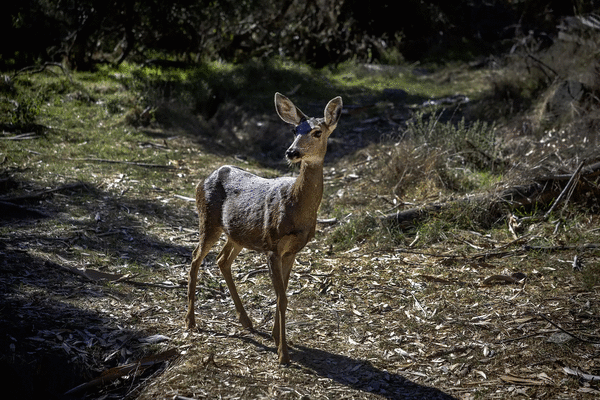
Fast-forward to today and America’s wildlife refuge system has expanded to a remarkable 570 sites, spanning more than 95 million acres across all 50 states — havens of last resort for the millions of other species with which we share this planet.
But in late May, the Department of the Interior announced what it hailed as the largest proposed hunting expansion in agency history, which is currently under public-comment review. If this expansion is implemented, it would designate more than 95% of wildlife refuge lands available for hunting — many for the first time — and profanely invert the very idea of a “refuge” by transforming sanctuaries into arenas for blood sport.
In its press release, the Department of the Interior declared that “more than 14 million” Americans hunt and thus stand to benefit from this policy change, based on the latest National Survey of Fishing, Hunting and Wildlife-Associated Recreation.
But do the math: That’s barely 4% of the U.S. population — a special interest category so puny that it’s dwarfed by the number of Americans who hike ( 63 million ), boat ( 47 million ) and birdwatch ( 43 million, not including home sightings). Apparently, Americans prefer to shoot geese with a camera rather than a rifle.
Put another way, fully 96% of Americans choose not to maim wild animals for their own amusement. The interests of that near-unanimous majority deserve representation too.
Tragically, many of the organizations you’d expect to rally to the animals’ defense are nowhere to be found. The National Audubon Society, World Wildlife Fund and National Wildlife Federation have all been deafeningly silent — or worse, offered quiet support for the expansion— as the Trump administration’s desecration of wildlands leaves lasting stains on American soil.
You don’t need to be a political scientist to predict where such timidity leads. This month, the administration also moved to open the habitats of endangered wildlife nationwide to farming, drilling, mining and real estate development. And as environmental groups stand idly by, even America’s National Parks, the crown jewels of the great outdoors, are being clawed open for hunting and trapping.
Some hunters assert that, in fact, they are the true conservationists. Hunting fees, the argument goes, provide a vital source of funding — a dubious claim nobody seems to question. But when researchers actually crunched the numbers, they found that an estimated 94% of total funding for wildlife conservation and management actually comes from the non-hunting public.
Voicing the opinion of the silent majority, Elaine Leslie, former head of the National Park Service’s biological resources department, recently told the Associated Press, “I don’t want to take my young grandchildren to a park unit only to have a hunter drag a gutted elk they shot across a visitor center parking lot.”
Indeed, the aspiration to mount a Gaston-esque rack of antlers over the fireplace fuels wildlife population imbalances by driving hunters to shoot the biggest, strongest ungulates they can find — the exact animals natural selection would have favored.
Most Americans seem to intuitively understand that sport hunting isn’t a passive hobby — it’s preventable violence that disrupts migration and hibernation patterns and shatters animal families. Wolves, for instance, mate for life; when one is killed, the other loses a lifelong companion. No wonder the sound of a human voice has been shown to strike more fear into the hearts of wild animals than any nonhuman predator.
Humanity has already transformed 75% of the land on Earth, leaving less room with each passing year for what naturalist Henry Beston called the “other nations” of the animal world. With wildlife populations already in freefall, the least we can do is not unilaterally declare war on those who remain.
____
Ryan Huling is the author of “The Hidden Nations of Animals.”
©2026 Los Angeles Times. Visit at latimes.com. Distributed by Tribune Content Agency, LLC.
















































Comments