Commentary: Texas is right. Everyone should read 'Fahrenheit 451'
Published in Op Eds
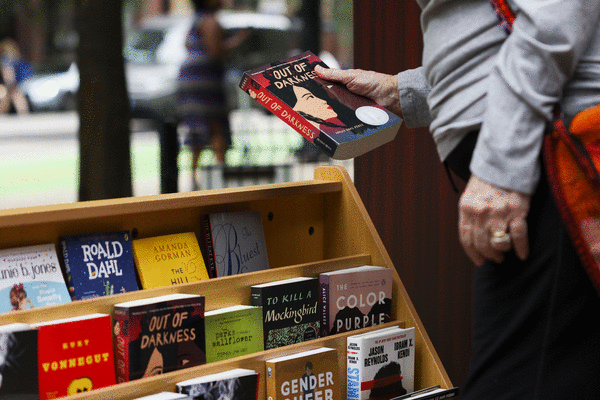
True story: The state that has led the nation in book bans is requiring all high school students to read the most famous literary attack on book banning. It’s stranger than fiction.
I’m talking about Texas, where state laws barring “indecent or profane content” and diversity, equity and inclusion programming have led to the purging of over 1,700 books from public schools. But Texas has also promulgated a list of texts that every student has to read, including Ray Bradbury’s “ Fahrenheit 451.”
Born in Waukegan, Illinois, in 1920, Bradbury published “Fahrenheit 451” at the height of the Cold War in 1953. His novel describes a dystopian world where all books are forbidden. Its protagonist, Guy Montag, is a “fireman” whose job is to burn them. Montag comes to recognize the power of reading to inform and enlighten human beings, but by that time it’s too late: Bombers annihilate his city with nuclear weapons in a war that nobody understands.
I’m delighted that every 11th-grader in Texas will be required to read “Fahrenheit 451.” And unlike many of my fellow liberals, I’m a cautious supporter of Texas’ new list of mandated books. Imposed by a Republican-led state board of education, the list has drawn attacks from critics who object to its inclusion of biblical passages.
I share those concerns. If the Bible is taught as God-ordained fact, that will surely violate the First Amendment’s ban on the establishment of religion. But I also believe that skilled teachers can present it as an engine of history, not as a timeless truth. You simply cannot understand the development of the United States — or of the world — unless you understand the Old and New Testaments.
And that means addressing the many injustices committed in their names, of course. Texas 11th graders will also have to read Nathaniel Hawthorne’s “ The Scarlet Letter,” which indicts the sanctimony and hypocrisy of self-proclaimed Bible believers. So does the Rev. Martin Luther King Jr.’s speech “I’ve Been to the Mountaintop,”— soon to be mandatory reading for Texas 10th-graders — where students will encounter his plea to white Christians to behave in more Christ-like ways.
To be sure, we can all imagine teachers who might instruct these texts as gospels in their own right, without probing their present-day implications. And we can also imagine school leaders who might block such discussions, out of fear that students might actually think for themselves.
That was the theme of Kurt Vonnegut Jr.‘s remarkable 1973 letter to a North Dakota school board, which is — amazingly — another required text on Texas’ new reading list. The board had ordered a janitor to burn all copies of Vonnegut’s novel “Slaughterhouse Five” at a district school, on the grounds that it used a curse word.
“Books are sacred to free men for very good reasons,” Vonnegut wrote. “If you are an American, you must allow all ideas to circulate freely in your community.”
True, Vonnegut allowed, some of his characters “speak coarsely.” But that’s how people talk “in real life,” he added, and “those words really don’t damage children much.” The real culprits, he argued, were “evil deeds and lying.”
Vonnegut sent his letter privately but urged the school board to publicize it. “Do you have the courage and ordinary decency to show this letter to the people,” he asked, “or will it, too, be consigned to the fires of your furnace?”
Texas has shown admirable courage by requiring readings by Vonnegut and Bradbury. And I’m happy that students in grades seven through 12 will have to read two books a year, from cover to cover, at a time when many schools assign snippets of texts instead of entire books.
But the real test of the state’s backbone is whether it will allow students to examine the book banning that’s happening all around them. I hope that every class reading “Fahrenheit 451” also watches the 2025 documentary film “ The Librarians,” which shows Texas librarians standing up to censors — and, even, to death threats — to keep controversial books on their shelves.
The film begins and ends with quotes from, yes, “Fahrenheit 451.” As recently as 2006, Texas parents challenged Bradbury’s book because of its vulgar language and its denigration of firefighters (really). Now it’s required reading for every student in the state. If that isn’t progress, I don’t know what is.
The new Texas book list isn’t perfect, by any means. Before it takes effect in 2030, I hope it adds more nonwhite authors — such as Ralph Ellison and Toni Morrison — and also texts from other religions, including Islam and Hinduism.
But it’s a good start. Book banning is a scourge across the country, not just in Texas. In my home state of Pennsylvania, for example, school districts banned nearly 300 books between 2023 and 2025. If all of our future citizens had to read “Fahrenheit 451,” they might also be inspired to challenge censorship.
Books are sacred, for very good reasons. It’s time we all learned that lesson, no matter where we live.
____
Jonathan Zimmerman teaches history and education at the University of Pennsylvania and serves on the advisory board of the Albert Lepage Center for History in the Public Interest.
___
©2026 Chicago Tribune. Visit at chicagotribune.com. Distributed by Tribune Content Agency, LLC.



















































Comments