Lynn Schmidt: Why the socialist sugar high ultimately crashes for Democrats
Published in Op Eds
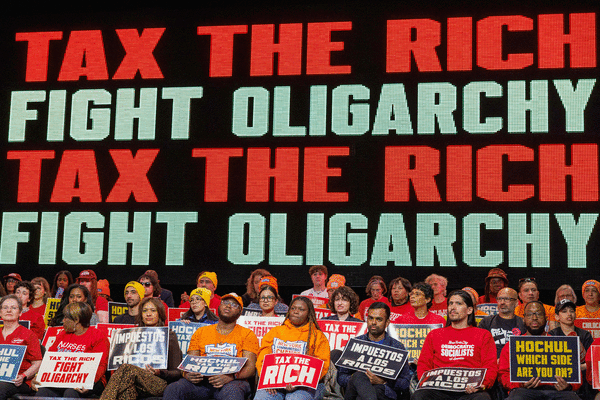
Democratic socialism has been winning in Democratic primaries lately, but it will ultimately lose — because it fails politically and economically.
Several Democratic socialist candidates this year have knocked off sitting Democratic incumbents and won primaries by wide margins in cities across the country, running under the label rather than adjacent to it.
Membership in the Democratic Socialists of America has grown from roughly 6,000 members a decade ago to more than 100,000 today, with wins or serious contention now appearing across the United States, mostly in blue cities.
The pitch is always the same, and it's often delivered as if no one has tried it before: Freeze the rent, cap the grocery bill, make college free. But the promise isn't new, and neither is what happens after.
It's a sugar high — and sugar highs crash.
St. Louis knows this rhythm better than most cities its size, because it ran the political experiment twice, and both times the same voters who cast the first vote came back to cast the second.
In 2020, Cori Bush beat 10-term incumbent U.S. Rep. Lacy Clay, D-Mo., by running to his left, becoming a founding face of the national Democratic Socialists of America (DSA) movement.
Once in office, Bush failed to deliver for her constituents, for example voting against a bipartisan infrastructure law that funded roads, bridges, and broadband in her own district.
In 2024, her own party's primary voters threw her out, handing the seat to Wesley Bell. Pro-Israel groups spent nearly $9 million helping make that happen, but the money bought an opening, not the outcome. An incumbent this vulnerable, in a seat this safe, should have been able to survive a single-issue attack. Bush couldn't.
Bush hasn't taken the hint. She's running this cycle again, seeking a rematch with Bell in the Aug. 4 primary, backed by the same DSA-aligned coalition that lost her the seat last time. She's betting St. Louis wants the sugar rush a second time around.
Former St. Louis Mayor Tishaura Jones, not DSA-branded like Bush but one of the most progressive mayors in St. Louis history, lost her re-election bid last year by 28 points, with a turning point traced largely to a single winter storm.
When ice and snow buried the city in January 2025, officials conceded the city had failed to grasp the gravity of the storm and had taken too long to abandon its policy of letting side streets melt on their own.
Jones would go on to lose to Cara Spencer — not a Republican, but a fellow Democrat running on the plain promise that the potholes would get filled and the streets would get plowed.
Bush and Jones failed for different reasons on the surface. One voted against her constituents' infrastructure, the other couldn't clear the streets. But beneath the surface, it's the same instinct: govern as if outcomes can be willed into being rather than funded, planned, or priced. That instinct isn't simply a political liability. It's an economic one.
Socialism's core economic failure is that it tries to override price signals — the information system that tells landlords where to invest, businesses where to hire, and workers where their labor is most valuable — with political mandates instead.
Price controls don't lower costs; they just hide them. Cap rent below what it costs to maintain a building, and landlords stop maintaining it, because the incentive to invest has been removed by policy. Mandate a service without funding it, and a city doesn't get the service for free — it gets the service by cutting something else.
But there's a distinction almost nobody in this debate is making, and it's the same one that trips up the economics above.
The capitalism most Americans are angry at right now isn't free-market capitalism, the kind that prices scarcity honestly. It's crony capitalism — a system where market outcomes are shaped less by competition than by who has a lobbyist, a committee seat, or a stock account that trades suspiciously well ahead of the votes that move it.
Socialism tries to override price signals with mandates; crony capitalism achieves the same distortion by other means, letting the well-connected rig the price signal rather than face it. Both end with the same voter standing in the same cold, wondering why the system stopped working for people like them.
Two parties, two bad answers to that same real problem.
Democrats want to override the fixed game with more government control. Republicans, too often, just want different friends running it. Neither offers voters what they're exhausted enough to reward: rules enforced evenly, on everyone, with no exceptions for size, connections, or campaign checks.
But Democrats have a clearer opening, if they'll take it. They don't need Republicans to fail; they need to stop indulging the DSA flank that keeps costing them their own coalitions.
The sugar high always crashes. Democrats can keep serving it, or they can be the ones who stop.
____
©2026 STLtoday.com. Distributed by Tribune Content Agency, LLC.



















































Comments