Andreas Kluth: Rubio the hypocrite is still better than Trump the nihilist
Published in Op Eds
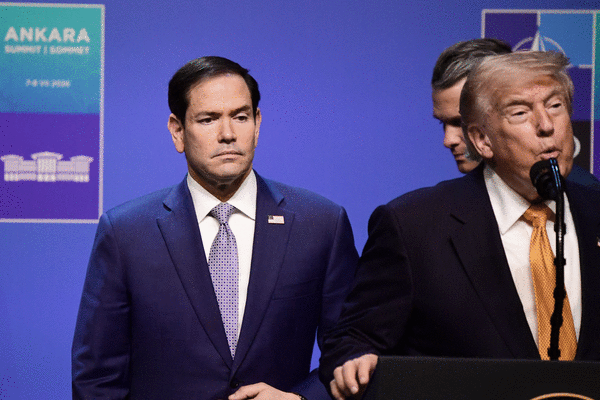
Behold the sheer hypocrisy of recent statements by Marco Rubio concerning two of the world’s most important waterways, the Strait of Hormuz and the South China Sea.
In his dual role as national security adviser and secretary of state, he told reporters asking about the fraught standoff in the strait that “No country is allowed to charge tolls or fees on an international waterway. That’s existing international law.”
Rubio was talking tough about resisting Iranian attempts to control the passage, of course. And he was right about the point of law.
What he omitted is that it was the United States under the leadership of his boss, President Donald Trump, that had brought about the current situation with its own serial breaches of international law. Those included attacking (alongside Israel) a sovereign nation, Iran, while negotiations about its nuclear program were still ongoing; and threatening to erase Iranian civilization by bombing civilian targets, which would amount to a war crime.
Rubio’s sanctimonious tone sounds especially dissonant alongside Trump’s cadence. “We are reinstating the THE IRANIAN BLOCKADE,” the president announced this week; “the U.S.A. will be, from this point forward, known as ‘THE GUARDIAN OF THE HORMUZ STRAIT,’ but as such, and as a matter of FAIRNESS, will be reimbursed, at the rate of 20% on all cargo shipped.” That sounds an awful lot like charging tolls or fees on an international waterway.
The same cognitive dissonance is on display in the South China Sea, an economic chokepoint that may be even more vital to the world economy than the Strait of Hormuz. Joining its traditional allies in Europe and Asia, Rubio’s State Department this week reaffirmed its “unwavering commitment to maintaining a free and open Indo-Pacific that is peaceful, stable, and rules-based, anchored in international law.”
The occasion was the 10th anniversary of a unanimous ruling by an international arbitral tribunal which ruled that China’s maritime claims on the region’s international seas and the territorial waters belonging to littoral states have “no legal basis.” Rubio’s affirmation was a message to China to stop harassing and bullying U.S. allies such as the Philippines. Right on.
And yet Rubio’s State Department yet again omitted some important context. The tribunal adjudicated according to the United Nations Convention on the Law of the Sea, often called a “constitution of the oceans,” which was adopted in 1982 and took effect in 1994. China is indeed a party to UNCLOS, which makes its truculence all the more reprehensible.
The United States, by contrast, is almost alone among its allies (alongside only Turkey and Israel) in staying outside the treaty, even though it had played a leading role in drafting its text. (1) Moreover, America has its own history of breaching or bending the spirit of UNCLOS, from mining the port waters of Nicaragua when the convention’s ink was barely dry to interdicting ships anywhere whenever it plays global cop.
In selectively invoking international law when and only when it suits the U.S., Rubio embodies a time-honored tradition of American foreign policy: hypocrisy. That might make sense for a once and probably future presidential candidate: He seems to be trying to buy political insurance for debates yet to come, by paying lip service to idealism (international law) while projecting realism (hard power) — in other words, by talking and acting the way “normal” American politicians used to.
The commander-in-chief, by contrast, is not a hypocrite. He has instead jettisoned all pretense, telling the New York Times that “I don’t need international law” because “my own morality, my own mind, it’s the only thing that can stop me.”
Trump said that in January, just after he had — illegally but successfully — abducted the head of state of Venezuela; months into an ongoing campaign of bombing civilian boats in the Caribbean that has so far killed more than 220 people (and which most American military lawyers consider blatantly illegal); and just weeks before he launched his war against Iran without any approval by the United Nations Security Council or Congress.
Which is worse: hypocritical lip service to international law, a la Rubio; or flagrant disregard of it, a la Trump? The latter is, because it’s catastrophic, argues Rosa Brooks, a professor at the Georgetown University Law Center. Nobody likes hypocrisy, but “by taking the trouble to lie, hypocrites may paradoxically reinforce the power of the norms they are violating,” she thinks. As the old adage has it, hypocrisy is the homage vice pays to virtue.
The United States has long been hypocritical in reciting (and often drafting) the rules and norms of the international system — everything from the United Nations Charter to the Geneva Conventions and the laws governing world trade — while sporadically flouting them. So was and is China, and almost every other great or even middling power.
But in recent years, some world leaders, notably Russia’s Vladimir Putin, have stopped paying even performative homage to law and instead embraced naked aggression, as despots did in the 1930s. And now the world’s most powerful leader, Trump, has done it too. Humanity may yet long for the bad but good old days of mere hypocrisy.
____
(1) The U.S. has a history of midwifing international conventions and then turning its back on them, from the interwar League of Nations to today’s International Criminal Court in The Hague.
____
This column reflects the personal views of the author and does not necessarily reflect the opinion of the editorial board or Bloomberg LP and its owners.
Andreas Kluth is a Bloomberg Opinion columnist covering U.S. diplomacy, national security and geopolitics. Previously, he was editor-in-chief of Handelsblatt Global and a writer for the Economist.
©2026 Bloomberg L.P. Visit bloomberg.com/opinion. Distributed by Tribune Content Agency, LLC.
















































Comments