Commentary: What happens after the cameras leave a Venezuela torn apart by earthquakes
Published in Op Eds
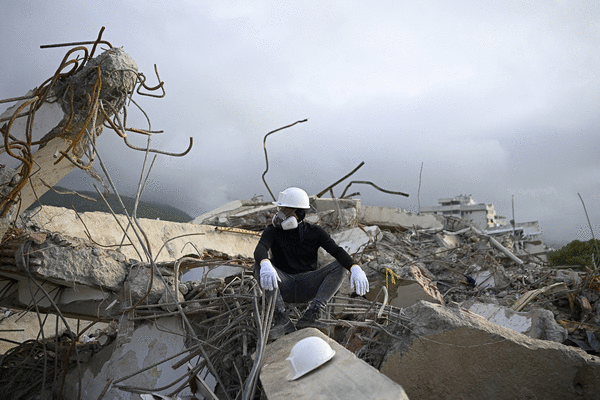
Some images stay with us long after they stop being news.
Mothers weeping for their children. Men of all ages clawing through concrete with their bare hands. Neighbors embracing strangers. People handing out water, carrying the wounded, offering a bed to someone who lost everything in a matter of seconds.
Earthquakes don’t just test a city’s resilience. They reveal the character of the people who live there.
On June 24, two earthquakes struck north-central Venezuela less than a minute apart. As of July 8, the official death toll stood at more than 3,800, with more than 16,700 injured and tens of thousands still unaccounted for, according to figures announced by Venezuelan authorities — numbers that forensic workers on the ground and United Nations officials warn may capture only a fraction of the true loss. The city of La Guaira has borne the brunt of the devastation, though the capital city of Caracas has also seen buildings damaged and evacuated by the hundreds and essential services knocked out.
But tragedies are rarely just about destruction. They’re about people.
In those first hours, when every minute meant the difference between life and death, it was ordinary citizens who started digging — many with their bare hands, as fuel shortages and a lack of heavy machinery stalled official rescue efforts, according to reporting. Neighbors set up collection points, handed out food, drove the wounded to hospitals and opened their homes to people with nowhere left to go. Amid that response, a phrase began to spread across social media: “Donde faltó gobierno, sobró pueblo.” That translates to: Where the government fell short, the people more than made up for it.
Images captured by AFP show hundreds of families sleeping in the streets of La Guaira, unable to return to buildings left cracked or on the verge of collapse.
The solidarity has crossed borders, too. According to the United Nations Office for the Coordination of Humanitarian Affairs, more than 40 international search and rescue teams — over 2,200 specialists and 140 search dogs — have deployed to Venezuela, while the United Nations activated emergency funding through its Central Emergency Response Fund. In the days that followed, new pledges of international assistance, including $150 million in aid from the United States and reconstruction support from China, expanded the humanitarian response.
Even as the odds of finding survivors shrank by the hour, people kept digging. Five days in, 21-year-old Aaron Levi Cantillo Vargas was pulled out alive after 106 hours under the rubble in Caraballeda, a rescue documented by The Guardian that restored hope just as it seemed to be running out.
For millions of Venezuelans, starting over is nothing new.
Over the past decade, more than 8 million Venezuelans have rebuilt their lives far from home, according to the Regional Interagency Coordination Platform for Refugees and Migrants from Venezuela. This time, the rebuilding will be different. It will mean rebuilding hospitals, schools, roads and homes. But it will also be emotional. Some families will never be the same, and entire communities will live for years with the memory of what happened.
And yet, amid the dust, something else has come into view.
A deeply human capacity has resurfaced, one that rarely makes headlines: the capacity to care for others even when you, too, have lost almost everything.
For a few days, Venezuela dominated our screens. We saw collapsed buildings, stories of improbable rescues and families waiting for word from loved ones still under the rubble. We shared photographs, followed every update and celebrated every life found.
But the news cycle moved on. Another story comes. Another crisis. Another place claims our attention.
And little by little, Venezuela slipped off the front pages — even though, for millions of people, the work of rebuilding is just getting started. Because reconstruction lasts longer than any news cycle.
It will take months to restore essential services. Years to rebuild schools, hospitals and homes. And, for many families, a lifetime to learn to live with an absence — or many.
Perhaps the hardest part of an earthquake isn’t when the ground stops shaking. Perhaps it comes after.
When the aid dwindles. When the cameras leave. When reconstruction stops being news and becomes the daily life of the people who remain.
Some images stay with us long after they stop being news.
The news ends. The grief does not. And the rebuilding has only just begun.
____
Cristina Guevara is a Latin America policy analyst and writer. She previously served as a policy and legislative adviser in Panama’s National Assembly.
___
©2026 Chicago Tribune. Visit at chicagotribune.com. Distributed by Tribune Content Agency, LLC.



















































Comments