Mark Gongloff: The US is getting a disaster salad with Dust Bowl dressing
Published in Op Eds
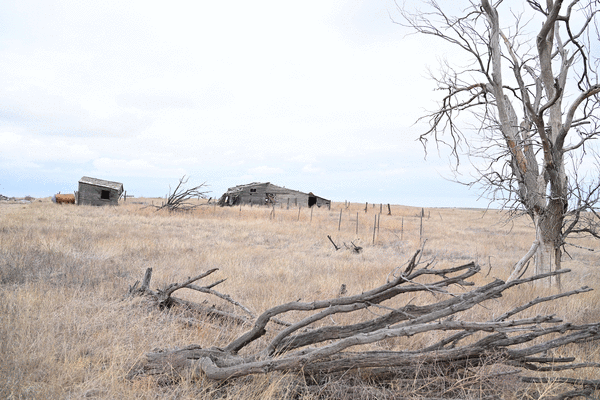
The Dust Bowl of the 1930s was a devastating but temporary confluence of human cluelessness and natural accident. It was also a demonstration of humanity’s ability to wreck an environment when we really set our minds to it. Thanks to that dubious superpower, we’re now living in a world of more and stronger natural disasters — including something that could soon look a lot like another Dust Bowl.
The good news is that our power to spoil nature has a flip side: an ability to protect the environment and shield ourselves from its flare-ups. The bad news is that we still aren’t using that side nearly enough.
Here’s how a “mini-Dust Bowl” could happen in the U.S. Plains in the next couple of years, according to a recent report from the private forecasting firm AccuWeather:
Step one: Much of the region has been in deep drought for anywhere from months to years, including the northern Plains states of Colorado, Montana, Nebraska, the Dakotas and Wyoming, altogether home to 25% of the nation’s cropland.
Step two: An El Niño weather pattern has formed in the eastern Pacific Ocean and could be one of the strongest on record.
Step three: One typical consequence of a strong El Niño is unusually dry weather in, uh-oh, the northern Plains.
Step four: Given that strong El Niño effects usually linger for a couple of years, these already dry places could get really dry.
The result probably wouldn’t be a repeat of the Okies packing up their belongings and fleeing to California. But it could be a yearslong period of extreme heat and drought, significant crop failures and dust storms. A disaster salad with Dust Bowl dressing, let’s call it.
“I don’t want to be an alarmist, but it’s a situation that bears watching,” meteorologist Joel Myers, AccuWeather’s founder and executive chairman, told me. “With a super El Niño, with effects that could last two to three years, the impacts could be significant.”
We have learned some important lessons since the original Dust Bowl that make a full repeat unlikely. Back then, the farmers that had settled the Midwest and Plains in previous decades ripped up native plants and overworked the soil, making it vulnerable to the series of droughts that started hitting in 1931. Today, we manage these lands much more intelligently. We’ve restored natural grasses, cultivated windbreaks and adopted sustainable farming techniques, flexing the positive side of our superpower.
“Even when we had a huge drought in 2012, which was very, very bad, we didn’t have another mini-Dust Bowl,” Stephanie Spera, a geography, environment and sustainability professor at the University of Richmond, told me. She also pointed out that the southern Plains states of Kansas, Oklahoma and Texas, site of 18% of U.S. cropland, tend to receive more rain during strong El Niños.
But those states would need a lot of rain to make up for nearly six years of drought, Joel Lisonbee, a scientist with the National Integrated Drought Information System, wrote recently. Meanwhile, improved farming can’t change how drought and heat interact to make each other worse as they did during the Dust Bowl. Physics hasn’t changed since the 1930s.
Dry, barren soil absorbs less heat, meaning it stays in the air. That’s why the U.S. was one of the hottest places on Earth in the 1930s, setting freakishly high temperature records that stand today (supplying climate-change deniers with false talking points, but that’s a different story). Hotter air hastens evaporation, which makes the dirt even drier, which makes the air even hotter, et cetera.
Dry soil is also more likely to be picked up by the wind. Once it’s in the air, it competes with moisture, making it harder for rain to form, which helps keep the drought going. And sometimes that dust in the wind gets caught in massive storms that darken skies and deliver dangerous lung-clogging particles hundreds of miles away.
America’s temperature extremes in the 1930s were a preview of what was coming after another century of humanity burning fossil fuels and spewing heat-trapping gases into the atmosphere. The planet is 1.4 degrees Celsius, or 2.5 degrees Fahrenheit, hotter today than preindustrial averages. All that extra heat makes the land drier, providing the ingredients for Dust-Bowl-like conditions.
The western U.S. has been in a megadrought since the turn of the century, its worst since the reign of Charlemagne. It has always been subject to dry spells, but the current ones are mostly driven by heat rather than swings in precipitation, according to a 2024 study by Lisonbee and others that was published in the journal Science Advances.
Meanwhile, lesser versions of the dust storms that clouded skies from Colorado to New York in the 1930s are not only still with us, they’re increasing in frequency and severity as the country warms. These cost $154 billion a year in damage in the U.S. alone, by one estimate, and deliver “blood rain” hundreds of miles away. It’s no Great Depression, but it is depressing.
Each new spell of drought and heat strains systems that evolved or were engineered under much different conditions. This produces what Marouane Temimi, a professor of civil and environmental engineering at Stevens Institute of Technology, calls “ecosystem and infrastructure fatigue.” Lakes Mead and Powell, the two biggest reservoirs in the U.S., are approaching critically low water levels as the Colorado River dries. This threatens their dams’ structural integrity and ability to produce hydroelectric power and deliver water to millions of people and acres of farmland downstream.
“If these events get more frequent, there are lasting damages,” Temimi told me.
So what can we do? Acknowledging the existence of climate change, as the Trump administration refuses to do, is one place to start. Rapidly curbing fossil-fuel emissions is another. Short of those two miraculous occurrences, policymakers and planners need to prepare for an increasingly hot, dry, dusty world. We need to build infrastructure that uses less energy and water, plant crops that are able to withstand drought and harden communities against dust storms, drought and other disasters.
In other words, it’s time to stop looking to history for instruction when the future is changing before our eyes. We made the 1930s happen, but we can still make the 2030s much more bearable.
_____
This column reflects the personal views of the author and does not necessarily reflect the opinion of the editorial board or Bloomberg LP and its owners.
Mark Gongloff is a Bloomberg Opinion editor and columnist covering climate change. He previously worked for Fortune.com, the Huffington Post and the Wall Street Journal.
_____
©2026 Bloomberg L.P. Visit bloomberg.com/opinion. Distributed by Tribune Content Agency, LLC.
















































Comments