Anita Chabria: Birthright citizenship ruling was a win for democracy -- and a warning about erasing history
Published in Op Eds
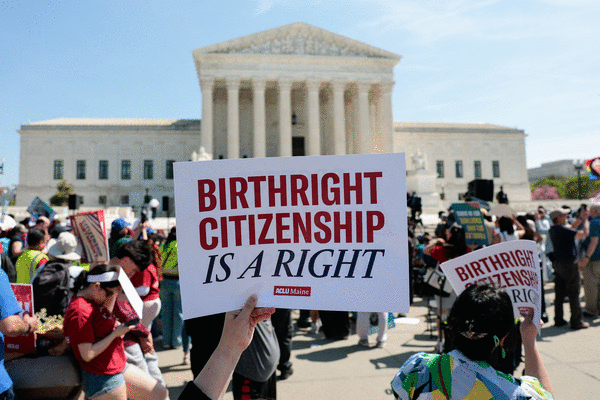
This week's narrow Supreme Court decision protecting birthright citizenship is rightly being hailed as a triumph for the American experiment.
By some, anyway.
Check out MAGA world and you'll quickly find Trump surrogates and even elected leaders spouting a kind of extremist anti-immigrant sentiment that once, not so long ago, was considered intolerable in the public sphere.
This has included suggestions that go as far as banning pregnant women from traveling to the United States for fear they might give birth here, and — no joke — one notable commentator writing that demanding female immigrants be sterilized might be a solution.
Trump's Homeland Security advisor Stephen Miller said after the ruling that children of immigrants might not be "qualified to carry on or capable of executing the inheritance of this country."
"We have people from all over the world, from Third World nations, nations that on their own would have never invented the wheel, let alone modern technology, let alone medicine, let alone air travel, and they can just come into the country, have a baby at a hospital, paid for it by you and me, and then that baby is automatically a citizen," Miller said.
Before you tell me that the Supreme Court has spoken and this is a done deal, no matter if there's more gross Miller mush, let me tell you about Supreme Court Justice Ketanji Brown Jackson's written opinion and why it matters. It is, if read in the right light, a warning for what comes next — a fight to rewrite history to serve political aims.
"The odds were long and the stakes were high," Jackson wrote about the creation of the 14th Amendment in 1866, which has long been understood as granting citizenship to any child born on U.S. soil and which was the focus of this case.
Still, she wrote, despite the unlikeliness of post-Civil War America rising to the challenge of inclusiveness, the amendment was always meant to do just that — because free Black people, recently emancipated but denied citizenship, "fought for the shared humanity of all people."
An alternative interpretation by MAGA world of this amendment and this history was the center of this case.
To greatly simplify, the 14th Amendment was originally a response to a Supreme Court decision, the Dred Scott case, that said freed Black slaves could not be U.S. citizens. MAGA world was arguing that the authors of the 14th Amendment never intended much more than that — citizenship for ex-slaves and their descendants.
While concurring with the majority of the court, Jackson also wrote her own summary that makes a vital point: Without history that includes the Black experience — as most of the arguments in this case did — we are left bereft of the suffering that has shaped our values and which gives us the empathy required to be a pluralistic society.
Black history — any non-white history, really — is the history of resistance and the road map to recovery from this dark era of hate.
It's hard to call someone your fellow citizen if you take away their humanity — which is exactly what this case was attempting to do by splitting into factions those who would fight for equality and rewriting history with only the voices that match the current administration's goals.
It was disappointing that the court, whose individual justices bounced around arguments from a myriad of sources outside of their erstwhile adherence to the ideas of originalism, did not call out that erasure more forcefully, and that it was left to Jackson to do so.
Jackson took that narrow idea that Black people — and the white legislators sympathetic to their cause — had only themselves in mind when crafting the 14th Amendment and attacked it head-on, arguing that if we just look at what Black people were saying at the time, the larger intent of the amendment becomes clear.
"This alternative account pitches Black Americans against immigrants when the advocates who promoted the Fourteenth Amendment did no such thing," Jackson pointed out of the MAGA version of events. "Freed Blacks fought for the shared humanity of all people."
That "universalist vision of belonging and citizenship," she wrote, "eventually won the day."
The 14th Amendment was largely written by Sen. Lyman Trumbull of Illinois, who took much of the basis of it from the legal arguments of Black intellectuals, including Frederick Douglass, the most influential Black statesman of the era.
Trumbull then argued in Congress that the amendment was meant to be inclusive — even of so-called "gypsies" and Chinese immigrants, who faced extreme racism, especially in California.
One congressman opposed to the measure warned that if it passed, Chinese immigrants would "overrun" California and "will double or treble the population." At the same time, the Romani would likely continue to "wander in gangs" and "have no homes, pretend to own no land, live nowhere, settle as trespassers where ever they go, and whose sole merit is a universal swindle," he warned.
Asked if the amendment would grant citizenship to those two controversial groups of immigrants, Jackson points out that Trumbull gave an unapologetic "undoubtedly," again drawing on the universalist ideas of Douglass and others.
The "child of an Asiatic is just as much a citizen as the child of a European," Trumbull said (and Jackson quoted, drawing from an amicus brief by Evan Bernick of Northern Illinois University and Jed Sugerman of Boston University).
"There is a serious breakdown in on the court that reflects the breakdown and echo chambers in America," Sugerman, the professor, told me Wednesday. "When it comes to history and originalism, you have to read more broadly than just the founding fathers that you liked."
So the history of the 14th Amendment is right there — equality not just for Black Americans but for immigrant Americans — but it required Jackson to write her own opinion to put it on the court record.
Legal scholars aligned with Trump did Olympic-level gymnastics in this case to parse what the authors of the 14th Amendment meant with the phrase "subject to the jurisdiction" — words that MAGA claimed were meant to secretly exclude undocumented immigrants.
Brown instead reminded us that outside of those white-only discussions when the amendment was written, it was the activism of Black people — their demand for colorblind equality — that actually shaped the final words that granted citizenship to all babies born within our borders.
Solidarity — the unbreakable strength of American democracy.
After the ruling, Trump wrote on social media that Congress could write legislation undoing birthright citizenship. Some pundits say that wouldn't work, but I'm here to say Trump has managed a bunch of stuff that the pundits said wouldn't work.
More chilling, and direct, were more comments from Miller.
"It's an abomination," he said of the ruling.
But "because of President Trump's courage and leadership, we are now on the precipice. Yes, we were dealt a setback, but because of his courage alone, we're on the precipice as a nation of being in a position to end this travesty once and for all, and that's what we have to fight for."
Miller and his ilk are seeking to rewrite history to justify their vision of the future of America.
Jackson alone in the court offered us both a warning and a path — a reminder that our history holds indisputable facts despite politics, and we erase them at our own peril.
©2026 Los Angeles Times. Visit at latimes.com. Distributed by Tribune Content Agency, LLC.



















































Comments