Jackie Calmes: The Supreme Court failed the test posed by Trump
Published in Op Eds
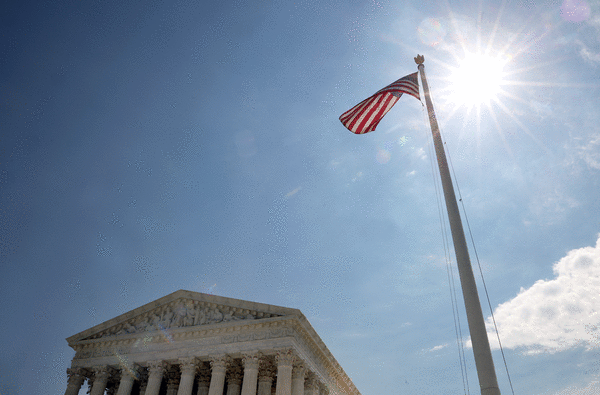
Even before President Donald Trump returned to office, the Supreme Court had further empowered him like no president before, by agreeing two years ago in Trump vs. United States that presidents have near-absolute immunity from criminal liability for acts in office. Perhaps it's this shiny new stay-out-of-jail-free card that's emboldened Trump 2.0 to act so brazenly in his own interest that he netted $2.2 billion just in his first year — nearly quadruple the year before, according to his financial-disclosure report released on Tuesday.
And all the while, in 2025 the Supreme Court continued adding to Trump's bank of powers. Many of his legal wins were only temporary, but the trend was clear. When the justices' just-ended term opened last October, I wrote in trepidation that not since the pre-Civil War years had a Supreme Court been so wrong for its moment in history.
Sometimes I hate to be right.
In the 1800s, the threat to the republic was slavery. These days the danger is a lawless, power-drunk president defiant in unprecedented ways toward the other, supposedly coequal branches of power, Congress and the judiciary. The court's 2025-2026 term was a test, I said last fall, and one I feared the court would fail, given its predilection for presidential power — the once-fringe unitary executive theory — and thinly veiled Republican partisanship.
It did fail. And the justices' stunning complicity with Trump in blurring the separation of powers and menacing democracy demands a response from Congress and voters.
The court conservatives, unlike many brave lower-court judges named by presidents of both parties, seem willfully obtuse about Trump's autocratic impulses. This is a president who two weeks ago told Axios "there are no limits" to his power, echoing his boast in January to the New York Times that only "one thing" constrained his power globally: "My own morality. My own mind. It's the only thing that can stop me."
But for notable exceptions — the justices' rulings that curbed Trump's tariff power, upheld the Constitution's birthright citizenship clause, blocked his bid to overrule states' election laws or fire a Federal Reserve governor — the court has mostly inflated this would-be king's power, blithely trashing longheld court precedents in the process. Besides often siding with Trump in his appeals, the court has favored him in 25 of the 31 cases challenging his actions in his second term, according to Erwin Chemerinsky, dean of the UC Berkeley Law School.
In typical fashion, the court saved the worst for the last days. On Monday, the six Republican appointees in Trump vs. Slaughter overruled a 90-year-old precedent and enabled Trump and future presidents to fire at will officials in federal agencies that were created by Congress to be independent and insulated from the political winds of changing administrations. The alternative — and Trump's ideal — is a return to the 19th-century spoils system, with jobs doled out to flunkies, friends and family. Expertise and institutional memory are sacked.
Thus the Slaughter decision — somehow the name seems apt — promises to be one of the most impactful ever in (re)shaping the government, and not in a good way. It further elevates presidents over Congress, and all but certainly leaves the public less protected from unsafe products, water, food and drugs, environmental damage, financial abuses and more that the agencies were created to police without political interference.
You don't have to believe me. Or the three dissenting liberal justices who warned, as Justice Sonia Sotomayor put it, that Slaughter's result "is a president who emerges with far greater power than ever before." Take it from Trump.
In a series of social media posts after the decision, he exulted that "90 years of precedent has been COMPLETELY AND UNEQUIVOCALLY OVERRULED, greatly increasing Presidential Power at a time when it is most needed!" It was, he repeated, "the Greatest Increase in Presidential Power in the last 100 years." Finally, "It is an Honor to be the sitting President" who won the case.
And it's our misfortune.
In two decisions last week, the court's six conservative justices also empowered Trump to continue his cruel crackdown on immigration — one that a majority of Americans opposes, polls consistently show, including Trump voters.
The court allowed Trump to yank the humanitarian legal status from hundreds of thousands of Haitians and Syrians who fled disasters, war and violence in their countries — and, by extension, of hundreds of thousands more people from other countries — and to deport them. And the court greatly restricted asylum in the United States, with a mean-spirited ruling (by Justice Samuel A. Alito Jr., natch) requiring those seeking refuge at the southern border to be on the U.S. side, yet allowing U.S. agents to physically prevent asylum-seekers from crossing over to apply, as federal and international law hold.
Even when the Supreme Court disfavored Trump, it showed its ideological and incoherent colors. Though it allowed him to fire independent agency officials without cause, it made an exception for the Federal Reserve in a separate case. Upsetting consumers is OK apparently, but not Wall Street. And the court should have settled the birthright citizenship case against Trump long ago, as many lower-court judges sought to do. His first-day executive order repealing birthright citizenship plainly violated the Constitution, federal law and court precedent — and yet the justices strung out the case and only this week decided on the constitutionality of birthright citizenship by just a 5-4 vote.
A counterreaction to Trump and the Supreme Court is coming, I believe. By laws and lawsuits, Congress must begin taking back its constitutional powers over spending, war-making, appointments and more. Sure, that's unlikely in this Republican-run Congress and under Trump, but the effort could begin if voters give Democrats a majority in November.
And Congress could pass laws to reform the Supreme Court, ideally backed by a popular movement. I don't favor enlarging it, but term limits for justices should be doable even in this polarized environment.
Just as with the pro-slavery Supreme Court of old, this court's and this president's trespasses can be remedied as the founders intended — by Congress and us voters.
____
Bluesky: @jackiecalmes
Threads: @jkcalmes
X: @jackiekcalmes
____
©2026 Los Angeles Times. Visit at latimes.com. Distributed by Tribune Content Agency, LLC.



















































Comments