Commentary: Homelessness just declined in the US. Trump's plans will take us backward
Published in Op Eds
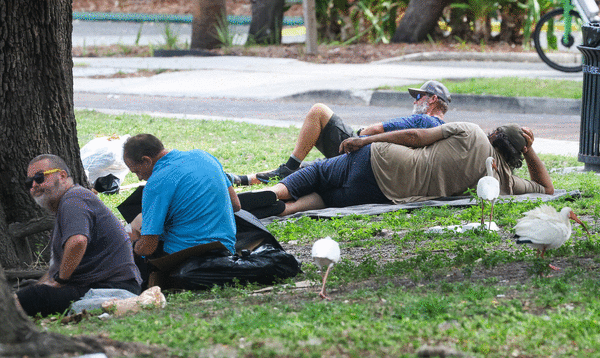
In June, the U.S. Department of Housing and Urban Development (HUD) finally released the long-awaited homelessness numbers for 2025, revealing a 3.3 percent decrease in overall homelessness between January 2024 and January 2025.
To be clear, this modest decline is not cause for celebration – 745,652 people remain homeless on a given night in this nation, which we can all agree is unacceptable.
Yet, for nearly a decade, homelessness has been on the rise, driven by skyrocketing rents and an economy that simply doesn’t work for regular working people. If we are making progress in the midst of the current affordability crisis, one would expect our leaders to double down on our most recent success.
Yet, the Trump administration has decided to go in the opposite direction by proposing to defund and dismantle massive swaths of the nation’s homelessness response system.
As someone who has worked on homelessness for decades, including working at HUD under three administrations, take it from me: This is an extraordinarily short-sighted and destructive approach. It is guaranteed to only make homelessness worse at a time when no community can afford that.
Unfortunately, this is not a new shift for the president.
Since before his second term, President Donald Trump has been fixated on outdated and historically failed homelessness policies that directly mirror Project 2025 proposals. These include a troubling emphasis on the kind of heavy-handed law enforcement and involuntary commitment tactics that are all too reminiscent of the administration’s immigration enforcement efforts.
But his proposals extend much further than that. In fact, in the past year, the Trump administration made several unprecedented attacks on homeless responses.
At a time when record numbers of people need help addressing the cost of housing – the key driver of homelessness -- this administration has incomprehensively proposed a 13% cut to HUD’s budget for FY 2027. This would virtually assure that fewer people would get the help they need to stay in their homes.
This administration has also illegally meddled in federal grants, attempting to force communities to adopt the administration’s policies on immigration and transgender rights to receive federal homelessness funding.
It has attempted to limit the amount of federal funds that can be spent on permanent housing solutions for people experiencing homelessness – a move that will force at least 170,000 formerly homeless people out of their housing and back onto the streets, including older adults, veterans, families with children, and those struggling with serious physical and mental disabilities.
And it has relentlessly attempted to erode support for people experiencing homelessness by characterizing them as criminals and threats against the community. In fact, this administration advanced an Executive Order that directs law enforcement to raid more encampments and involuntarily commit unhoused people, despite officers not having the training or tools to do so safely, effectively, or responsibly.
All of this is taking place amid an affordability crisis that is driving an astounding 17,500 people a week into homelessness systems for the very first time, according to HUD.
Any one of these proposals is shortsighted and dangerous. Collectively, they represent a needless broadside against the lifesaving efforts of frontline homeless services workers. It is yet another catastrophically reckless response to a crisis that deserves better leadership.
To be sure, our homelessness systems can and must run more effectively. Providers are too often understaffed due to low pay, burnout, and turnover among frontline workers. They are hampered by unhelpful regulations and administrative burdens that slow the time it takes to get people off the streets and into housing. Many homelessness policies lack the flexibility that would make them more practically useful for people who need help. And we need much closer collaboration between the various systems that serve people before, during, and after their homelessness.
Addressing these needs would benefit everyone: providers, local businesses, neighbors, and, of course, people who are homeless. Unfortunately, that isn’t where the administration is focused.
America’s homelessness crisis is not acceptable, full stop. If we are going to sustain any of our progress, we have to all work together. Our frontline workers are meeting that challenge. Mayors and governors are meeting that challenge. Members of Congress are meeting that challenge.
It’s time for the administration to work for our most vulnerable neighbors, and not against them.
_____
Ann Oliva is the CEO of the National Alliance to End Homelessness.
_____
©2026 The Fulcrum. Visit at thefulcrum.us. Distributed by Tribune Content Agency, LLC.





















































Comments