Editorial: American democracy's biggest losers: voters in closed-primary states
Published in Op Eds
Halfway through the U.S. primary election season, at least one thing is clear: Voters in states that hold closed party primaries are, as usual, losing out.
More than 20 states hold primaries in which only registered party members are eligible to participate. In a battleground state or district, that process can produce competitive general elections between Democrats and Republicans. But in areas where one party dominates, which is most of the country, it often leaves voters stuck with a single candidate who lacks majority support and reflects the priorities of ideological interest groups more than those of average voters.
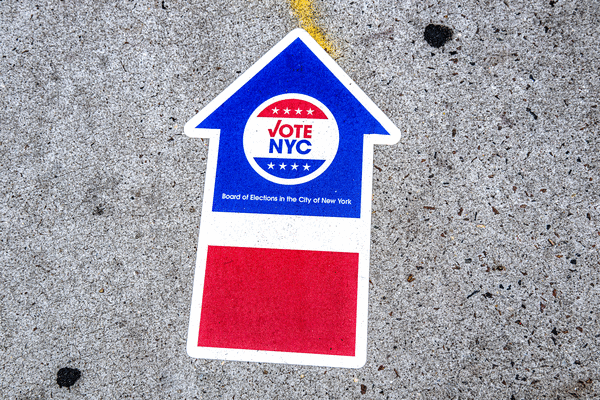
Take New York City’s recent primaries. In a four-way race for a Manhattan State Assembly district, the results were so close — the two leading candidates each have about 27% of the vote — that a recount may be required. But whoever comes out on top will not face a runoff — or a Republican, since none is running, which is the case in many other races, too. When Republicans, independents and third-party members arrive at the polls in November, joined by many Democrats who didn’t vote in the primary, they’ll have a lousy choice: rubber-stamp the primary winner or write in a protest vote.
Some will leave the ballot line blank. Far more will stay home, and it’s hard to blame them. The election will have been decided in a partisan primary by about 5% of the district’s voters.
Similar scenarios played out across the city, including in three of the nation’s highest-profile races for the U.S. House of Representatives. In two, no candidate received a majority in the Democratic primary, and the second-place finishers were within about 4 percentage points of the winner. But in all three races, the victors will face only token Republican opposition in November. The elections are already effectively over.
In addition to disenfranchising voters, depressing turnout, allowing small-plurality winners and making low-profile primaries tantamount to election, such contests also advantage the most extreme, polarizing and bombastic candidates, because they’re dominated by voters and special interest groups on the fringes of both parties. Meanwhile, more moderate candidates often feel forced to embrace radical positions they don’t actually believe in, then maintain them once in office or else face their greatest fear: being “primaried.” It is not by accident, but by design, that Washington is full of legislators who cannot seem to compromise.
Better alternatives exist. Five states — Alaska, California, Louisiana, Nebraska and Washington — hold primaries that are open to all candidates and voters. The top two finishers (or four, in the case of Alaska, which also uses ranked-choice voting) advance to the general election, regardless of their party affiliation. This helps keep general elections from being uncontested.
California’s otherwise dysfunctional electoral system gets this right. Take San Francisco, home to the state’s highest-profile House campaign this year — the race to succeed Representative Nancy Pelosi. The primary featured three main candidates, all of them Democrats. The top finisher received 41% of the vote, while the runner-up (who Pelosi endorsed) received 30%. There will now be a spirited campaign between them, giving voters a real choice in November.
Similarly, in elections for California governor and Los Angeles mayor, no candidate received more than 34% of the vote. In those and all other of the state’s races, the top two candidates now have a chance to make their cases to general election voters, who typically far outnumber primary voters.
California voters adopted their open system over the objections of party leaders and activists, who dislike it because it reduces their control of primaries and thus general elections — and the influence, funding and jobs that come with victory. In other states, too, party leaders have fought to block open systems — and in the case of Louisiana, they’ve succeeded in partially rolling them back, despite their broad public support.
Voters in all states should demand that their governments open election systems and stop denying them the right to competitive contests. A single-candidate general election is no election at all.
____
The Editorial Board publishes the views of the editors across a range of national and global affairs.
©2026 Bloomberg L.P. Visit bloomberg.com/opinion. Distributed by Tribune Content Agency, LLC.





















































Comments