Stephen L. Carter: Citizenship debates have always been tied up with race
Published in Op Eds
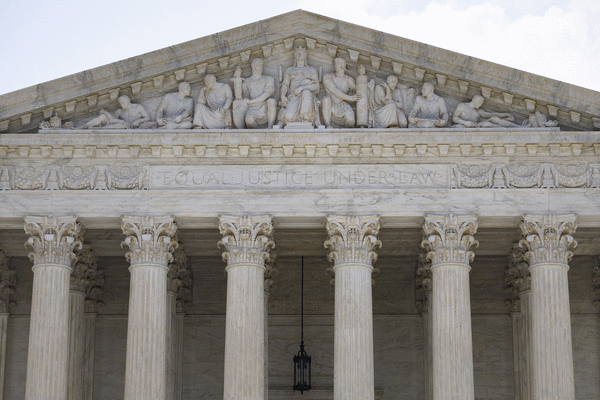
The Supreme Court was correct on Tuesday to strike down President Donald Trump’s order excluding from the 14th Amendment’s guaranty of birthright citizenship those who are born when their parents are “unlawfully or temporarily present” within the nation’s borders. The result matters for many reasons. One is that the majority correctly recognized that the history of the argument over American citizenship has long been bound up with race.
The citizenship clause of the 14th Amendment was adopted specifically to overturn Dred Scott v. Sandford, which had declared that Black Americans, even if born free, could not be citizens. Chief Justice Roberts’s majority opinion argued that by reversing Dred Scott, those who drafted the clause intended to adopt the English common law rule that all those born within the nation’s borders were citizens. It was, in the argot, the soil, not the blood of one’s birth, that made a citizen.
For the majority, the adoption of the 14th Amendment brought history to a halt. This makes practical interpretive sense. Justice Thomas and Justice Alito, in their dissents, pointed to events later in the 19th century suggesting a narrow view of birthright citizenship. Chief Justice Roberts dismissed this history as “revisionist,” a word that is in this context perhaps too freighted with irony.
What he meant is that the clause should be understood today as those who drafted and adopted it understood it: those within the nation’s borders, whether or not they have the legal right to be present, and even if they are, in words from the 1860s that are heavily debated by the justices, “temporary sojourners.”(1)
But even if the court stops history there, the rest of us should not. We have never quite escaped race in immigration law, as even a brief look at the past and the present reminds us.
Let’s go back to the founding. The 1790 Naturalization Act provided that only a “free white person” could become an American citizen. After the Civil War, naturalization laws were amended to permit those of African descent as well as White persons to be naturalized. But the exclusion still had racial effect. So it was in 1913, when California passed the Webb-Haney Act, which prohibited ownership of agricultural land or entering certain leasing arrangements by “aliens ineligible for citizenship.” The statute made no mention of race, but everyone knew that it was directed at the state’s growing Asian immigrant population, and at Japanese residents in particular.
Here’s the punchline: Federal law made it difficult for Asian immigrants to become citizens. But they kept coming anyway, so that their children would be. No doubt some of those adults arrived illegally, and, yes, every nation should defend its borders. Still, one cannot help concluding that for President Trump and his inner circle, the threat to the nation would be those children.
As my friend and colleague Akhil Amar writes, the birthright citizenship clause is, fundamentally, about babies: “Babies born in America under the American flag are born equal citizens, period.” It is to the little child and not to the parent, perhaps of uncertain status, that the right attaches.
Much of the political debate, alas, is about the parents. And although it pains one to say so, here, especially today, the connection of policy to race is difficult to resist. If we were first to deny citizenship to children born while their parents are illegally present on these shores, and next to limit by race those who can legally enter, the foreseeable result, intended or not, would be fewer citizens (those babies) of the “wrong” nationality or color.
Is this an outdated way of thinking? One can but wish. My concern here is not the old and vicious and abandoned congressionally mandated country quotas, but instead the conscious decisions made by the current administration. It was stomach-churning to see, for example, President Trump’s bizarre and unapologetic order to prioritize asylum applications from Afrikaans-speaking (in practice, White) South Africans. No doubt there exist White South Africans who have suffered discrimination, but there’s not a shred of serious evidence that if denied asylum they would face what the president called “genocide.”(2)
More importantly, it is difficult to figure out exactly what, other than their skin color, separates them from so many people in Africa, or for that matter in Asia and Latin America, whose conditions at home are far worse. Last week, the Supreme Court ruled that asylum seekers who are turned away at the border are not entitled to hearings on their claims because they didn’t get across. But for White South Africans, at least those who speak Afrikaans, the gate is wide open.
Or consider the administration’s repeated racially tinged references to Haitians (which I have discussed in this space before). In another decision last week, the Supreme Court upheld the administration’s termination of Temporary Protected Status for Haitians and Syrians. The justices might have been correct on the sheer breadth of the president’s statutory authority, and the fault for that lies with Congress for delegating the power to begin with.
But as Justice Elena Kagan’s dissent points out, the evidence that race played a role in the termination is vast, and “includes statements by the President so repellent and racially inflected that the majority declines to put them in print.” I won’t repeat them here. But Kagan is bolder. She sets forth several of the remarks in question, and concludes, not inaccurately: “The references — of filth, disease, and primitiveness — are shot through with racial stereotypes and tropes.”
There has always been a racial ugliness to our immigration policy, and the birthright citizenship order, whether intentionally or out of sheer recklessness, added to that ugliness. Whatever its other deficiencies, that one bears emphasis.
Chief Justice John Roberts’ opinion for the majority states that the purpose of the amendment’s birthright citizenship clause was to extend “to every free-born person in this land” what he memorably labels “the right to have rights — to freely participate in our political community.” Glowing language, to be sure, but it can be improved. For “free-born person” read “newborn baby.” Then add one more bit: “Wherever the parents hail from, and however they got here.”
That’s what birthright citizenship is about.
_____
(1) The majority and dissent agree on the existence of certain exceptions, such as the children of ambassadors.
(2) For disputes of Trump’s claim by Afrikaners, see, for example, here and here.
_____
This column reflects the personal views of the author and does not necessarily reflect the opinion of the editorial board or Bloomberg LP and its owners.
Stephen L. Carter is a Bloomberg Opinion columnist, a professor of law at Yale University and author of “Invisible: The Story of the Black Woman Lawyer Who Took Down America’s Most Powerful Mobster.”
_____
©2026 Bloomberg News. Visit at bloomberg.com. Distributed by Tribune Content Agency, LLC.



















































Comments