David M. Drucker: Trump's economic pivot isn't coming. He's made that clear
Published in Op Eds
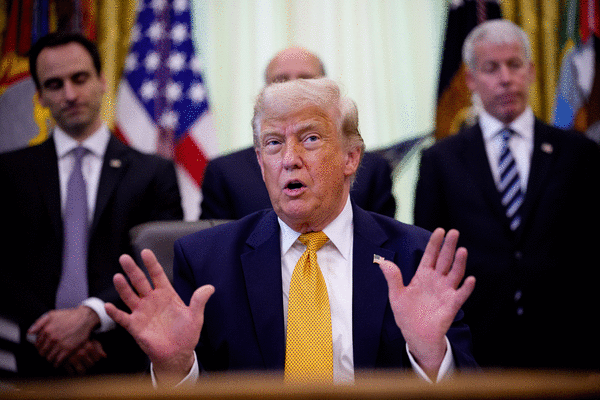
For Republicans in Congress who’ve been clinging to hope that President Donald Trump might finally focus on the economy ahead of the midterm elections, their time might be better spent searching for proof that the tooth fairy is real.
The same day Trump reaffirmed support for an agreement with Iran to end the war, he turned his attention to Capitol Hill. Did he demand or introduce legislation addressing voters’ No. 1 priority, what they believe is an unacceptably high cost of living? No. Rather, the president revived his push to strong-arm how the 50 states and Washington, DC, administer elections, an issue that barely registers on voters’ radar, outside of MAGA social media circles.
Trump’s fixation is on passing a more stringent version of the SAVE America Act, which would require identification and proof of citizenship be presented to vote while severely curtailing mail-in voting, among other changes to election law. In fact, the president postponed Jay Clayton’s nomination to replace Tulsi Gabbard as director of national intelligence to jam Senate Republicans into supporting the legislation. It doesn’t matter to him that Clayton’s appointment has the consensus backing of Republicans and key Democrats in the U.S. Senate. The president is now allowing Bill Pulte to serve as the acting leader, a move many Senate Republicans oppose, as leverage to drum up support.
Trump is also holding hostage renewal of crucial government spying tools, known as Section 702 of the Foreign Intelligence Surveillance Act, enacted in the aftermath of 9/11. Of course, the president could be focused on more than one issue at a time; that goes with the job. But he still refuses to acknowledge that any aspect of the economy is underperforming on matters related to affordability or otherwise.
“The word ‘affordability’ is a fake word, made up by the Democrats…. [T]hey made it up because I inherited these high prices,” Trump told reporters last week.
“Our Country is doing GREAT. Record Jobs Numbers and Stock Market. BEST ECONOMY EVER!” Trump added Sunday in a Truth Social post. “We are WINNING on all fronts. WINNING LIKE NEVER BEFORE.”
But that’s just not reality. Inflation has spiked since Trump launched the Iran war on Feb. 28, with the Consumer Price Index climbing 0.5% from April to May — and a whopping 4.2% since the same period in 2025, according to the Labor Department. That was the highest rate of inflation since the 4.9% during the year that ended April 2023, as Bloomberg reported this month.
Theoretically, there’s still time for Trump to address the economy to improve his party’s prospects in the midterms, still more than five months away. (Labor Day is considered the true beginning of the campaign season.) That pivot could help the president resuscitate an overall job approval rating of 40.4% that is even worse than his handling of the economy and inflation, at 35.1% and 28.5%, respectively. Midterm elections tend to be a referendum on the party that occupies the White House — especially when the economy is voters’ top concern. So, if Trump’s ratings go up, so, too will the GOP’s chances of preserving its roughly 10-seat House majority and defending its three-seat Senate advantage.
Absent that, Democrats are poised to have quite a bit to celebrate on the evening of Nov. 3.
Trump’s decision to sue for peace and end a war in Iran he started might be interpreted as a pivot of sorts to the economy. After all, the president told reporters his decision was based on preventing another Great Depression and being likened to Herbert Hoover, who served in the White House when the stock market crashed in 1929. “I didn’t want to see economic catastrophe. If you kept [the war] going, that could have happened,” Trump said, according to ABC News.
But there’s a difference between an acknowledgment and a pivot.
Trump recognizing an economic risk is not the same as pivoting his agenda to address an economic condition, like excruciatingly high prices for gas, groceries and other consumer goods. A healthy majority of voters have considered those issues a reality for most of the past year. If Trump was intent on fixing the economy, he wouldn’t spend all his time and political leverage attempting to convince congressional Republicans to pass legislation that has nothing to do with economy.
Anyone who’s been paying attention shouldn’t be surprised.
During Trump’s first term, speculation about when he would finally “pivot” from unconventional politician to normal, functioning president was rampant. The topic even became something of a joke in political circles. This time around, Save (America Act) yourself some time and skip to the punchline.
____
This column reflects the personal views of the author and does not necessarily reflect the opinion of the editorial board or Bloomberg LP and its owners.
David M. Drucker is a columnist covering politics and policy. He is also a senior writer for The Dispatch and the author of "In Trump's Shadow: The Battle for 2024 and the Future of the GOP."
©2026 Bloomberg L.P. Visit bloomberg.com/opinion. Distributed by Tribune Content Agency, LLC.

















































Comments