John M. Crisp: Why doesn't Iran have a right to a nuclear weapon?
Published in Op Eds
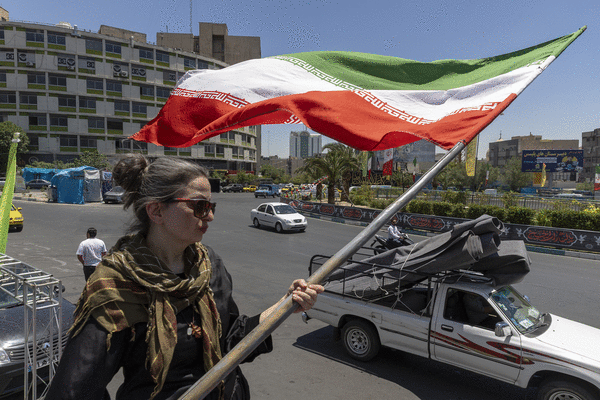
Why doesn’t Iran have a right to a nuclear weapon? The question seems preposterous, unless one looks at it from Iran’s point of view, which President Donald Trump and his negotiators are unable or disinclined to do.
In fact, Trump has characterized Iran’s regime as “fanatical,” “nuts,” “evil” and “crazy,” which suggests that it doesn’t really have a point of view.
This mistaken understanding of Iran’s leaders jeopardizes the chances of solving the current crisis with diplomacy. You just can’t negotiate with “crazy” people.
Don’t misunderstand: I make no defense of the ayatollahs. A theocracy is perhaps the worst form of government, and the Iranian regime is probably the worst of the worst. However, the ayatollahs may be fanatical, but they’re not irrational: They have interests, motives and goals, economic and otherwise. They are also swayed by fear and pride, just like we are.
In short, Iran has rational reasons for wanting a nuclear weapon that go far beyond the fanatical notion of destroying Israel and The Great Satan.
Let’s start with fear: Iran is a big country in a strategic location with lots of resources. Its neighborhood includes powerful rivals, especially the nuclear-armed Israel and Saudi Arabia, a Muslim country, but Arab and Sunni instead of Persian and Shia.
Iran sees other threats: In this century, the United States has had as many as 140,000 troops on Iran’s western border in Iraq and more than 100,000 to the east in Afghanistan. Presidents George W. Bush and Donald Trump have mused openly about taking over Iran militarily. In fact, we’re in a war that began with, among other vague goals, a call for regime change.
In the last century, the U.S. did, indeed, foment what amounted to regime change by implementing a coup that deposed Mohammad Mosaddegh, a nationalistic prime minister with democratic leanings, and reinforcing the power of the Shah, an autocrat who ruled by force and terror. The Shah was so corrupt and oppressive that the 1979 revolution was almost inevitable.
In short, the ayatollahs don’t have to be crazy, homicidal fanatics in order to desire a nuclear weapon. Every country wants to defend itself, and it’s not hard to see why Iran might want the same.
Trump seems to recognize this: In March, one month after the war started, he said that a primary goal of the war was to “destroy their missiles and raze their missile industry to the ground.”
But recently Trump said, “What am I going to do? Am I going to let Saudi Arabia have missiles, but they (Iran) can’t have them?”
Of course. And it’s hard to see how this logic doesn’t apply to nuclear weapons, as well.
Then there’s pride. Iranians are proud of a culture 10 times more ancient than our mere 250 years. Trump doesn’t understand that Iran doesn’t see itself as a third-rate power. He was always terribly mistaken to think that Iran could be bullied or bombed into submission.
But countries can be convinced by deft diplomacy, including security guarantees and economic relief, to voluntarily give up their aspiration for nuclear weapons. Examples: Japan, South Korea, Taiwan, Egypt and Belarus, among others.
Historians will be hard pressed to determine the most pernicious blunder of the Trump era: Jan. 6? Capricious worldwide tariffs? Weaponization of the Department of Justice? The coarsening of American politics and culture? The unprovoked war against Iran?
History still has to play out, but I might bet on Trump’s 2018 abrogation of the Joint Comprehensive Plan of Action as his biggest mistake. A full defense of the agreement is beyond the scope of this column, but by many reliable accounts, it was effectively fostering moderation in Iran, while steering the country away from nuclear aspirations and in the direction of normalcy.
We’ll never know how that might have turned out.
Here’s one thing we do know: Trump’s ill-advised attack on Iran and his clumsy, shortsighted diplomacy have firmly established one thing in Iran: an intense motivation to acquire a nuclear weapon. They see it as essential to survival. Who could blame them?
___
©2026 Tribune Content Agency, LLC


















































Comments