Commentary: Israel is the wild card as the US and Iran work to ink a lasting peace deal
Published in Op Eds
A diplomatic agreement isn’t worth the paper it’s written on if implementation is shoddy or nonexistent. So it should come as no surprise that U.S. and Iranian officials were back at it again days after the sides signed a memorandum of understanding that virtually everybody in Washington hates in one way or another.
This past weekend, Vice President JD Vance flew to Switzerland for several days of follow-on negotiations with the Iranians. The sit-down kick-started a 60-day time frame during which the United States and Iran will seek to clinch a formal agreement on the latter’s nuclear program in exchange for broad U.S. sanctions relief for the Iranian economy.
Vance was reasonably pleased with the outcome. According to a joint statement released on Monday, the U.S. and Iran agreed to further technical talks, created several working groups and established a de-escalation cell to ensure that the Strait of Hormuz remains open and the separate ceasefire in Lebanon is adhered to.
It’s that last item that has the most potential to upend the negotiations. On its own, the war in Lebanon, which has killed more than 4,000 people since it restarted on March 2, has nothing to do with keeping the strait functional or ending the conflict between Washington and Tehran. Yet as a practical matter, the two are very much connected. The Iranians insisted that for the rest of the memorandum of understanding to proceed, President Donald Trump’s administration must press Israel to end its war against Hezbollah in Lebanon, which has uprooted more than 1 million Lebanese from their homes and resulted in an Israeli occupation of a band of Lebanese territory roughly 6 miles into the country.
Unfortunately for the White House, ending the war in Lebanon is proving to be an even more complicated endeavor than ending the war in the Persian Gulf. The situation in Lebanon is not firmly in Washington’s control — not because it doesn’t have any influence but rather because one of the combatants, Israel, views the war against Hezbollah as vital for its own security. Israel and Hezbollah have been shooting at each other since Oct. 8, 2023, the day after the deadly Hamas assault in southern Israel, and have continued with varying degrees of intensity ever since. Multiple ceasefires have come and gone.
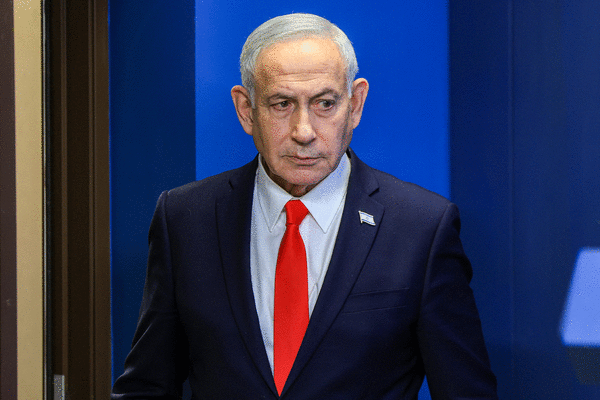
If events in Lebanon weren’t attached to his Iran peace deal, perhaps Trump could ignore or downplay the hostilities there. He doesn’t have that luxury. In the weeks since, Trump has grown frustrated with Israel’s military strategy, gotten on the phone to yell at Israeli Prime Minister Benjamin Netanyahu for acting irresponsibly and warned the Israelis about collateral damage. This is all a bit much for Netanyahu and his government, who were forced to suspend operations in Lebanon even though Israel wasn’t a direct participant in the negotiations. Iran’s negotiators have effectively saved Iran’s Lebanese proxy from further destruction and injected a dose of disunity in the U.S.-Israel security partnership. Tehran is not going to drop the Lebanon issue anytime soon; during the weekend talks in Switzerland, Iranian officials made it clear that stabilizing the Israel-Hezbollah truce was the first item on its agenda.
Trump is now essentially responsible for keeping Netanyahu onside, which is easier said than done. Despite the two men continuing to insist in public that their personal and professional relationships are excellent, it’s clear to observers that they don’t see eye to eye on Iran, Lebanon or the Middle East at large. Although the United States and Israel might be strong partners, their interests have never been perfectly aligned.
The peace accord Trump struck with Iran clearly illustrates this. As the conflict dragged on past the four to six weeks the White House originally predicted and as Iran shut down the Strait of Hormuz to squeeze global energy supplies, Trump grew more interested in turning the oil spigot back on than meeting any of the maximalist objectives he originally set out to achieve: destroying Tehran’s nuclear program, capping Iran’s missile program, overthrowing the regime and otherwise compelling the Iranians to submit to American diktats. Finding an exit ramp and stopping his approval ratings from dropping further became his two most urgent priorities, and the memorandum of understanding, although hardly the most impressive agreement, helped him do both.
For the Israelis, though, the memorandum is an absolute disaster. Members of Netanyahu’s cabinet, as well as some high-profile Israeli commentators, have spent the last few days blasting Trump’s peace deal as one of the most blatant acts of appeasement since then-British Prime Minister Neville Chamberlain gifted part of the old Czechoslovakia to Adolf Hitler in 1938. None of Israel’s own goals in Iran have been accomplished through the memorandum, and Netanyahu’s political opponents, who are gearing up for an election this fall, have used the result to paint the prime minister as Trump’s lap dog. A poll by Hebrew University in Jerusalem found that an astounding 92% of Israelis surveyed believed Iran won the war, and a majority strongly advocate for continued Israeli military operations in Lebanon.
This puts Netanyahu is an extremely difficult spot, and while he’s weathered these kinds of dilemmas before, it’s difficult to see how he can wriggle out of them now. Implement Trump’s deal and refrain from further attacks on Hezbollah, and the domestic criticism will further compound from an electorate that was already hawkish well before Hamas’ Oct. 7, 2023, attacks. Defy the deal as if the ceasefire is optional, and Netanyahu is certain to run headfirst into a confrontation with Trump, the commander in chief of a country that has sent a significant amount of defensive military equipment to Israel.
Trump is often categorized as the ultimate wild card. In this scenario, though, it’s Bibi Netanyahu.
____
Daniel DePetris is a fellow at Defense Priorities and a foreign affairs columnist for the Tribune.
___
©2026 Chicago Tribune. Visit at chicagotribune.com. Distributed by Tribune Content Agency, LLC.



















































Comments