Mark Gongloff: The White House's top science goal is ignorance
Published in Op Eds
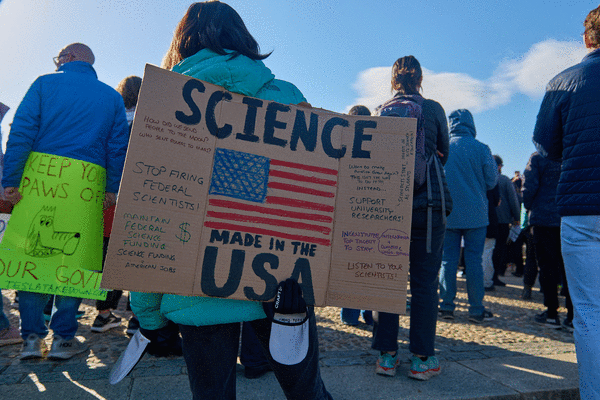
Shutting down scientific inquiry because it discovers things you don’t like is a bit like turning off all the instruments on your plane because they warn you there’s a mountain ahead. It may satisfy your immediate urge to live in denial but will soon turn deadly.
The Trump administration’s crusade to dismantle a scientific establishment long a national treasure and the envy of the world is a blueprint for deliberate ignorance. But that’s a feature, not a bug.
As Adam Serwer wrote about the first Trump administration’s cruelty, the ignorance is the point. If objective reality as measured by science is no longer available, then it’s easier for President Donald Trump to conjure up a new reality in a way that thrills and rewards supporters, including the fossil-fuel companies that helped get him elected a second time.
The latest example is a plan by Trump’s National Science Foundation to dismantle a vast monitoring system called the Ocean Observatories Initiative, which compiles mountains of publicly available data about every aspect of the northern Atlantic and Pacific oceans. One of its jobs is to track the Atlantic Meridional Overturning Circulation (AMOC), the network of currents that helps keep Europe from freezing over, among other desirable effects. Scientists have become increasingly anxious about the health of AMOC as the planet has warmed, melting Greenland’s ice and disrupting the system that keeps AMOC moving.
The shutdown of the system also comes as the world’s oceans are “at grave risk as ecosystems and habitats approach or surpass critical tipping points” because of climate change, overfishing and pollution, according to a United Nations report released on Monday. Dying coral reefs, declining fisheries, warming seas and rising waters are all aspects of this crisis, and all are being carefully watched by the hundreds of ocean buoys the government is shutting down.
Then again, maybe if we stop measuring this crisis, it will simply go away. During the COVID-19 pandemic, Trump often suggested fewer COVID tests would lead to fewer COVID cases. Why wouldn’t the same logic apply here?
Sure, you would lose that argument to any baby that has developed object permanence. But you would at least satisfy the fervent climate denialism of your base while giving you cover to continue squashing clean energy and propping up coal, gas and oil.
Since the moment Trump took office again in January 2025, his administration has taken hundreds of steps to do just that, everything from ending subsidies on renewables to forcing old, polluting coal plants to keep operating. These are obvious, blunt-force measures to support a fossil-fuel industry that bankrolled the campaigns of Trump and other Republicans in 2024. The subtler approach is to stifle science so that we no longer measure exactly how much burning those fuels is heating the planet and making the atmosphere more chaotic.
That’s the only semi-rational explanation for shutting down an ocean-monitoring system that cost $386 million to build and collects data useful to everyone from fishing-boat captains to farmers. Or for no longer tracking America’s billion-dollar weather disasters when they’re more numerous than ever, driving up insurance costs across the country. Or for cutting off funding for a global databank of weather disasters. Or for dismantling the National Center for Atmospheric Research (NCAR), which helps meteorologists predict the weather, a service with an annual economic benefit of $31.5 billion, while also gathering data on a heating planet.
A federal judge recently halted some of NCAR’s demolition, and the White House Office of Management and Budget has proposed moving the institution’s weather studies to new management. But the uncertainty about its future has already shut down research and chased away scientists who might never return. Trying to separate weather science from climate science is like trying to separate duck science from waterfowl science. They’re not exactly the same, but you can’t have one without the other.
The administration’s stated rationale for wrecking NCAR gives away its game. Despite being led by OMB, this vandalism has nothing to do with saving money. OMB Director Russell Vought dismissed NCAR as “one of the largest sources of climate alarmism in the country,” echoing language used in the Heritage Foundation’s Project 2025, of which Vought was a co-author.
NCAR’s work doesn’t “align” with the administration’s “priorities,” according to OMB documents obtained as part of a lawsuit by NCAR’s manager, the University Corporation for Atmospheric Research, against the government. Those stated priorities include leaving the Paris climate agreement and other global pacts, slashing environmental regulations and just generally pretending the climate isn’t changing at all.
Obstructing and muddling science, like Interior Secretary Doug Burgum’s nonsensical claims that carbon dioxide pollution is welcome because it makes plants grow, is straight out of the old fossil-fuel playbook for slowing the transition to cleaner fuels. But it also satisfies and reinforces the climate disbelief among Trump’s MAGA base, further splitting the country into opposing tribes that live in different realities.
It’s no mistake that the percentage of Republican voters who think climate change is “very important” has collapsed to just 11% in the past two presidential elections, down from 44% in 2008. For many in Trump’s tribe, burning oil is manly and strong, like their leader, while caring about wildfires and floods is pathetically woke.
Of course, wokeness didn’t inspire people to start trying to understand the climate 5,000 years ago. They knew their lives and livelihoods depended on it. Such connections have only grown more complex in the intervening millennia, and every cheap, science-defying political stunt comes with a cost. The “Environmental Protection Agency” letting grocers get away with using planet-heating HFCs for longer in the name of cutting grocery bills? That will cost grocers more in supply and maintenance, expenses shoppers will ultimately bear.
The costs will grow exponentially if we don’t listen to the unanimous science on climate and curb our carbon emissions more quickly. We have already spent $20 trillion so far this century cleaning up after weather disasters, by one estimate. Unabated warming could shave 20% from global gross domestic product in the longer run.
Ignoring science won’t make food or housing affordable or keep floods or wildfires at bay. You might not want to believe in the approaching mountain, but that doesn’t make it any less real.
____
This column reflects the personal views of the author and does not necessarily reflect the opinion of the editorial board or Bloomberg LP and its owners.
Mark Gongloff is a Bloomberg Opinion editor and columnist covering climate change. He previously worked for Fortune.com, the Huffington Post and the Wall Street Journal.
_____
©2026 Bloomberg L.P. Visit bloomberg.com/opinion. Distributed by Tribune Content Agency, LLC.





















































Comments