Commentary: What the New Republic got right -- and wrong -- about free speech at my university
Published in Op Eds
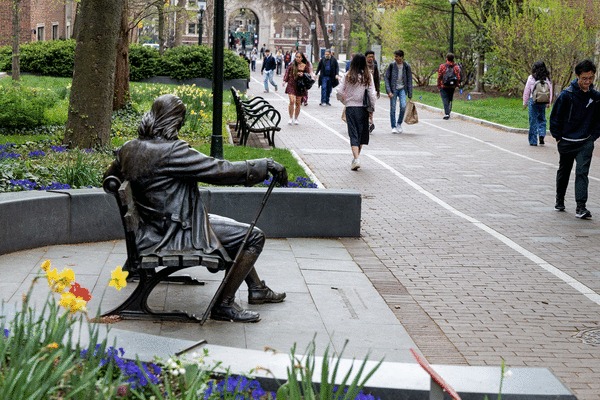
The University of Pennsylvania is hostile to free expression. It has imposed a series of new speech restrictions, especially upon critics of Israel. The campus is eerily silent, even as Israel attacks Lebanon and the United States bombs Iran.
That’s the theme of an excellent piece published in May in The New Republic by journalist Jordan Heller. Caving to conservative donors and Penn alum Donald Trump, the university has targeted anti-Israel faculty members and students. Now most of them bite their tongues instead of raising their voices.
But Heller ignores the other group of people at Penn who don’t feel like they can speak out: political conservatives. They’re not his people — or mine — so they don’t count.
And that highlights the biggest problem for free speech on American campuses. We all want to see our own speech protected, but we turn a blind eye when our opponents get silenced.
I arrived at Penn in September 2016, just two months before Trump won the presidency for the first time. Like the overwhelming majority of my colleagues, I voted for Hillary Clinton. But I also urged students who supported Trump to speak up in class, so we could learn from them.
That never happened. My handful of Trump-friendly students came out to me in my office, with the door shut. If anyone found out how they voted, they told me, they would be canceled.
So they keep their opinions to themselves. According to the most recent national survey by the Foundation for Individual Rights and Expression, conservative college students are about three times more likely than their liberal peers to self-censor.
One reason might be to remain in their teachers’ good graces. In the same FIRE survey, 37% of very conservative students said they hide their beliefs from professors to get a good grade, as compared with just 6.5% of very liberal students.
But almost everyone is disguising what they think, just to stay on the safe side. In a recent study of undergraduates at Northwestern and the University of Michigan, 88% said they had pretended to hold more progressive views than they really believed to “succeed socially or academically.”
The most commonly hidden opinions are about gender. Over three-quarters of the students said they disagreed with the idea that “gender identity should override biological sex” in sports and healthcare, but that they would never admit that to anyone else.
I watched that dynamic unfold during the controversy over trans female swimmer Lia Thomas at Penn. In public, almost everyone on campus supported her right to compete on the women’s team. Privately, however, many students told me they thought otherwise. They were just too scared to say so out loud.
Last year, under threat of losing $175 million in federal funds, Penn stripped Thomas of her individual records. As Heller notes in his New Republic piece, that marked the start of “Penn’s capitulation to Trumpism.” We’re afraid the Trump administration will come after us again, so we’re clamping down on anything that could put us in its crosshairs — especially speech that might be seen as antisemitic.
The administration has subpoenaed Penn for a list of some of its Jewish employees, as part an investigation of antisemitism on campus. The last thing we want to do is give it more ammunition.
So we drafted new “open expression” rules, which allow Penn to prohibit speech that “targets individuals or groups” on the basis of religion and race. If the university thinks what you’re saying is antisemitic, it can shut you down.
Or it can try to silence you via Title VI, which bars institutions receiving federal funds from engaging in discrimination. As Heller reports, one professor was summoned to our Title VI office for wearing a Palestinian flag on her garment at an off-campus event. Another was questioned about why they assigned a reading about a Palestinian who suffered trauma at an Israeli checkpoint.
Given this context, I understand why some opponents of Israel are afraid to speak up. And I’m grateful to Heller for highlighting Penn’s cowardly assault on their free speech.
But we also need to acknowledge that other members of our community — especially political conservatives — feel muzzled, too. Anything less will betray the principle that we claim to hold dear.
To be clear, I don’t think the university is actively suppressing right-wing speech in the same way that it has tried to censor critics of Israel. But both groups of people are walking in fear. So we should raise our voices on their behalf, whether we agree with them or not.
Either you believe in free speech for everyone, or you don’t believe in it at all. We need to repeat that, over and over, until we know it by heart.
____
Jonathan Zimmerman teaches history and education at the University of Pennsylvania and serves on the advisory board of the Albert Lepage Center for History in the Public Interest.
____
©2026 Chicago Tribune. Visit at chicagotribune.com. Distributed by Tribune Content Agency, LLC.















































Comments