Commentary: America's lead in AI is now at the mercy of local zoning boards
Published in Op Eds
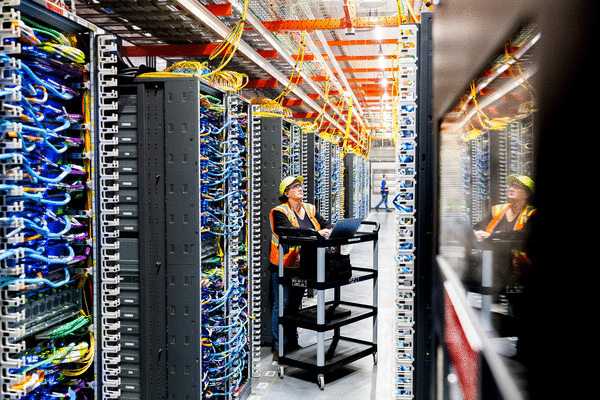
A Gallup poll released last month ought to alarm anyone who cares about whether the United States can best China in the artificial intelligence race. More than 7 in 10 Americans now oppose the building of AI data centers anywhere near where they live — and 48% are strongly opposed, a level of local resistance that exceeds opposition to new nuclear power plants.
The opponents are not fringe, and their concerns — higher utility bills, water draw, noise and competing land use — are legitimate, specific and grounded in how these facilities operate. In L.A.’s neighboring Monterey Park, voters overwhelmingly cast ballots to ban all data centers in their city. Nationally, opposition seems to only be gaining momentum.
If the AI industry and its investors continue to treat this opposition as a public-relations nuisance rather than a policy problem requiring engineering and contract redesign, they will hand the AI race to Beijing without ever losing a chip-design contest in Washington.
The strategic stakes are real. By most estimates the U.S. holds a roughly seven-month lead over China in frontier AI capability, and that margin exists almost entirely because of “compute” or processing power advanced by GPUs, the world’s leading semiconductor chips, along with the megawatts of power and the cooling that turn algorithms into productive data. Every credible roadmap to 2030 assumes hundreds of billions of dollars in new domestic data-center buildout to meet the growing demand for AI’s expansion and capabilities. Stretch that buildout across five extra years of permitting fights, and America’s lead quickly disappears.
Now consider where the buildout happens: in counties, at planning commissions and utility board hearings, in front of elected officials whose phones light up with constituents worried a new 500-megawatt campus down the road will draw down their aquifer and double their electricity bill.
Those constituents are not crazy to worry. On a recent drive to Charlottesville, Va., I was struck by the sight of a 550,000-square-foot data center along Interstate 66, the kind of facility this debate actually concerns. A single hyperscale facility can consume several million gallons of water each day for cooling, while the status quo of rate design in most states permits utilities to spread the cost of new transmission and generation across all customers, meaning the retiree in the bungalow helps pay for the substation that serves the cloud provider. That is a politically unsustainable arrangement, leading to the polling now showing up in Gallup.
This is the part the accelerationist wing of the industry has not absorbed: In a federal system, no one bulldozes through local objection at scale. You can win a zoning fight. You cannot win 5,000 of them while the political class reads the same poll everyone else does.
The good news? The underlying economics are forgiving, if anyone bothers to design for them. Three structural fixes would convert most opposition into grudging acceptance, and even a meaningful share of that opposition into active support.
First, interruptible load. U.S. electric grids are built to meet absolute worst-case demand: late afternoon on the hottest summer days. The rest of the year, substantial portions of that capacity sit idle. A data center that contractually agrees to throttle down or switch to on-site battery storage during the few hundred hours per year of peak demand allows utilities to spread enormous, fixed infrastructure costs across a larger base, which lowers the bill for every other customer. The technology exists. The contracts do not, because no one has insisted on them. Similarly, water consumption can be mitigated by best practices zoning codes that require closed-loop water cooling systems to lower usage by 80% to 95%.
Second, cost allocation in customer rate design. New transmission, new substations and new generation built specifically to serve a data-center campus should be paid for by the data-center operator, not by residential ratepayers. Where the new infrastructure produces system-wide savings, those savings should flow back to local households. A handful of states are inching toward this through “large-load tariff” reform; none has yet built the model that ought to become the template.
Third, host-community benefits that are proportional to the imposition. Loudoun County, Va., the world’s largest concentration of data centers, collects roughly $890 million in annual data-center tax revenue, about 38% of its general fund. That revenue has allowed the county to lower its residential property tax rate every year for a decade. Loudoun County has its frictions with industry, but the local political coalition in support of data centers is durable because residents see the money. Elsewhere, residents see only the cooling towers.
None of these ideas undermine competition or seek unfair advantage from regulators. It is the price of operating at scale inside of a democracy, and some industries have learned to pay up. Pipelines fund landowner trusts. Wind farms pay county royalties. Ports finance neighborhood mitigation. Industries that pay grow; industries that don’t, stall.
The real choice in front of the American AI buildout is not between speed and regulation. It is between an industry that does the unglamorous work of being a tolerable neighbor and one that loses to China while filing briefs against local counties.
Beijing is not waiting for the planning commission to adjourn.
_____
Warren Wimmer is CEO of Global Leaders Assembly Foundation, a former energy and infrastructure lender, and Principal at Wimmer Associates.
_____
©2026 Los Angeles Times. Visit at latimes.com. Distributed by Tribune Content Agency, LLC.




















































Comments