Commentary: The philanthropic model behind America's presidential centers is changing
Published in Op Eds
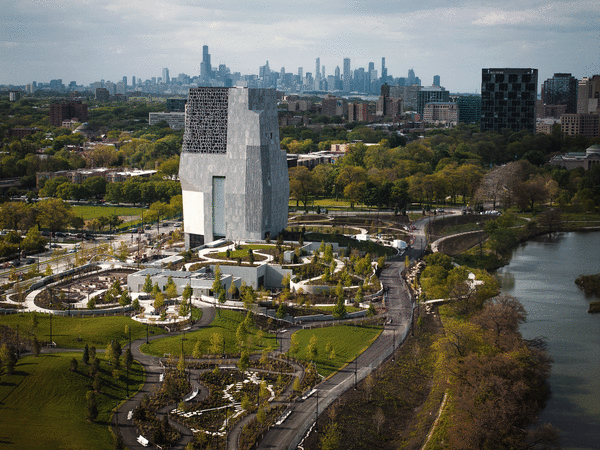
When the Obama Presidential Center opens on June 19, it will arrive with the kind of civic gravity Chicago understands well. A dedication ceremony. A weekend of programming. A new landmark rising from Jackson Park after years of anticipation, scrutiny, fundraising and debate.
Chicago has always known how to stage history. What matters now is how that history will be institutionalized.
This is not simply another museum opening.
The 19.3-acre campus on the South Side has been shaped through years of private fundraising and public attention, designed to function as a library, museum, convening space and public park. The center is expected to attract hundreds of thousands of visitors annually and generate billions in long-term economic activity. But the numbers alone are not what make the project significant. What matters more is what those numbers represent: ambition at civic scale.
Presidential centers are often described as places where history is preserved. Increasingly, though, they are becoming something more expansive. They are philanthropic institutions that shape how history is funded, interpreted, experienced and ultimately remembered.
That evolution extends far beyond Chicago.
Across the country, presidential centers have grown well beyond their archival origins. The George W. Bush Presidential Center combines a museum with a policy institute and university partnership, extending its influence into contemporary civic discourse. The Clinton Presidential Center operates not only as a library, but also as a platform for global initiatives and public engagement. Even the Reagan Presidential Library, often viewed as a more traditional example, was built and sustained through substantial private support.
The common thread is structural, not political.
These institutions are built through massive fundraising efforts that bring together donors, foundations, corporations, universities and civic partners. The presidential foundations behind them do far more than raise money. They shape the vision, define the scale, and determine what the institution can become decades after construction crews leave and opening ceremonies fade into memory.
In Chicago, those dynamics land in a city where conversations about investment are never abstract.
Jackson Park sits within a stretch of the South Side where development has long carried emotional, economic and political weight. For decades, residents have watched promises of revitalization arrive alongside fears of displacement and uneven benefit.
Supporters of the Obama Presidential Center view it as a generational investment capable of creating jobs, expanding programming, attracting visitors and bringing sustained visibility to the surrounding community. Critics and neighborhood advocates raise a different set of questions: whether longtime residents will still be able to afford the neighborhoods around it, whether economic opportunity will be distributed equitably, and whether the transformation unfolding around the center will ultimately benefit the people who remained through years of disinvestment.
Both realities can exist at once.
A presidential center can serve as a cultural anchor and an economic catalyst. It can also accelerate change in ways that become difficult to contain once momentum builds. The philanthropic model behind projects of this scale does not eliminate those tensions. In many ways, it exists inside them.
That is where the question of who benefits becomes more than symbolic.
Local residents may gain access to employment opportunities, expanded programming, improved infrastructure and increased investment. Visitors arrive for exhibitions and leave with a carefully curated understanding of presidential legacy. Universities and institutional partners gain proximity to one of the country’s most visible civic platforms. Donors become attached to a project that will carry national significance for generations.
Each constituency experiences the institution differently. The benefits are real, but they are not always distributed evenly. That is not necessarily a flaw in the model. It is the reality of how major civic institutions operate when they are built at this level of visibility, ambition and scale.
What has changed is the degree to which philanthropy now drives that scale.
Earlier presidential libraries operated more closely within traditional federal archival frameworks. Today’s presidential centers require extraordinary amounts of private capital to support broader ambitions. They are designed not only to preserve records, but to convene, educate, influence and shape civic life long after the presidency itself has ended.
That shift places philanthropy much closer to the center of how presidential legacy is constructed.
Funding does not determine historical fact. It does, however, shape the institution responsible for presenting those facts. It influences the breadth of programming, the accessibility of the space, the durability of operations, and the extent to which the institution can remain meaningfully connected to the surrounding community over time.
In Chicago, those dynamics are visible before the doors even open.
The Obama Presidential Center arrives as the city continues wrestling with larger questions surrounding growth, housing, equity, public investment and neighborhood identity. It also arrives as the country moves toward its 250th anniversary, a milestone that will inevitably prompt renewed attention to how American history is framed, interpreted and publicly understood.
Presidential centers will play an important role in that process.
They are no longer passive archives housing documents behind climate-controlled walls. They are active civic institutions where history is interpreted, presented, institutionalized, and, to some extent, shaped by the systems that sustain them. The philanthropic model behind these centers allows for ambition and long-term reach.
Presidential legacy in the United States is no longer defined solely through retrospection and archival preservation. Increasingly, it is institutionalized through large civic spaces designed, funded and operated in real time.
Modern presidencies now carry the expectation of a post-presidential institution requiring years of fundraising and sustained philanthropic investment. These centers do not simply preserve the past. They create forward-facing platforms that shape how a presidency will be encountered and understood long after the administration itself has ended.
Ultimately, the Obama Presidential Center will be judged on far more than attendance figures or opening-weekend enthusiasm. Over time, its success will depend on whether it remains connected to the city that hosts it, whether its programming continues to resonate, and whether the promises surrounding economic and community benefit are realized across the neighborhoods it touches.
And that is not only a Chicago question.
It is a question facing every city that hosts one of these institutions, and every philanthropic model increasingly responsible for sustaining them.
Presidential centers are often introduced as places where history is preserved.
In reality, they are places where history is built, interpreted, structured and sustained.
And increasingly, they are built through philanthropy.
____
Andre Dowell is founder and president of the National Philanthropic Foundation, advancing philanthropic legacy, next generation leadership, and civic understanding. He previously served as director of development at the White House Historical Association, focusing on stewardship and American history.
_____
©2026 Chicago Tribune. Visit at chicagotribune.com. Distributed by Tribune Content Agency, LLC.




















































Comments