Commentary: Judicial independence over judicial sycophancy
Published in Op Eds
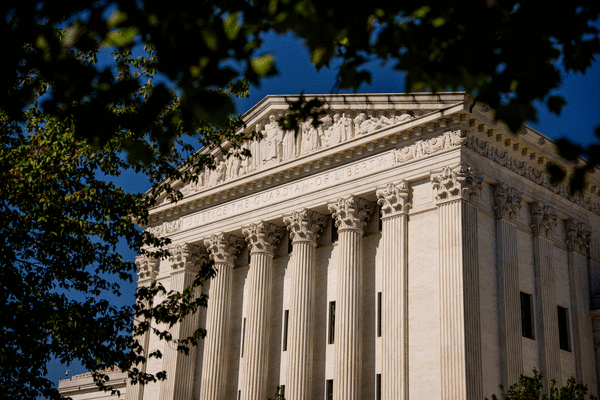
While the president of the United States has the power under Article II, section 2 of the United States Constitution to appoint justices of the Supreme Court and other federal judges, all of whom have lifetime tenure, the president must exercise this power with the “Advice and Consent” of the Senate.
The Senate’s advice and consent cannot be meaningfully exercised without the chance to question judicial nominees. Thus, a key component of the Senate’s evaluative process is the confirmation hearings during which senators question the president’s nominees.
Many nominees are alert to efforts to discern their views on disputed legal issues and unsettled law and decline to answer such questions or answer them in a manner that avoids violating the prohibition against opining. Nominees of both parties who were appointed to the Supreme Court rightly refused to answer such questions.
One Republican nominee who scrupulously honored the prohibition against answering improper questions, even off the record, was Roger J. Miner, then a judge on the Second Circuit Court of Appeals. In 1987, Judge Miner was reputedly at the top of President Ronald Reagan’s list of possible replacements for Judge Robert H. Bork when opposition to his Supreme Court nomination became insurmountable.
During the pendency of the Bork confirmation hearings, a Republican member of the Senate Judiciary Committee telephoned Miner at his home and inquired into his views on the then hot-button issue of abortion. Miner’s wife overheard her husband reply that “he would decide each case on its merits.” Judge Miner later explained to his wife that his “reputation was too high a price to pay for a seat on the Supreme Court of the United States.”
During the recent Senate confirmation hearings, the nominees for various federal courts were asked, “Who won the 2020 election?” Some senators were taken aback when the nominees uniformly answered that former President Joe Biden “was certified as the winner of the 2020 election.” Senator Richard Blumenthal, D-Conn., observed that the nominees were unwilling to say that Biden had won the election.
The nominees did not try to disabuse the senator of his observation, and when the senator again confronted one of them with their unwillingness to say whether or not Biden had won the election, the nominee asserted that it had become “a matter of political concern,” to which Blumenthal retorted that it was also “an issue of fact.” The nominee then avoided a direct answer by using the word “fact” when stating that Biden was “in fact certified the winner of the 2020 election.” As all the nominees similarly skirted a direct answer, Blumenthal concluded that they feared offending the president.
In its November 2025 report, the organization Demand Justice earlier had noted that all 44 recent federal judicial nominees provided the same answer to the Biden question “using key words and evasive language,” to avoid answering “basic questions of documented, established, and historical fact,” namely that Biden won the popular vote. Other nominees were not even willing to state that Biden was certified the winner, instead asserting only that he “served” as president.
Notably, and in contrast to the question posed to Judge Miner, these nominees were not asked about an unsettled or disputed legal issue, as it is more than six years since the 2020 election, and it had already been fully litigated. “Given the sheer number of election-related cases that lacked merit, federal judges in states like Colorado, Michigan, and Wisconsin have begun moving to consider and, in at least one instance thus far, implement sanctions against the lawyers that submitted them.” That the Department of Justice has commenced investigations into the election procedures of certain states does not alter those facts.
As judicial independence complements, if not ensures, a judge’s neutrality, the uniformly evasive answers of the nominees reflect obeisance to the president, rather than compliance with the prohibition of “allow(ing) family, social, political, or other relationships to influence judicial conduct or judgment.” At any other time in American history, such obeisance would be disqualifying. Why refuse to acknowledge the popular vote? What harm is there other than offending the president?
While we are free to express or not express ourselves when we see fit, nominees to the federal judiciary must candidly and honestly answer proper questions posed by senators of both parties. The nominees’ responses at the recent confirmation hearings reflect a lack of candor at best and, at worst, immoderate obeisance to the president. Such sycophancy in a judge does not pass the smell test; this retired judge smells a rat.
____
Justice Barbara Jaffe, retired from the Supreme Court of the State of New York, is a volunteer of Lawyers Defending American Democracy (LDAD).
_____
©2026 The Fulcrum. Visit at thefulcrum.us. Distributed by Tribune Content Agency, LLC.

















































Comments