David M. Drucker: The GOP's YOLO caucus is peak government
Published in Op Eds
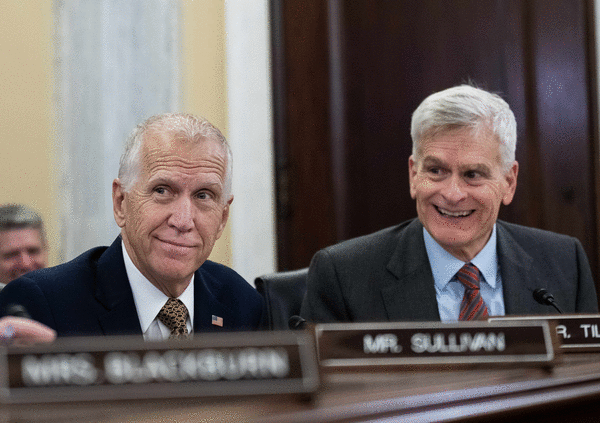
The fact that a pair of Republican senators are being heralded for doing their jobs reveals just how much Congress has atrophied, especially during President Donald Trump’s second term.
Freed from the president’s political yoke, Senator Thom Tillis (because he opted against running for reelection) and Senator Bill Cassidy (because he lost his primary to a Trump-endorsed opponent) have suddenly taken to wielding Congress’ constitutional power.
North Carolina’s Tillis almost single-handedly forced the Trump administration to abandon a bogus investigation of then-Federal Reserve Chair Jerome Powell. And Louisiana’s Cassidy joined his colleague in opposing White House priorities the instant he delivered his concession speech May 16: He voted with Democrats, for the first time, to limit Trump’s war-making powers in Iran.
The pushback against the leader of the Republican Party has struck observers as so unusual that Tillis and Cassidy have been labeled the so-called YOLO Caucus, as in “you only live (or lose, in this case) once.” The term is used to describe a state of mind in which a person feels he or she has nothing left to lose. But the two senators aren’t going skydiving, Rocky Mountain climbing or riding a bull named Fu Manchu (hat tip to Tim McGraw). They’re simply doing the job they were elected to do per standard procedure in the user’s manual.
Keep in mind: Congress’ powers were not spelled out in Article I of the Constitution by happenstance. The legislative branch of government was meant to be “supreme” among the three instead of coequal. “The Founders expected members of Congress to be jealous of their power,” explained Timothy Harper, the director of constitutional studies at Advancing American Freedom, the conservative think tank founded by former Vice President Mike Pence.
The perception that Tillis and Cassidy are YOLOing is a stark reminder that both Democratic and Republican members of Congress have been abdicating more and more (and more) of their authority to the executive branch for too many years. In fact, it’s become normal.
“Members of Congress defer to the president whenever their party occupies the White House,” Harper said. They do so out of political expediency: fear of the president, fear of voters who like the president, and a desire to bypass opposition from the minority party on Capitol Hill — particularly in the Senate, where most legislation requires 60 votes to overcome the filibuster.
This dynamic existed during Joe Biden’s administration and even preceded Trump’s first presidency under Barack Obama and George W. Bush, as I wrote last year. But under Trump’s second administration, the expansion of executive authority has happened on a scale so large that many Americans have come to believe the fabric of democracy is under threat.
The important question now is: Will other GOP lawmakers join Tillis and Cassidy in the YOLO Caucus? With Trump’s job approval rating at a nadir and a toxic political atmosphere for Republicans, it’s fair to examine whether the fear of being ousted in midterm elections this fall will overwhelm the fear of Trump and his loyal grassroots supporters. Some signs point to yes.
A backlash from Senate Republicans forced Trump and the Justice Department to abandon a $1.8 billion slush fund intended to compensate those convicted of crimes for purportedly political reasons, including Trump’s allies. The president’s request for $1 billion to fund his proposed White House ballroom and his appointment of Bill Pulte as director of national intelligence have also run into opposition from Republicans in the Senate — and the House. And just last week, four House Republicans joined with Democrats to push through the War Powers Resolution on Iran.
Then again, it’s probably wise to avoid — as former Fed Chairman Alan Greenspan might say — overexuberance. “I’m skeptical that members of Congress, of either party, have a renewed interest in governing and exerting power,” Joseph Postell, an associate professor of politics at Hillsdale College in Michigan, told me. “There has certainly been some pushback from congressional Republicans recently, but I think it is mostly due to the unpopularity of some of the president’s policies and actions.”
Let’s not forget why the YOLO Caucus exists in the first place.
Cassidy lost his primary because Trump wanted retribution after the senator voted to convict the president at his second impeachment trial more than five years ago. Tillis looked at the prospect of having to simultaneously bend the knee and look over his shoulder throughout the final two years of his second term and said, “No, thanks.”
Senator John Cornyn of Texas, who is so far declining YOLO Caucus membership, also lost his primary following Trump’s endorsement of his challenger, state Attorney General Ken Paxton. Representative Thomas Massie of Kentucky suffered the same fate, as did a collection of state senators in Indiana who defied the president on redistricting.
That’s why so many congressional Republicans, even those who have since won their primaries, are treading cautiously. With an eye toward renomination in 2028 and fear of a vengeful Trump whose desire for retaliation knows no statute of limitations, many congressional Republicans aren’t making any radical shifts.
But the Democrats’ hair-raising experience with Trump’s second presidency is not converting them into born-again adherents to the separation of powers either, as NOTUS reported earlier this year. Predictably, the party wants the next Democratic president to have the opportunity for the same troubling powers seized by Trump. “We can’t play the game that Republican presidents get lots of power and Democratic presidents don’t,” Senator Elizabeth Warren of Massachusetts, a Democrat, told NOTUS.
As the saying goes: You only live once.
_____
This column reflects the personal views of the author and does not necessarily reflect the opinion of the editorial board or Bloomberg LP and its owners.
David M. Drucker is a columnist covering politics and policy. He is also a senior writer for The Dispatch and the author of "In Trump's Shadow: The Battle for 2024 and the Future of the GOP."
_____
©2026 Bloomberg L.P. Visit bloomberg.com/opinion. Distributed by Tribune Content Agency, LLC.


















































Comments