Allison Schrager: The influencer economy has crossed the line
Published in Op Eds
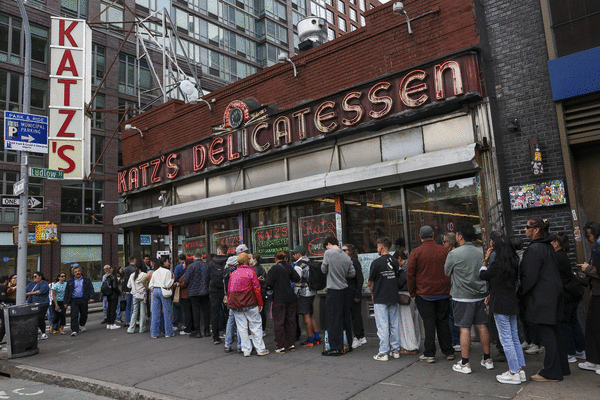
Saturdays in Greenwich Village require contending with the lines. Starting at 9 a.m., you see blocks-long queues of people waiting for all sorts of things: bagels, pastries, pizza, soggy sandwiches, premium frozen yogurt with candy on it. Even if you don’t want to, you will get swept up in a line, because they take over the sidewalks.
To be honest, I don’t mind. The lines are the visible representation of capitalism at work. Commerce, meritocracy, the fruits of technological innovation — all are on display, thanks to the rise of the influencer economy.
I’m also aware that all these people aren’t waiting for the food, exactly. The lines exist because someone posted a short video saying this French dip will change your life or this dotcake is the best in the city. The line-waiter wants to get that sandwich or cake so they can share their experience and grow their audience, or maybe just gain the approval of their network.
According to one survey, 60% of Generation Z — and 48% of millennials — say they waited in line for more than 30 minutes to eat a specific food in the last year. Most say they’d do it again, and that at least part of the motivation was to post on social media.
All of which is revealing about the economy. Inequality has become more obvious to everyone. There’s an hours-long line for one pizza place, while the struggling shop around the corner (whose pizza is just as good) has few customers. Getting the influencers’ approval is a matter of luck and knowing who to target. The influencer economy itself also has a winner-takes-all element, with some influencers earning high six figures while most earn nothing.
That said, it’s worth noting that the influencer economy is an improvement on what came before. I recently reread a decades-old cover story in New York magazine about the young women, dubbed “Power Girls,” who controlled “much of Manhattan’s trendiest nightlife” in the late 1990s. They were the original influencers. High-heeled, attached to their flip phones, and with bleached and straightened hair, they owned PR firms that could make or break a business. They could draw up a guest list for a launch party (and see that it got covered in the New York Post), get a celebrity to go to a restaurant or club, and then make sure it had a line out of the door.
These women all shared two characteristics: They were young and extremely well-connected. It was a rare and powerful combination. There are a lot of young people in the workforce, but few are also born into the kind of wealthy New York family that confers access to and even power over A-listers at an early age.
Back then, the Internet was still young and there was no social media. People learned about new products or hot places by reading reviews or stories in newspapers or magazines — or better yet, about a rich or famous person enjoying them in the gossip columns.
Now the world is different. Social media has democratized information, and influencers have largely replaced PR people. Getting into the papers is less important. If you want to build hype and make a brand, you hire or engage an influencer. Today’s power influencers are also young, but they might come from anywhere. They don’t need wealth or connections. They don’t even have to live in New York.
All they need is a phone, a little charisma, a loud voice, and a willingness to document 90% of their waking hours. About 75% of Gen Z/millennials say being a “content creator” is a viable career, and 45% say they are creators, most as a hobby.
It is a much more democratic way to wield power. Audience size is critical; you must court an economically diverse population. Whereas those “Power Girls” had to know how to please only a relatively small subset of the right people.
The displacement of nepo PR people by influencers offers a preview of how the economy is changing. Public relations jobs still exist, but technology has made the narrow skills of the Power Girls less valuable. The influencer economy is more accessible and employs more people, but is also more chaotic and uncertain. If a brand works with influencers, it is not cheap or guaranteed to work, but it is still cheaper than hiring a PR firm used to be.
What influencers sell is also more accessible. Only a limited number of people ever had the means or ability to go to a party at Moomba. All anyone needs to procure the crispiest sourdough bagel in Manhattan is time and an alarm clock. Hawking somewhat affordable goods also helps an influencer build an audience. In a New York where more people wait in line for food than at nightclubs, that matters.
Influencing is still a winner-take-all market, like much else in the U.S. economy. But who the winners are, and who they need to please, has become more democratic. Such is the nature of technological change: Almost everyone laments the jobs it destroys, but few appreciate the ones it creates.
_____
This column reflects the personal views of the author and does not necessarily reflect the opinion of the editorial board or Bloomberg LP and its owners.
Allison Schrager is a Bloomberg Opinion columnist covering economics. A senior fellow at the Manhattan Institute, she is author of “An Economist Walks Into a Brothel: And Other Unexpected Places to Understand Risk.”
_____
©2026 Bloomberg L.P. Visit bloomberg.com/opinion. Distributed by Tribune Content Agency, LLC.



















































Comments