Commentary: Can governing survive without continuity?
Published in Op Eds
Modern societies depend on continuity.
Electric grids are built over decades. Infrastructure systems require long investment cycles. Defense planning depends on sustained procurement and strategic consistency. Climate adaptation, energy systems, artificial intelligence governance, public health preparedness, and fiscal stability all require institutions capable of maintaining long-term priorities across multiple administrations.
The gap between winning and governing has a downstream consequence. Policies now reverse rapidly between administrations, and the systems that depend on stable direction find it harder to absorb the discontinuity.
In several major 20th century policy domains, broader governing coalitions sustained longer planning horizons across administrations even during periods of sharp political conflict. The interstate highway system, Cold War defense planning, postwar alliances, and major infrastructure and research investments unfolded across multiple political cycles because enough institutional continuity existed to sustain them. Stronger committee structures that rewarded specialization, a shared information environment rather than the partisan-sorted media of today, and political coalitions still organized around governing priorities rather than mutual opposition all helped sustain that continuity.
Those conditions have weakened. The institutional habits that once carried major commitments across administrations have eroded. At the same time, the systems that those commitments support — grids, infrastructure, defense, technology, public health — have grown more interconnected and less forgiving of reversal.
Consider energy.
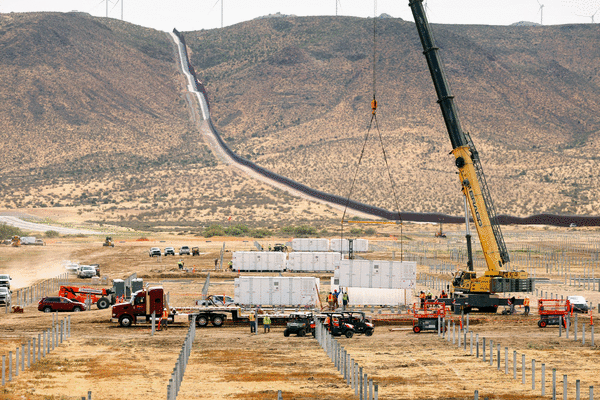
The Inflation Reduction Act of 2022 created the most significant federal commitment to domestic clean energy investment in a generation. Within two years, a change of administration and a follow-on law, the One Big Beautiful Bill Act of 2025, phased out many of those incentives and rescinded grants tied to active projects. Manufacturers canceled projects already underway. Sixteen projects were canceled in the first quarter of 2025 alone.
Tribal nations were among the hardest hit. Of the $484 million in grants awarded to 46 tribes in 2024, roughly 85-90% have since been clawed back. Tribal energy costs, already among the highest in the country, remain elevated as a result. The grants were obligated money — funds the federal government had committed and that recipients had begun to spend. Private capital committed alongside those grants — for development, engineering, and site preparation — was stranded. The money spent before the reversal is not returned, and the energy capacity it was meant to produce does not exist.
The cost of that whiplash is not only domestic. Iran closed the Strait of Hormuz in early 2026 in response to U.S. and Israeli strikes, and at the time of this writing, the strait remains effectively closed under a conditional ceasefire, with roughly one-fifth of global oil consumption transiting the route under normal conditions.
The United States does not need Middle Eastern oil. Domestic production is more than adequate, and what the country imports from Canada and elsewhere reflects refinery economics and market choice rather than necessity. But oil prices are set globally, and American consumers pay the shock at the pump regardless of where the barrels originate. The IRA was building exactly the capacity that would have reduced that exposure, accelerating the shift to electricity in transportation, heating, and industry. China and other countries moving faster on clean-energy buildout are better positioned to absorb the kind of disruption the Hormuz closure represents. The United States canceled the policy that was reducing its vulnerability a year before events proved its worth.
Democracies depend on disagreement and political change. They also depend on institutions capable of sustaining long-term priorities across political transitions. Rapid technological change, instantaneous communication, and tightly interconnected economic and information systems compress political time horizons in ways the Civil War, the Depression, and the Cold War did not.
Whether American coalitions can adapt to those compressed horizons is the open question. The clearest early evidence will come from voters, not parties. Realignments tend to show up first in local and state elections before they reach national politics. The 1960s civil rights realignment was visible in Southern state results before it shaped a presidential election. The Tea Party shifted primaries and special elections before it shifted Washington.
The current picture is harder to read. Some voters appear to be moderating, choosing candidates who promise to govern rather than fight. Some are moving further toward the extremes of their party, rewarding candidates who treat the opposing side as the primary threat. Some are disengaging from electoral politics altogether. Which of these patterns gains ground over the next several cycles will tell us more about whether the coalitions can reorganize than any analysis of current party behavior.
____
Edward Saltzberg is the Executive Director of the Security and Sustainability Forum and writes The Stability Brief.
_____
©2026 The Fulcrum. Visit at thefulcrum.us. Distributed by Tribune Content Agency, LLC.





















































Comments