Commentary: Save our endangered kelp forests
Published in Op Eds

Until recently, the main threats to kelp and coral reefs were overfishing and pollution. Now it’s our warming seas.
A study carried out by scientists from the National Oceanic and Atmospheric Administration (NOAA) and 30 other institutions around the world reports that the ocean absorbed more heat last year than ever before. Now the agency is predicting a record-breaking El Niño (periodic Pacific warming) this year that will impact global weather.
This bad news about a changing climate comes on top of a marine heatwave currently stretching from Micronesia to coastal California. Scientists say it’s likely to become more severe than the heat wave known as the “Blob,” which appeared off the Pacific coast between 2013 and 2017 and contributed to widespread loss of marine life and kelp forests on the West coast.
These oceanic heat waves can increase regional water temperatures 4-8 degrees or more, leading not only to critical habitat loss —84% of the world’s coral reefs experienced bleaching in 2025 alone — but also generating more severe storms and torrential rainfalls, as was the case in Hawaii and Wisconsin this year.
While people are somewhat aware that the world’s coral reefs are in trouble, fewer know that cold water kelp forests have declined by more than than 50% since the mid-20th century. Kelp plays a key role in the life cycles of commercially valuable marine fishes such as cod, salmon and herring. Many species of kelp and other seaweeds also provide a source of food for human consumption, with a 35-40 million metric ton annual aquaculture harvest.
Like coral reefs, kelp forests provide coastal storm protection, and like terrestrial forests, they contribute to the oxygen we breathe through photosynthesis. A report published by Nature estimated that globally, kelp forests contribute half a trillion dollars a year in goods and services.
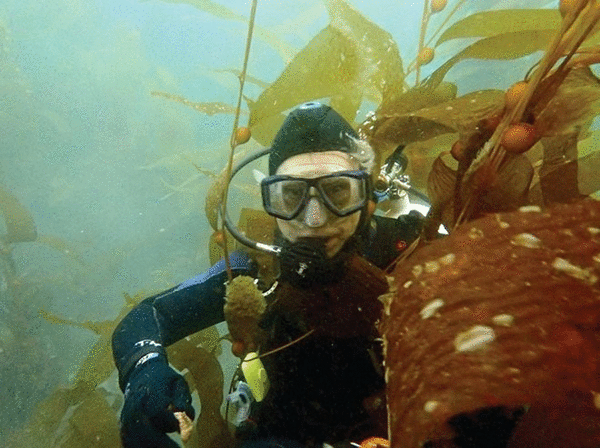
Diving in kelp has inspired and delighted me and my friends for years. Seeing its loss is heartbreaking for those of us who find wonder and grace in its majestic ever changing cathedral light and dense trunks (stipes), blades and canopies full of schooling fish, curious seals and jewel-like nudibranchs or sea slugs.
So what happens to the leafy sea dragons, whales and sharks dependent on kelp forests if they disappear? What happens to us? Neither science nor society has figured that one out.
The hopeful news is that kelp is one of the most resilient and fastest-growing organisms on earth — the bamboo of the sea — capable of growing up to two feet a day, even as it faces decline.
I’ve swam through a kelp forest that 10 years earlier had been a moonscape-like sea urchin barren (urchins eat kelp and rapidly multiply in the absence of sea otters and other predators). I’ve gone out with the nonprofit Bay Foundation off southern California whose divers, by smashing millions of overabundant urchins, have witnessed the return of more than 80 acres of healthy giant kelp forest.
In Argentina and the Azores, citizen action has led to the creation of large marine parks that harbor healthy wild kelp, while in South Korea, where their fisheries agency sees kelp as essential to their food security, a $29 million a year investment has seen the restoration of 50,000 acres of kelp forest to date with the aim of restoring 125,000 acres by 2030.
And yet, short of a rapid transition off ocean warming fossil fuels — which is not happening in this moment— we really can’t hold out much hope for the future of kelp forests. Our focus now must be on saving what’s left, with the understanding that kelp forests, although resilient, are in need of active human intervention.
This should include establishing more fully protected marine parks and investing in essential research and restoration efforts such as the “Help Our Kelp Act” recently introduced in Congress would help fund.
We must do all that we can so that these kelp forests, which have been around for more than 30 million years, will one day thrive again, to the benefit of coastal communities both human and wild across the temperate seas of our still awesome blue marble planet.
_____
David Helvarg is an author and executive director of Blue Frontier, an ocean policy group. His latest book, “Forest of the Sea: The Remarkable Life and Imperiled Future of Kelp,” has just been released by Island Press, an imprint of Princeton University Press. This column was produced for Progressive Perspectives, a project of The Progressive magazine, and distributed by Tribune News Service.
_____
©2026 Tribune Content Agency, LLC.





















































Comments