Mark Gongloff: Killing Lake Powell won't save the Colorado River
Published in Op Eds
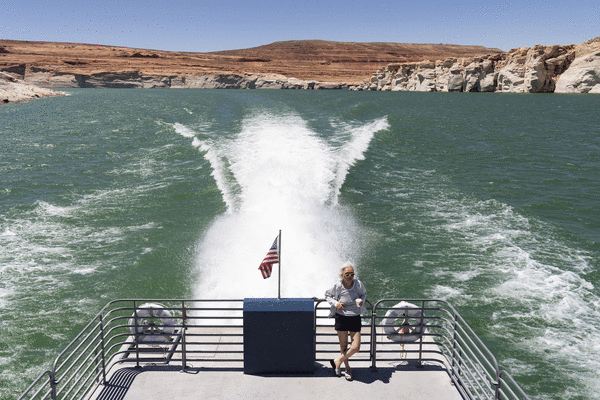
Contrary to popular belief, rearranging deck chairs on a sinking boat can theoretically be of some benefit, if you’re clearing a path to the lifeboats, say, or keeping panicky people busy. Very quickly, though, you’ll have to confront the real problem, which is that you are on a sinking boat.
Unlike the Titanic, the Colorado River has too little water rather than too much. But many of the solutions people are proposing to address the river’s worst crisis in recent human history are tantamount to deck-chair rearrangement. None address the long-term, underlying issue that we are asking too much of a dwindling resource.
“We have a much smaller glass and too many straws in that glass,” Brad Udall, senior water and climate scientist at Colorado State University, told me. “The only way to make it work in the long run is to pull some straws out.”
After one of the warmest, driest winters on record and a historically arid quarter-century, the river’s two biggest reservoirs, Lake Mead and Lake Powell, are at 29.5% and 23.5%, respectively, of their capacities. The Colorado’s recent annual flow of about 12 million acre-feet (AF) per year is about 2 million AF lower than its historic flow and 4.5 million AF lower than the amount of water promised to U.S. states, tribes and Mexico by the Colorado River Compact of 1922 and a 1944 treaty. (An acre-foot is how much it takes to flood an acre with a foot of water; it’s usually enough to supply two households per year.)
With 40 million people and 5.5 million acres of farmland depending on its water, a vanishing Colorado River is an emergency that will only grow more dire as the planet warms and water grows more scarce in the West. One more snowpack-light winter like the one we just experienced could cause a 2.59 million AF water shortage for consumers, warns a new report from analysts at Arizona State University and other research groups. That would be enough to sink Lakes Mead and Powell to levels that would threaten not just the hydroelectric power produced by the Hoover and Glen Canyon dams but the structural integrity of those dams. A mere crisis could become a humanitarian catastrophe.
Such desperate times have inspired calls for some desperate measures. One standby idea is to sacrifice Lake Powell to save Lake Mead. Letting river water flow straight into Lake Mead would bolster that reservoir, theoretically reduce how much river water gets lost to evaporation and avoid water getting stuck behind Glen Canyon Dam where it’s of no use to the 25 million people who need it downriver. Recent U.S. Bureau of Reclamation efforts to protect the dam by filling Powell with water from reservoirs upriver was “robbing Mead to pay Powell,” water expert Ronald Rudolph wrote last month in an op-ed for the Las Vegas Review-Journal.
As the author Zak Podmore noted in a separate op-ed in the Salt Lake City Weekly, Glen Canyon Dam is built so that Lake Powell is effectively at “dead pool” — unable to reliably deliver water downstream — at just 3,500 feet, not much lower than its current 3,528 feet. It will stop generating power at 3,490 feet. He makes a compelling argument for giving up the ghost and reengineering the dam to let all of Lake Powell’s water go and restore Glen Canyon to its natural state.
As it is, much of Glen Canyon’s pre-flooding ecosystem has quickly returned as Lake Powell has retreated, exposing gorgeous canyons and rock formations like the Cathedral in the Desert that had been submerged for decades. Just two of its 18 boat-launch sites are available for a lake that once entertained millions of boaters. This aquatic tourist spot is already turning into an earthier one.
But Udall and other water experts insist draining Powell to fill Mead is only a stopgap. Given that Powell is nearly 2,500 feet higher in elevation than Mead, it’s cooler and less likely to evaporate. Reworking Glen Canyon Dam to still function at lower water levels, as Podmore and lower-basin states have suggested, is a good idea but will cost billions of dollars.
The states that use the river have been haggling for months about a new agreement for divvying up its water, missing deadline after deadline for a deal. If they can’t agree soon, then the federal government will impose its own solution this summer, an outcome all parties have already signaled will make them unhappy.
That result will include not only the status quo for Lake Powell but for a 1922 compact that was signed on what might as well be a different planet. Since then, Earth has warmed by 1.4 degrees Celsius, making droughts more frequent and severe. Even if we were to stop burning fossil fuels tomorrow and thus limit the amount of greenhouse gases we spew into the atmosphere, the warming that has already happened would still mean a Colorado River with less to give.
Gerald Kauffman, director of the University of Delaware’s Water Resources Center, suggests tearing up the 1922 compact and replacing it with something closer to the 1961 Delaware River Basin Commission, a regional body with state and federal representatives. This might cut down on the chronic interstate squabbling that plagues the Colorado.
“Unless the way water is managed in the basin changes, these fights will keep occurring,” Kauffman said.
Perhaps more important, everyone using Colorado River water needs to accept that the allocations they were promised 104 years ago will never be available again. If supply is tight and getting tighter, then it’s time to address demand.
A good place to start would be agriculture, which takes up half of the river’s flow. And most of that goes to alfalfa and other water-intensive grass hay. This cow food consumes more water than all the cities, factories and data centers in the basin combined. It accounts for nearly a third of the river’s total water use, according to a 2024 study in the journal Communications Earth & Environment. And about 20% of the alfalfa grown is shipped overseas, according to a 2022 University of Arizona study.
An economist would say we should simply price beef and dairy in accordance with their environmental impact and water according to its scarcity. A politician would laugh and laugh at such talk. The politician will win this argument for now. But the policy equivalent of mere furniture-shuffling won’t prepare anybody for the inevitable.
____
This column reflects the personal views of the author and does not necessarily reflect the opinion of the editorial board or Bloomberg LP and its owners.
Mark Gongloff is a Bloomberg Opinion editor and columnist covering climate change. He previously worked for Fortune.com, the Huffington Post and the Wall Street Journal.
©2026 Bloomberg L.P. Visit bloomberg.com/opinion. Distributed by Tribune Content Agency, LLC.





















































Comments