Commentary: California is at the center of the fight against Parkinson's
Published in Op Eds
What will it take to cure Parkinson’s disease? It’s one of the first questions I asked when I was diagnosed in 1991, and one that patients and families still ask today. A lot has changed in those three decades, and thanks to the tireless efforts of a global community of scientists, patients and advocates, we’re closer to a cure than we’ve ever been. But it’s no secret that finishing the job will take everything we’ve got — and the science continues to outpace the money.
Right now, Californians have a massive opportunity to change things for the better. Senate Bill 895, introduced by Sen. Scott Wiener, would create the California Foundation for Science and Health Research, funded through a voter-approved multibillion-dollar bond. The proposed foundation would aim to take on some of our most pressing challenges, from diseases like Parkinson’s and cancer to climate change and wildfires.
In Parkinson’s, cells that produce dopamine gradually stop doing their job. The functions our bodies rely on — including movement, mood and cognition — break down, worsening over time. But biology doesn’t have to be destiny. Research is already changing what’s possible for people with Parkinson’s, and California is proving it.
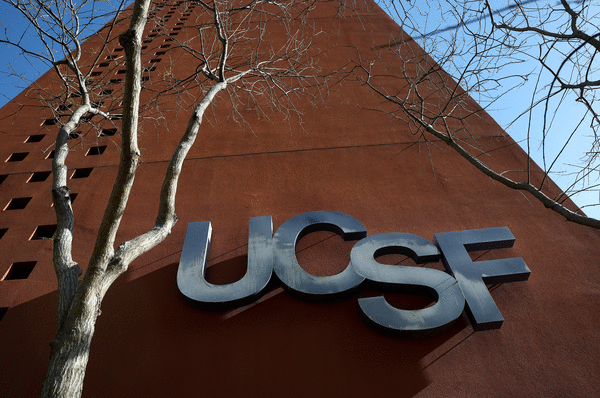
At UC San Francisco, researchers have developed a new generation of adaptive deep brain stimulation — technology that reads brain signals in real time and adjusts treatment automatically. At UC San Diego, scientists have reprogrammed brain cells to replace the dopamine-producing neurons Parkinson’s destroys, reversing symptoms in early pre-clinical models.
The Michael J. Fox Foundation is proud to have helped fund both efforts, but this is just a fraction of what’s within reach — and we can’t get there on our own. No single organization can. What we need is public investment to match the scale of the enormous opportunity before us. That’s what will take us further and faster than ever.
More than 1.2 million people in the U.S. — including nearly 135,000 Californians — live with Parkinson’s and related conditions today. Parkinson’s is the world’s fastest growing neurological disease, and in 2024 alone, the disease cost patients, families and taxpayers across the country a stunning $82 billion. That includes things you’d expect, like doctor’s visits and medications. It also includes the quieter, more insidious costs: premature retirements, college funds siphoned away, spouses enlisted as full-time unpaid caregivers.
Whether you live with Parkinson’s or not, you’re paying for it. For some of us, there’s no opting out. But for California taxpayers, SB 895 gives you a chance to put your money to better use — directing it toward cures instead of costs to ease the burden on all of us.
There has never been a better moment to go all in on Parkinson’s research. Nearly two dozen new treatments have been approved in the last decade. More than 175 are currently in clinical development, half of which aim to slow or entirely stop the disease — not just treat its symptoms — something we’ve never been able to do before. In 2023, scientists validated the first test that can detect Parkinson’s biology in living humans, even years before outward symptoms emerge. That breakthrough is already changing how we diagnose and treat the disease — and how we might soon prevent it altogether.
Behind this momentum are tens of thousands of people — patients who roll up their sleeves and join clinical trials, scientists who turn dead-ends into detours, fundraisers who power research and advocates who help policymakers understand what’s at stake. I’m endlessly grateful for this community — one that chooses, every day, to push against the limits of what we know. I’ve seen them chip away at some of the most complex questions in brain science and say, “We can do more.” Again and again, they do.
Our biggest roadblock isn’t a lack of talent or promising ideas. We’re not short on ingenuity or determination. What we need is increased public investment to scale those ideas, getting research dollars into the hands of brilliant people who can kick down every door until we find the breakthroughs we’re looking for.
I’ve realized for a long time that cures won’t fall from the sky. We have to climb up and get them. California’s world-class universities, research hospitals and biotech industry have created an ecosystem where discovery accelerates and compounds. It’s a place where entrepreneurial thinking meets scientific rigor — where smart, ambitious people come together to solve our toughest problems.
Senate Bill 895 is a bet on California’s ability to do what it does best, at exactly the moment when science is set to sprint.
To the California Senate: Thank you for passing this bill. Your leadership and commitment to science are moving us closer to cures. To the California Assembly: I urge you to do the same. And to Californians: Call your Assemblymembers and Gov. Gavin Newsom — let them know why this bill matters to you. If it reaches the ballot in November, vote for it.
Millions of people and families affected by disease in California and across the country are counting on us to get this right. The science is ready. How fast it can go is up to us.
____
Michael J. Fox is an actor, an author and the founder of the Michael J. Fox Foundation for Parkinson’s Research. He was diagnosed with Parkinson’s disease at age 29.
_____
©2026 Los Angeles Times. Visit at latimes.com. Distributed by Tribune Content Agency, LLC.





















































Comments