Karishma Vaswani: Japan is stepping up as Asia's new powerbroker
Published in Op Eds
The U.S. would have you believe it is showing leadership in Asia. Yet the nation displaying real resolve is Japan.
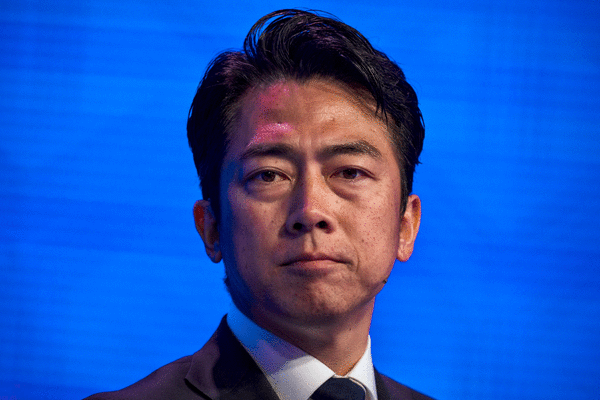
Standing up to China over its rapidly expanding military strength is what the Indo-Pacific wants to hear from Washington. Instead, it was left to Japan’s Defense Minister Shinjiro Koizumi to do that when he took the stage at Asia’s premier security forum on Sunday. He offered a vision for the Indo-Pacific that was more candid and ambitious than his American counterpart the day before.
“This region must remain open to all countries that respect our shared rules and principles,” Koizumi said. His message to others at the Shangri-La Dialogue in Singapore was clear: Tokyo is ready to do more to boost growth and enhance security in the region. Japan is already working to provide increased military cooperation, information sharing and training to nations such as the Philippines and Australia, while offering $10 billion in financial support to those in Southeast Asia to help with soaring crude oil prices driven up by the U.S.-Israel war with Iran.
Beijing regularly bristles at Tokyo’s rising regional stature and often invokes Japan’s wartime history — and its own violent experience of occupation — to warn of any revival of its historic rival’s military power. In a not-so-subtle reference, Koizumi alluded to China during his speech, saying: “There’s a country that has a huge arsenal of nuclear weapons and strategic bombers. Japan has neither of such weapons, and yet Japan is labeled ‘new militarism.’ Isn’t it strange?”
In contrast to that boldness, U.S. Defense Secretary Pete Hegseth took a softer line on China. He repeated the phrase “constructive strategic stability” to describe Washington’s ties with Beijing — a slogan President Xi Jinping put forward during a recent summit with President Donald Trump. Hegseth also conspicuously avoided directly mentioning Taiwan in his speech, prompting praise from the Global Times, the tabloid mouthpiece of the Chinese Communist Party. That’s an achievement no American official should aspire to.
The messaging discipline on Taiwan was notable, Ankit Panda, a senior fellow at the Carnegie Endowment for International Peace told me on the sidelines of the forum. “Hegseth showed up with the idea to not do anything to upend the new camaraderie between Xi and Trump. He stuck to the script.”
I’ve been to several of these gatherings over the years, and while previous American administrations also had their missteps with Asia, there was at least an attempt to articulate a shared future. Not so for Hegseth, who instead called for a return to realism and signaled once more that Washington expects the region to shoulder more of its own security burden.
What Hegseth didn’t explain — and what no one in the Trump administration has adequately answered — is what American leadership actually looks like in a region being asked to do more for itself. If Asian nations are spending more on defense, are they doing so under a U.S. umbrella, or quietly preparing for a world without one?
A former diplomat watching the speech told me it was “good enough” and that Asia should simply be happy the U.S. was still in the room. But good enough is not great at a time of such geopolitical uncertainty. Many nations will be quietly alarmed by what the relative silence on Taiwan signals: An accommodation of Beijing that goes beyond pragmatism toward something closer to capitulation.
Notably, China didn’t send its defense minister to the forum for the second consecutive year, choosing to deploy a lower-level delegation instead. Koizumi’s willingness to call out Chinese military behavior, frame the region’s security as a collective project and lead the momentum for coalition-building among smaller Indo-Pacific states will be viewed as a genuine threat by Beijing.
While it has been in the works for several years, Japan’s elevation to the post of the region’s preferred stabilizer has received fresh momentum under Prime Minister Sanae Takaichi. Her government plans to raise defense spending from 1% to 2% of gross domestic product by fiscal year 2027–28, a historic shift in a nation whose postwar constitution limits military activity.
But it’s her position on Taiwan that has really irritated the Chinese. Last year in parliament, she said the island’s future was “a survival threatening” situation for Tokyo, and her assessment is echoed by regional counterparts such as the Philippines. Bound by a common goal of deterring China’s “nefarious plans,” a reference to clashes with Beijing in the South China Sea, Manila is seeking closer ties with Taiwan, Vietnam and Japan, the archipelago’s Defense Secretary Gilberto Teodoro told Bloomberg News on the sidelines of the meeting.
Other nations worried about both the U.S. and China could be encouraged to join what Teodoro calls a new defense alliance. They should also quietly begin assessing their exposure to a potential Taiwan crisis. Along with the Philippines, Thailand and Indonesia have large numbers of citizens working there who could be caught up as potential refugees in a conflict.
None of this is to say that the U.S. is withdrawing from Asia. Its military presence remains substantial and alliances are strong. But sometimes leadership is about the willingness to say the uncomfortable things out loud. This weekend, that came from Japan.
_____
This column reflects the personal views of the author and does not necessarily reflect the opinion of the editorial board or Bloomberg LP and its owners.
Karishma Vaswani is a Bloomberg Opinion columnist covering Asia politics with a special focus on China. Previously, she was the BBC's lead Asia presenter and worked for the BBC across Asia and South Asia for two decades.
_____
©2026 Bloomberg L.P. Visit bloomberg.com/opinion. Distributed by Tribune Content Agency, LLC.





















































Comments