POINT: The World Cup is coming to America; America already came to soccer
Published in Op Eds
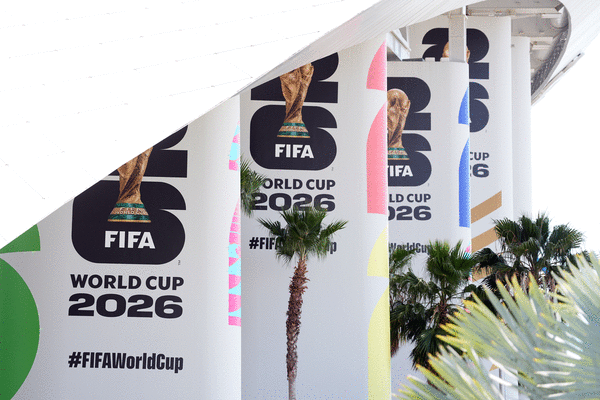
The World Cup is coming to America. For many observers, that represents soccer’s arrival in the United States. I think it represents something else: the culmination of a transformation that has been underway for half a century.
I’ve probably watched “Once in a Lifetime,” the documentary about the rise and fall of the New York Cosmos, more times than I should admit. I first watched it as I was beginning my professional career in sports and political public relations. As a fan, I was drawn to the story. As a professional, I became fascinated by the question underneath it: How do new ideas break through?
The older I get, the more I think “Once in a Lifetime” is less a documentary about soccer than a documentary about cultural change.
As a kid growing up on Long Island in the afterglow of Pelé’s Cosmos era, I drew crayon pictures of Pelé, Giorgio Chinaglia, Steve Zungul and Shep Messing. I was too young to have fully appreciated Pelé’s Cosmos firsthand.
You wouldn’t have known it from the schoolyard.
His name was spoken with the same reverence reserved for larger-than-life sports figures such as Reggie Jackson. We caught the occasional highlight on local sports broadcasts, but more often we heard stories — especially about Pelé’s bicycle kicks and impossible goals. His legend traveled faster than the footage.
The documentary shows just how close soccer came to a breakthrough in the 1970s. The ingredients were seemingly all there: global superstars, celebrity owners, sold-out crowds, media attention and cultural cachet.
Looking back, I increasingly think there was one ingredient still missing: time.
The stars, attention and excitement were all there. What wasn’t there yet were the generations.
The seeds had been planted, but they needed time to take root. The breakthrough wasn’t denied. It was delayed. Soccer needed time to take root in American life.
One observation in the film has stayed with me for years. Even as the North American Soccer League was collapsing, millions of American kids had begun playing soccer. I was one of them.
Like many children growing up in Nassau County, New York, I played soccer as much as — if not more than — Little League baseball and eventually played high school soccer.
The kids inspired by soccer’s first boom became the next generation of players. Players became parents. Parents became coaches. Coaches became consumers.
The payoff took decades.
Pelé and the Cosmos introduced the sport to a broader American audience. The 1994 World Cup demonstrated that the United States could embrace the global game on a massive scale. Major League Soccer provided the foundation. Later stars such as David Beckham and Lionel Messi helped deepen soccer’s place in American culture.
What strikes me today is how often we confuse moments with movements. The World Cup is a moment.
The more important story is the movement underneath it. Cultural change rarely happens all at once. It happens through repetition. Children play. Families return. Communities invest. Habits become traditions. The event gets the attention. The repetition changes the culture.
That’s why I believe the significance of the 2026 World Cup is often misunderstood. The tournament is not creating a soccer culture in America. It is revealing one.
For half a century, generations of Americans have been making soccer part of their lives and passing it on to their children.
The World Cup is not the beginning of that story. It is the payoff.
The World Cup is coming to America. In many ways, that’s the point. America has already come to soccer.
____
ABOUT THE WRITER
Jonathan Grella is the founder of JAG Public Affairs. He wrote this for InsideSources.com.
___
©2026 Tribune Content Agency, LLC





















































Comments